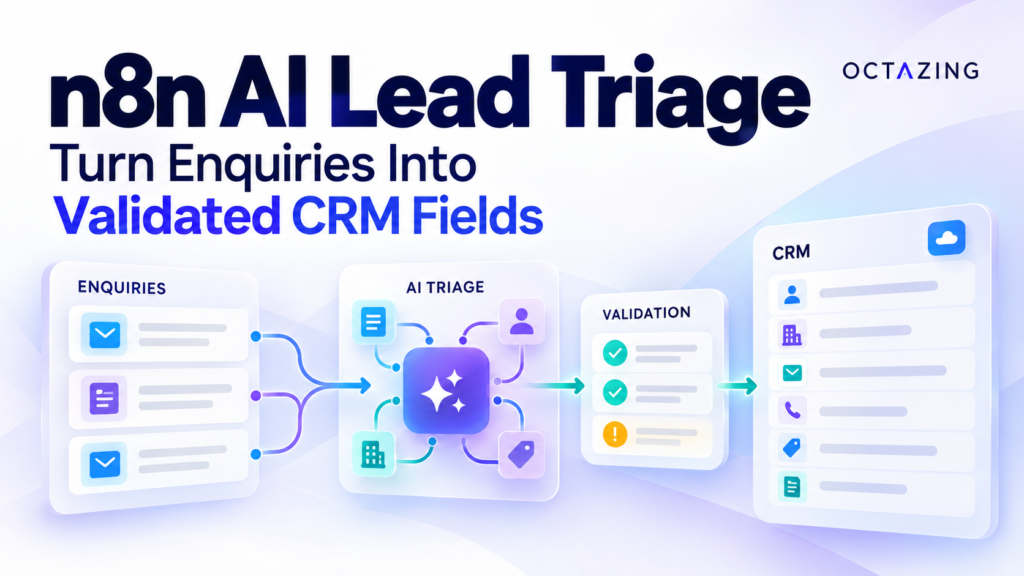
n8n AI lead triage can turn a free-text enquiry into a small set of validated fields before your existing routing rules run. Use the model to extract what the prospect actually said. Keep qualification policy, consent decisions, and CRM permissions outside the model.
This walkthrough describes a proposed workflow design. Configure the nodes, credentials, validation, and storage for your environment before using it with live enquiries. It is an AI-assisted workflow with a fixed sequence; an agent is optional if additional lookup decisions are genuinely needed.
See the agentic marketing automation hub for the broader architecture.
Define the information you want to extract
Start with a short approved list: requested service, stated timeline, explicitly mentioned systems, and information that remains unknown. Give each extracted field a supporting phrase from the enquiry so a reviewer can inspect it.
Illustrative enquiry: “We manage twelve Google Ads accounts and need a weekly report in Looker Studio. We want to start next month.” The model may identify reporting as the service and retain “next month” as the prospect’s stated timeline. Budget remains unknown.
{
  "service": "marketing_reporting",
  "service_evidence": "need a weekly report in Looker Studio",
  "timeline_raw": "next month",
  "systems_mentioned": ["Google Ads", "Looker Studio"],
  "budget": null
}
This is an example output shape, not a ready-made n8n workflow export. Define your own allowed service values and validation rules.
Build a sequence that can recover
- Receive the submission. Authenticate or otherwise protect the intake endpoint, validate the payload, and record a durable event ID.
- Persist the enquiry. Retain the original request in an approved system before returning successful receipt. Keep the lead available if the model fails.
- Prepare a limited model input. Supply the enquiry and approved service definitions. Omit contact details the extraction task does not need.
- Extract structured fields. Request allowed values, explicit evidence, and unknown values where information is missing.
- Validate the result. Parse the response, check field types and allowed values, and verify that quoted evidence appears in the source text.
- Apply business rules. Use the validated service field in your existing scoring and ownership process.
- Write permitted fields. Use an idempotent event-based process, confirm the CRM record, and retain the write result.
Implement event deduplication in persistent storage. A visual workflow alone does not make repeated deliveries safe, particularly when multiple executions run at the same time.
Keep interpretation separate from prioritisation
A classification such as “reporting request” is an input to qualification, rather than proof that the lead is ready for sales. Follow your existing lead scoring and routing policy for priority and ownership.
Preserve explicit form selections as authoritative unless your policy allows correction. If the submitted service and the free-text request disagree, flag the conflict for review. Do not silently replace the prospect’s selection.
Give ambiguous enquiries a useful path
Route an enquiry to a reviewer when the service is unclear, required evidence is absent, or the request crosses several service categories. Model-generated confidence numbers should not be treated as calibrated probabilities.
A deterministic validation failure and a business ambiguity are different exceptions. Record the reason so the team can distinguish a broken integration from a prospect who needs a clarifying conversation.
Use the human review design for approvals and the CRM data contract for permitted fields.
Test beyond the happy path
Test missing timelines, several services in one request, unsupported requests, non-English text relevant to your audience, malformed model output, and duplicate webhook deliveries. Include enquiries containing instructions that attempt to change the workflow. Treat all prospect text as data, and enforce permissions in application logic.
Measure extraction correctness, unresolved enquiries, review time, and confirmed handoff completion. Add representative cases to your workflow evaluation set as you discover failures.
Frequently asked questions
Should the model assign the lead owner?
Keep assignment in the agreed routing policy. The model may extract service information that the policy uses, but it should not invent ownership rules.
What happens if the model is unavailable?
Retain the enquiry and send it to the defined manual path. Retry only within your time and cost limits, using the same durable event identity.
Build a more reliable enquiry handoff. Contact Octazing with your form fields, CRM, and the examples your team finds difficult to classify.