Direct answer:
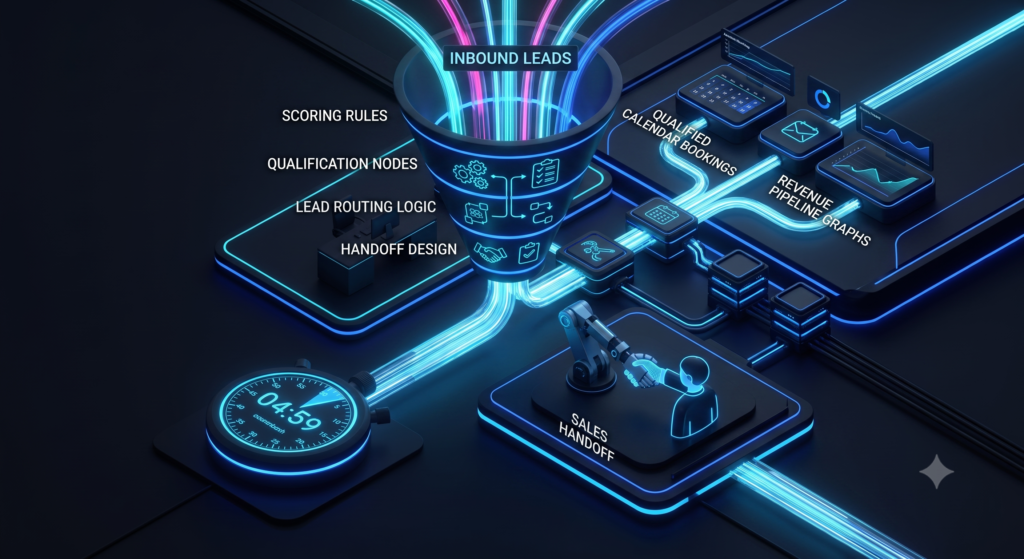
Lead scoring only works when sales believes the score predicts effort worth spending. That means a small set of transparent rules, routing that matches ownership, and a handoff packet that answers “why this lead, why now, what next?”—not a black-box score from twenty weak signals.
What lead scoring is (and is not)
Lead scoring assigns priority to inbound or nurtured contacts so teams respond in the right order with the right owner.
It is not:
- A substitute for a clear offer or ICP
- A guarantee the deal will close
- A dump of every marketing tag into a single number
Useful scoring answers three questions for a rep:
- Is this person in-market enough to talk now?
- Are they a fit for what we sell?
- Who should own the first serious conversation?
Why sales ignores most scoring models
Common failure patterns:
| Problem | What sales experiences | Result |
|---|---|---|
| Too many signals | Score moves for newsletter opens and random page views | Score ignored |
| Opaque model | “The system said 82” with no reason | No trust |
| Score without ownership | High score, unclear assignee | Cherry-picking or pile-up |
| No SLA by score band | “Hot” treated like “cold” | Process theater |
| Handoff is a form dump | Rep gets fields, not context | Rework and delay |
If sales builds a parallel spreadsheet or personal inbox rules, your score is already dead.
Design principle: score for action, not for vanity
Every point on the model should map to an action:
- Who is notified
- How fast they must respond
- What channel to use
- What talk track or next step is allowed
If a signal cannot change an action, drop it from the score.
A practical scoring framework (fit × intent × readiness)
Keep three buckets. Weight them explicitly so marketing and sales can argue about inputs, not magic.
1. Fit (are they our kind of customer?)
Examples of fit signals:
- Company size or segment (when known)
- Industry or use case match
- Geography you serve
- Role (decision-maker vs researcher)
- Product or service interest selected on the form
Fit protects sales time. High intent from a non-ICP still needs a polite path—but not enterprise SDR urgency.
2. Intent (did they ask for something valuable?)
Examples:
- Demo, pricing, or “talk to sales” request
- High-intent page path (pricing, implementation, comparison)
- Inbound via partner or referral
- Reply to a sales-assisted sequence
Page views alone are weak. Requests for human time are strong.
3. Readiness (can we act now?)
Examples:
- Complete contact path (phone/WhatsApp/email that works)
- Company identifiable
- Timeline or budget stated (if you ask)
- Existing customer vs net-new (different playbooks)
Incomplete records create “hot scores” that cannot be worked.
Simple starting model:
Start with a short list (8–12 rules max). Example shape:
- Strong intent action: +30 to +50
- Clear fit: +20 to +30
- Weak engagement only: +5 or less
- Disqualifiers: route to nurture or close-loop, not “sales now”
Refine monthly with win/loss feedback—not weekly model rewrites.
Routing: the half of scoring teams forget
A score without routing creates a leaderboard, not a workflow.
Routing patterns that work
- Round-robin within a segment — Fair distribution for similar leads
- Named ownership by region or product — Clear accountability
- Pod model — Small team shares a queue with visible SLA
- Overflow rules — If owner does not accept in X minutes, reassign
Pair score bands with SLA
| Band | Example meaning | Response target | Owner type |
|---|---|---|---|
| A | High fit + high intent | Minutes, not hours | Primary sales / senior AE |
| B | Fit with medium intent | Same business day | SDR or AE per rules |
| C | Intent, unclear fit | Qualify then route | SDR / solutions assist |
| D | Low fit or incomplete | Nurture or ask for data | Marketing automation |
Publish this table. Ambiguity is where trust dies.
Handoff design: what must travel with the lead
When marketing (or the website) passes a lead to sales, the handoff should include:
- Score and reasons — Top 3 signals that produced the score
- Source and campaign — How they arrived
- Requested outcome — Demo, pricing, partnership, support
- Last assets touched — Pages or content that show intent
- Constraints — Geo, language, product line
- Already said — Form answers, chat summary, prior tickets
Reps should not start with “So… what do you need?” if the form already answered it.
Handoff quality check:
If a new hire cannot start a relevant first call from the CRM record alone, the handoff is incomplete.
How to implement without a data science project
Step 1 — Align on ICP and disqualifiers
One workshop. Written definitions. Shared examples of good and bad leads.
Step 2 — Map entry points to actions
Forms, chat, WhatsApp, webinars, partners—each needs a path into the same lead object.
Step 3 — Encode a tiny rule set
In CRM or middleware (e.g. automation tools such as n8n):
- Calculate score from explicit fields
- Write “score reasons” into a visible field
- Assign owner
- Fire notification
Step 4 — Instrument the funnel
Track:
- Time to first response by band
- Accept/reject rate by owner
- Meetings booked by band
- Closed-won by band (even if lagging)
Step 5 — Monthly score review with sales
Ask only:
- Which “A” leads wasted time?
- Which “C” leads should have been “A”?
- Which signals do we no longer believe?
Change few rules; change them deliberately.
Scoring and first-touch speed work together
Fast response to the wrong lead wastes capacity. Slow response to an “A” lead wastes demand.
Connect the systems:
- A-band → immediate notify + short SLA
- Auto-acknowledgment for all bands
- Human first substantive reply prioritized by band
That is how scoring becomes an operations lever, not a marketing report.
FAQ
Should we use predictive AI scoring?
Only after a transparent rules baseline exists and sales trusts the process. AI can rank finer differences later; it cannot fix unclear ICP or broken handoffs.
How many points should website visits be worth?
Usually little. Prefer intent actions (demo request, pricing view combined with form submit) over raw page counts.
What if sales wants every lead?
Then you do not have a capacity model. Scoring only works when leadership accepts that some leads wait or go to nurture.
Where does OCTAZING fit?
OCTAZING’s workflow approach ties scoring to routing, multi-channel notification, and closed-loop attribution—so the score changes who is alerted and how outcomes are measured, not only a number on a record.
30-day checklist
- Write ICP and disqualifiers in one page.
- List current entry points and owners.
- Ship a visible score + “reasons” field.
- Define A/B/C/D bands and SLAs.
- Wire notifications to a channel the team actually uses.
- Review ten worked leads with sales each week.
- Adjust at most three rules at month end.
Key takeaway
Lead scoring earns sales adoption when it is explainable, tied to routing and SLA, and completed by a handoff that carries context. Start small, measure actions taken, and improve rules with sales feedback—not with more invisible points.
To put these ideas into practice, explore first-touch automation and lead scoring and routing, or request a workflow review with Octazing.