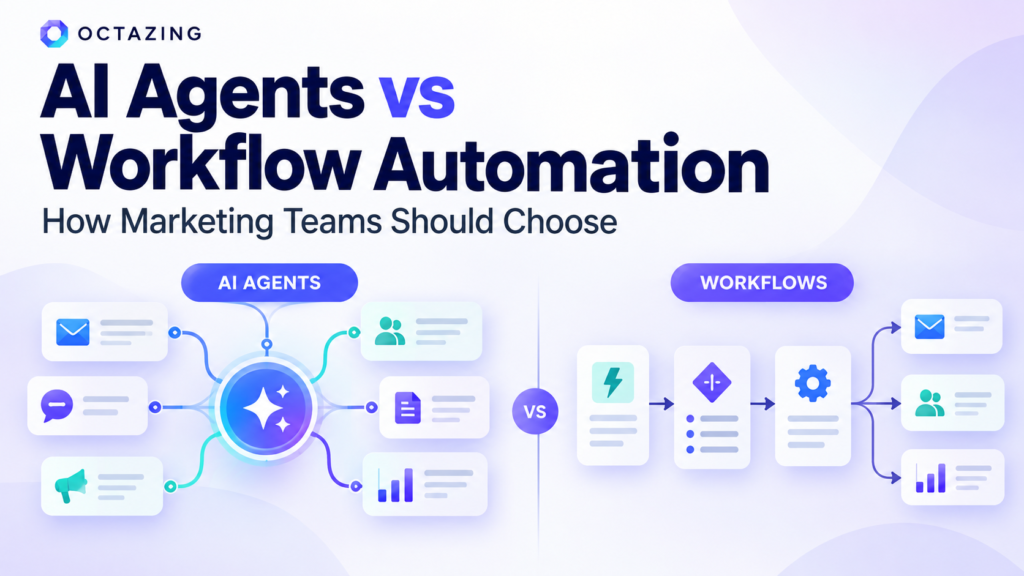
Choose workflow automation when the steps and decisions are predictable. Use a bounded AI task when a fixed process needs help interpreting unstructured information. Consider an AI agent when the system must choose among different permitted actions to complete a goal. The decision depends on your workflow and the consequences of a mistake.
For the broader implementation framework, start with our agentic marketing automation guide.
Distinguish the three approaches
A conventional workflow might check the service selected on a form and route the record to the relevant team. The same input and current business rules should produce the same decision.
An AI-assisted workflow keeps the sequence fixed but inserts a model task. For example, the model extracts a requested service from an enquiry, then a validator checks that the answer belongs to an approved service list.
An agent receives a goal and may choose a lookup or action based on what it finds. n8n’s AI Agent documentation describes a model connected to tools, with the agent deciding which tool to use. That discretion creates a different testing requirement from a fixed sequence.
| Marketing task | Suggested starting approach | Reason |
|---|---|---|
| Route by a submitted region field | Fixed workflow | The routing policy is explicit |
| Identify the requested service in free text | Bounded model task | Language varies, but the output choices are limited |
| Calculate campaign CPA | Fixed calculation | The formula and inputs should be reproducible |
| Investigate an incomplete CRM handoff | Read-only agent, if needed | The next useful lookup may depend on earlier findings |
Ask whether the next step really varies
Write down the last several cases your team handled. If each case followed the same sequence, a fixed workflow may be sufficient. If only one step required language interpretation, isolate that step rather than giving the whole process discretionary control.
An agent becomes more useful when a lookup reveals information that changes the next lookup. Even then, define the permitted destinations and stop conditions. “Investigate this lead” needs boundaries such as approved records, allowed fields, and a maximum investigation budget.
Separate business policy from interpretation
The meaning of an enquiry may need interpretation. Territory ownership, communication preferences, and account permissions should come from authoritative business rules.
For example, a model might identify a request for Google Ads reporting. A validated service field can then enter the normal assignment workflow. The model should not invent a new sales territory or decide that an unavailable employee is the best owner.
Our n8n AI lead triage walkthrough uses this separation. Start with a workflow audit if the handoff rules are unclear.
Assess the consequence of a wrong action
An incorrect internal draft can be reviewed. An incorrect external message has already reached a prospect. A change to an advertising budget can affect spend before anyone reads a summary.
List the actions your proposed system can perform and who is responsible for each. Begin with read access and proposals where possible. Add write access only after the team can test, review, and recover the specific action.
Account for operating effort
Agents may require repeated model calls, tool lookups, and more extensive evaluation. Fixed workflows also need monitoring and maintenance, but their decision paths are usually easier to inspect.
Compare the complete cost: implementation, subscriptions, model usage, review, corrections, and support. A more flexible system earns its place when that flexibility improves a measured outcome. Use the automation ROI scorecard to make the comparison explicit.
A practical selection worksheet
- Name the workflow outcome.
- Identify the decisions that require interpretation.
- List permitted actions and their consequences.
- Define how each action’s success will be verified.
- Assign an owner for failures and maintenance.
If your team cannot answer the verification question, narrow the scope. For a CRM workflow, a data contract helps define what the system may read, propose, and write.
Frequently asked questions
Is a workflow with an LLM automatically an agent?
No. A model can perform one task inside a predetermined sequence. Agentic behaviour involves discretion over which permitted actions to take.
Can we combine rules and agents?
Yes. Fixed rules can enforce permissions and validate outcomes while an agent investigates a narrow problem or proposes a next step.
Need help choosing the right approach? Request a workflow review from Octazing with one example of the work your team currently performs.