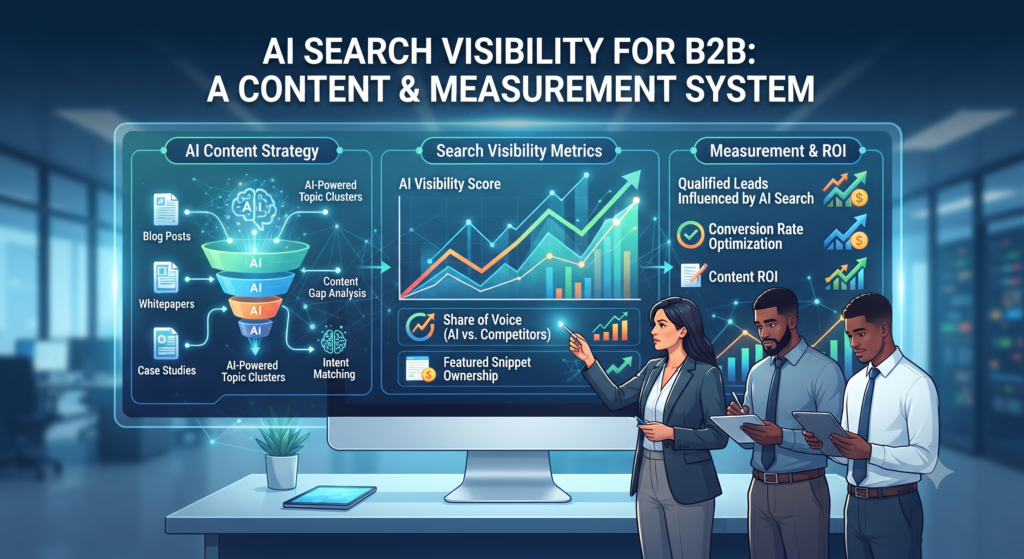
B2B AI search visibility means making your expertise discoverable and useful when buyers research through AI search experiences. A mention, a citation, a website visit, and a qualified enquiry are different outcomes. Build a system that records each instead of treating one chatbot answer as proof of market coverage.
The practical starting point is a small group of buyer decisions you can answer well. Google describes its generative search experiences as relying on established search foundations in its official optimization guidance. Use that foundation, then measure the questions that matter to your business.
Choose a decision, not a broad category
“Marketing automation” is too broad for an initial test. A more useful decision is whether a revenue team should automate CRM handoffs internally or hire implementation support. List the buyer’s constraints: existing tools, team capacity, approval requirements, data quality, and maintenance ownership.
Create a question set covering understanding, comparison, implementation, and risk. Keep commercial fit visible. Traffic from people solving an unrelated problem can make a visibility chart look promising without creating suitable demand.
Build a hub with distinct supporting pages
The hub should explain the decision and direct readers to deeper answers. Supporting pages should each resolve one specific uncertainty. Avoid publishing several lightly rewritten articles aimed at the same query.
- Use decision-ready comparison pages to explain alternatives and trade-offs.
- Maintain an evidence register for claims, examples, and changes.
- Check crawler access and indexing controls before interpreting absent citations.
- Use a repeatable visibility measurement protocol to track what actually changes.
Choose descriptive links inside the relevant discussion. A reader should understand why the next page helps before clicking it. Keep the hub’s summaries brief enough that each supporting article still adds material value.
Give important claims an evidence trail
Separate platform facts, your recommendations, and your own experience. Cite official documentation for product behavior. Label illustrative examples. Publish client outcomes only when you can verify the figures, describe the measurement method, and have permission to use them.
For example, a page about reporting automation can show a sample acceptance checklist without inventing a percentage of time saved. A useful explanation of boundaries often helps a buyer more than an unsupported performance claim.
Keep access and content quality separate
Check page responses, indexing directives, canonical URLs, internal links, and the content available to crawlers. Access is a prerequisite for retrieval by a particular system, not evidence that the page deserves selection. Fixing a firewall block and improving a weak answer solve different problems.
Review the rules for each crawler separately. OpenAI documents search and training crawlers as different agents in its crawler reference. Make those choices deliberately rather than assuming one permission governs every use.
Measure observations and business outcomes
| Layer | Record | Interpretation |
|---|---|---|
| Observed answers | Prompt, platform, date, cited URL | A repeatable research sample |
| Website activity | Identifiable referrals and enquiries | Visits you can actually observe |
| Commercial outcome | Qualified conversations and opportunities | Demand relevant to your offer |
Keep the prompt set stable across reviews. Record changed pages and release dates. Answers can vary between runs, accounts, and platforms, so treat movements as observations to investigate. Do not rename all unexplained direct traffic as AI traffic.
A focused first implementation
Start with one commercial question, one hub, and a few genuinely distinct supporting pages. Review access, evidence, and usefulness before expanding. Give each page an owner and a reason to be updated, such as a changed integration requirement or a new buyer objection.
When the system produces relevant enquiries, connect that feedback to the content plan. Octazing’s AI search visibility work can combine content structure, technical checks, and measurement; explore Octazing’s services to discuss a scoped implementation.