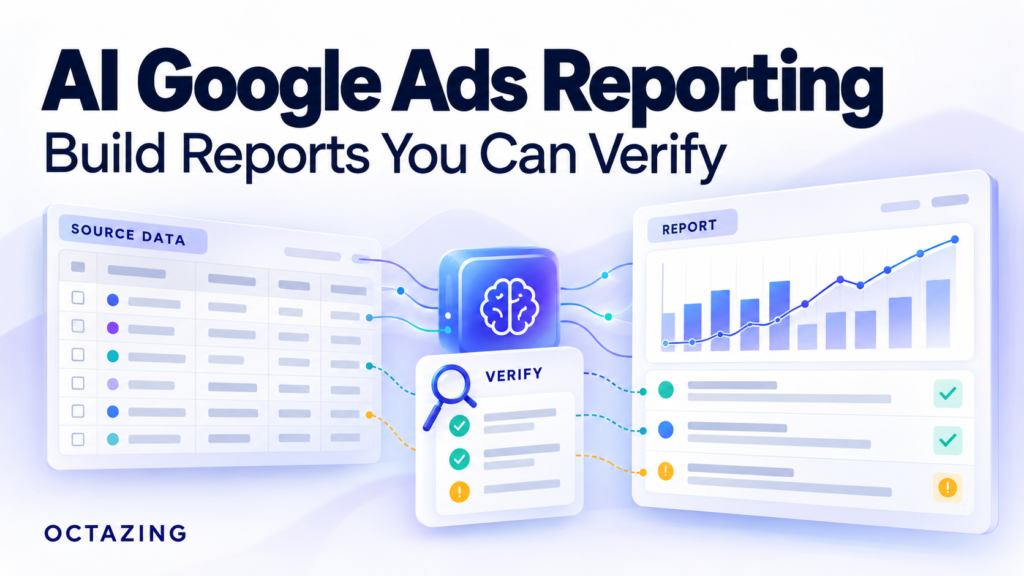
AI Google Ads reporting works best when a reporting pipeline retrieves and checks the metrics before a model writes commentary. Calculate costs, rates, and comparisons in code or your reporting layer. Give the model verified results and require it to distinguish observed changes from possible explanations.
This is a fixed AI-assisted workflow. A bounded agent can investigate an exception later, but it should use approved read-only sources. Start with the agentic marketing automation guide to choose the appropriate level of discretion.
Define the report before connecting tools
Write down the account list, reporting period, account time zones, currencies, conversion actions, and business outcome. Decide whether the report measures platform conversions, qualified leads, or CRM opportunities. Keep those measures distinct.
A multi-account report should show which accounts were expected and which returned usable data. An empty result needs investigation; it should not silently appear as zero performance.
Retrieve and reconcile the source metrics
The Google Ads API reporting guide explains querying resources, attributes, segments, and metrics using GAQL. Use supported fields for your API version and retain the extraction timestamp and query definition with the report.
Reconcile a sample against a matching Google Ads report. Check the date basis, filters, selected conversions, time zone, and whether segmentation changes the row totals. Normalise cost units before calculations and keep different currencies separate unless you apply an explicit exchange-rate policy.
Calculate comparisons outside the model
- CTR equals total clicks divided by total impressions.
- Average CPC equals total cost divided by total clicks.
- CPA equals total cost divided by the defined conversion count.
- ROAS equals the defined conversion value divided by cost.
Use the same definitions in both periods. For an aggregate rate, calculate it from aggregate inputs rather than averaging campaign percentages. Return an unavailable value when a denominator is zero.
The following figures are illustrative and describe two equal reporting periods. They are not Octazing client results.
| Metric | Earlier period | Later period |
|---|---|---|
| Spend | INR 60,000 | INR 80,000 |
| Defined conversions | 24 | 20 |
| CPA | INR 2,500 | INR 4,000 |
The deterministic observation is a 60% increase in CPA. The figures alone do not establish why performance changed.
Label incomplete conversion data
Google’s conversion-delay guidance explains why recent periods may appear weaker while later conversions have not yet arrived. Apply your account’s observed lag and reporting definitions when interpreting the latest period.
Mark provisional results, rerun recent periods when appropriate, and record whether a report was restated. Avoid presenting a provisional conversion decline as a settled campaign failure.
Give AI an evidence packet
Provide the reporting definitions, verified metric table, data-quality notes, and any approved change-history evidence. Ask the model to return observations, uncertainties, and proposed checks in separate sections.
For the example above, acceptable commentary would explain that CPA increased while spend rose and recorded conversions fell. It could recommend checking the conversion setup and account changes. It should not assert that the audience is saturated without evidence.
Use a data contract to define what the pipeline may read and what the generated commentary may contain.
Review the report before recommending action
Check every quoted figure against the verified packet. Flag unsupported causal claims, missing accounts, changed definitions, and comparisons between incompatible periods. Keep reporting credentials restricted to the operations the workflow requires.
Sending a report and changing a campaign are separate actions. Route any proposed budget or bidding change through the team’s authorised process. Include these boundaries in the workflow testing checklist.
Frequently asked questions
Can AI decide why CPA changed?
It can suggest hypotheses and relevant checks. A causal conclusion requires supporting evidence and an appropriate analysis design.
What should we measure in a reporting pilot?
Reconciled reports completed, corrections required, review time, missing-data incidents, and total operating cost. The ROI scorecard includes review and maintenance effort.
Make your marketing reports easier to trust. Contact Octazing with your account structure, reporting definitions, and a sample of the report you want to automate.