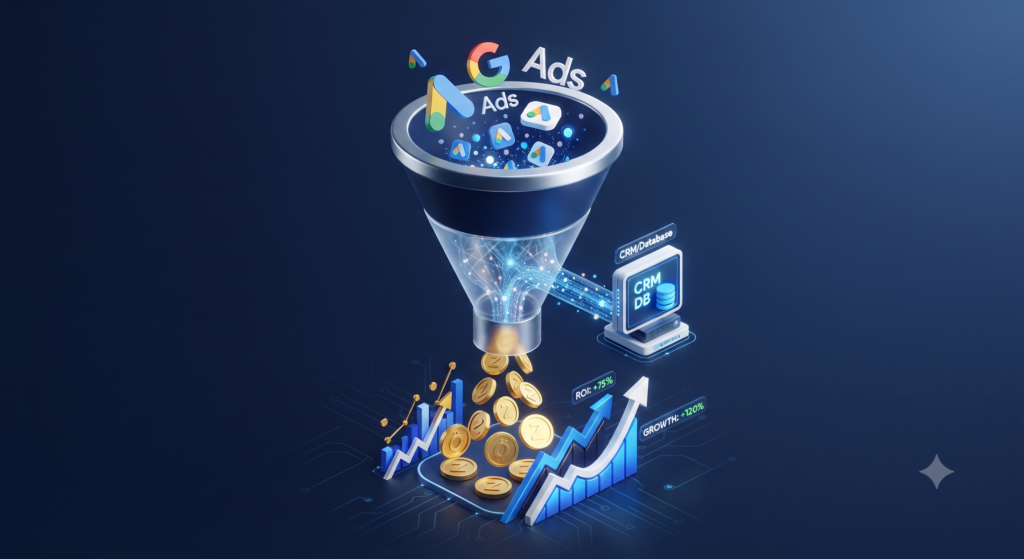
In the world of digital advertising, there is a persistent gap between “leads” and “revenue.” You launch a campaign, the clicks roll in, and your Google Ads dashboard shows a flurry of conversion data. But here is the million-dollar question: How many of those leads actually converted into paying customers?
If your marketing strategy relies solely on online form submissions or “thank you” page loads, you are missing half the picture. You are optimizing for volume rather than value.
To bridge this gap, you need Google Ads Offline Conversion Tracking (OCT). By feeding your actual, bottom-of-the-funnel revenue data back into Google’s machine learning algorithms, you don’t just track clicks—you optimize for the bottom line.
What is Google Ads Offline Conversion Tracking?
Google Ads Offline Conversion Tracking is a powerful mechanism that allows you to upload conversion data—which happens outside of Google’s digital environment (such as in your CRM, ERP, or Point of Sale system)—back into your Google Ads account.
When a user clicks an ad, Google assigns a unique identifier called a GCLID (Google Click ID). When that user becomes a qualified lead or a paying customer in your offline system, you map that GCLID to the sale and send it back to Google.
Why Offline Conversion Tracking Matters
Modern bidding strategies like Target ROAS or Maximize Conversion Value are only as smart as the data you feed them. If your system only knows about “form fills,” it will relentlessly chase low-quality leads that never result in a sale. By feeding actual revenue data back, you teach the algorithm to find users who share the characteristics of your high-value customers.
Performance Marketing Audit – Click here to help identify if your current tracking setup is underperforming.
The “Black Box” Problem: Why Relying on Online Metrics Is Risky
A study by HubSpot indicates that nearly 60% of marketers struggle to demonstrate the impact of their campaigns on company revenue. Without offline tracking, your ad spend is often allocated toward:
- Low-intent traffic: Bots or users just “window shopping.”
- Irrelevant Leads: Prospects who fill out a form but don’t meet your business criteria.
- Disconnected Customer Journeys: A user might click an ad on a mobile device, research on a tablet, and finalize a purchase via a phone call or in-store visit.
When you implement Google Ads Offline Conversion Tracking, you transform your advertising from a guessing game into a precision-engineered growth engine.
How It Works: The Technical Foundation
To successfully implement OCT, your technical architecture needs to handle three core components:
1. Capturing the GCLID
Every time an ad is clicked, Google appends a GCLID to the destination URL. You must configure your website forms (or landing pages) to capture this parameter and store it alongside the lead information in your CRM (Salesforce, HubSpot, Zoho, etc.).
2. Storing and Qualifying
Once the lead enters your system, it stays there until it hits a specific stage (e.g., “Closed-Won”). Your system must be able to associate the original GCLID with the eventual status update.
3. Importing to Google Ads
There are three primary ways to import this data:
- Google Ads API: The gold standard for automation.
- Zapier or Third-Party Connectors: Ideal for teams without heavy engineering resources.
- Manual Uploads: CSV imports (not recommended for scale).
Pro Tip: Google recommends uploading conversion data at least every 24 hours to ensure your bidding algorithms stay fresh and responsive.
The Impact: Driving ROI Through Smart Bidding
Once you have established a consistent flow of offline data, the real magic happens. You can now shift your bid strategy from “Maximize Conversions” to “Maximize Conversion Value.”
When Google’s AI knows that User A resulted in a $5,000 deal while User B resulted in a $50 deal, it will aggressively bid higher for users who match User A’s profile. This isn’t just optimization—it’s revenue-driven marketing.
Advanced Google Ads Bidding Strategies – Read more to deepen your understanding of AI-driven bidding.
Common Challenges and How to Overcome Them
Implementing OCT isn’t without its hurdles. Here are the most common bottlenecks we see at Octazing:
- Data Silos: Your CRM team and your Marketing team aren’t talking. Solution: Establish a “Source of Truth” where the GCLID is the primary key linking marketing effort to sales results.
- Privacy and PII: Never send Personally Identifiable Information (PII) like names or emails to Google. Solution: Use Google’s Enhanced Conversions for Leads, which hashes user data on the server side to maintain privacy compliance.
- System Latency: Sales cycles take time. Solution: Don’t wait for a closed-won sale to report back. Upload intermediate milestones (e.g., “Qualified Lead,” “Sales Meeting Booked”) to give the algorithm earlier signals.
Take the Next Step with Octazing
Implementing Google Ads Offline Conversion Tracking can feel overwhelming. You don’t have to do it alone. At Octazing, we specialize in building full-funnel tracking architectures.
Checklist: Is Your Business Ready for OCT?
- Do you use a CRM? (Salesforce, HubSpot, Pipedrive, etc.)
- Can your landing pages capture URL parameters?
- Do you have a clear definition of a “High-Value” customer?
- Do you have the technical capacity to link the GCLID to your CRM records?
Conclusion
The era of “set it and forget it” digital advertising is over. To compete in today’s market, you must be as data-driven as the platforms you advertise on. Google Ads Offline Conversion Tracking is the bridge between your sales team’s success and your marketing team’s strategy.
By closing the loop, you stop paying for clicks and start investing in revenue.
Contact Octazing for a comprehensive Marketing Intelligence Audit