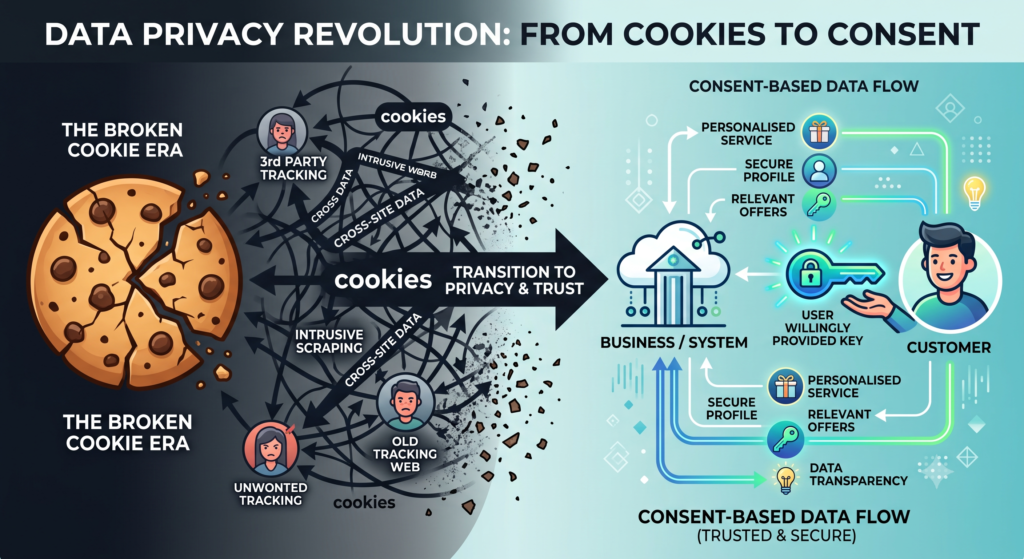
Browser privacy restrictions differ, and third-party cookies have not been removed across the board. Google announced in April 2025 that Chrome would maintain its approach to third-party cookie choice, rather than introduce a new standalone prompt. Measurement plans should account for the actual browser and user settings involved. For a generation of marketers who grew up targeting audiences based on where they’d been tracked across the web, this is a genuine turning point. The advertisers adapting fastest aren’t the ones who found a clever workaround for cookies. They’re the ones who stopped needing them, by building an entirely different data foundation — and using AI to make that foundation do more with less.
First, the Vocabulary That Actually Matters
The data conversation gets confusing fast because “first-party” and “zero-party” get used almost interchangeably, and they shouldn’t be.
- First-party data is what you collect through someone’s behavior on channels you own — website analytics, purchase history, app usage, browsing patterns. The customer didn’t necessarily choose to hand this over; it’s a byproduct of interaction.
- Zero-party data is what a customer intentionally and proactively tells you — quiz answers, stated preferences, a “how did you hear about us” survey response. Nobody inferred it. They said it.
- Third-party data is what you buy or license from someone else, usually assembled from tracking the customer never directly consented to in any meaningful way. This is the category disappearing.
The distinction matters because zero-party data sits at the top of the trust hierarchy: it’s the most accurate, the most consent-clear, and — this is the part AI changes — the most useful raw material for a model to work with, because it tells you what someone actually wants rather than what an algorithm merely inferred from their clicks.
Why AI Makes This Shift Survivable (and Actually Better)
Losing third-party cookies used to mean losing precision. That was true before AI got good at working with smaller, higher-quality data pools. A few shifts explain why the AI-plus-first-party-data combination is outperforming the old cookie-based approach in the metrics that matter:
Identity resolution replaces tracking. Customer Data Platforms now use AI-driven identity graphs — deterministic and probabilistic matching across email, device, and loyalty IDs — to stitch together a single customer view from data you actually own. This doesn’t just replace what cookies did; in owned-channel environments, it does it more reliably, because the data isn’t degraded by cross-site tracking restrictions in the first place.
Server-side tracking closes the measurement gap. By early 2026, roughly three-quarters of mid-to-large brands had moved at least some conversion tracking server-side, sending events directly from their own servers to ad platforms instead of relying on a browser pixel that iOS and ad blockers routinely interfere with. Server-side APIs — Meta’s Conversions API, Google’s Enhanced Conversions, TikTok’s Events API — now function as required infrastructure, not an advanced option, because browser-based tracking alone can miss more than half of conversions on iOS devices.
AI-powered contextual targeting got dramatically smarter. The old version of contextual advertising — matching ads to a webpage’s broad topic — has been replaced by large language models that read page content at the paragraph level, understanding sentiment, nuance, and intent well enough to make contextual targeting a genuine substitute for behavioral tracking in many categories, not just a fallback.
Predictive modeling extends first-party data further than it could reach alone. Once you have a clean, consented first-party dataset, AI models can build lookalike audiences and predict likely converters from patterns in your own customer base — effectively doing with permissioned data what third-party trackers used to do with scraped data, and often more accurately, because the training signal is cleaner.
How to Actually Build the Zero-Party Data Layer
This isn’t a technology purchase so much as a design discipline. The tactics that are working in 2026:
Value-exchange collection. Zero-party data only flows when the customer gets something for sharing it — a product recommendation quiz, a personalized style profile, a preference center that controls what content and offers they see. Sephora’s Beauty Insider program and Spotify Wrapped remain the reference examples for a reason: the customer shares data because doing so visibly makes their experience better, not because a form demanded it.
Progressive profiling. Don’t ask for everything at signup — conversion rates on forms drop noticeably with every additional required field. Ask one meaningful question per touchpoint over time instead, building the profile gradually rather than front-loading friction.
Self-reported attribution. With AI-driven discovery (search, AI chat assistants, recommendation feeds) making the customer journey harder to track through platform data alone, a single post-purchase survey question — “how did you first hear about us?” with explicit options — has become one of the highest-ROI data tactics available, because it closes a measurement gap that no tracking pixel can currently close on its own.
Clean room partnerships. For brands needing scale beyond their own first-party pool, data clean rooms let two parties (a retailer and a brand, a publisher and an advertiser) match audiences without either side exposing raw customer data to the other — a second-party data model built specifically for a privacy-regulated environment.
The Advertisers Who Get This Right
Retailers and publishers with genuine first-party scale are becoming more valuable to advertisers than ever, not less — a brand that can offer access to a well-resolved, permissioned audience is now selling something that can no longer be replicated by anyone buying third-party lists. That’s part of why retail media networks have grown so aggressively: they sit on exactly the kind of consented, transactional first-party data that AI targeting models need most.
For everyone else, the practical roadmap looks like this: build one strong value-exchange collection point, centralize the resulting data in a CDP rather than letting it sit in channel silos, connect server-side APIs to your major ad platforms, and let AI modeling do the targeting work that cookies used to do — just built on data your customers actually chose to give you.
The Bottom Line
The cookie-based targeting era wasn’t just ending because of browser policy — it was ending because it was built on an adversarial relationship between advertisers and the people being tracked. Zero-party data plus AI targeting flips that relationship: customers get more relevant experiences because they told you what they want, and advertisers get targeting precision that’s arguably more durable than what cookies ever provided, because it isn’t dependent on a tracking technology someone else can switch off. The businesses treating this as compliance busywork are going to fall behind the ones treating it as the actual future of targeting.
For help connecting measurement to business outcomes, explore Octazing’s server-side attribution service or request a measurement review.