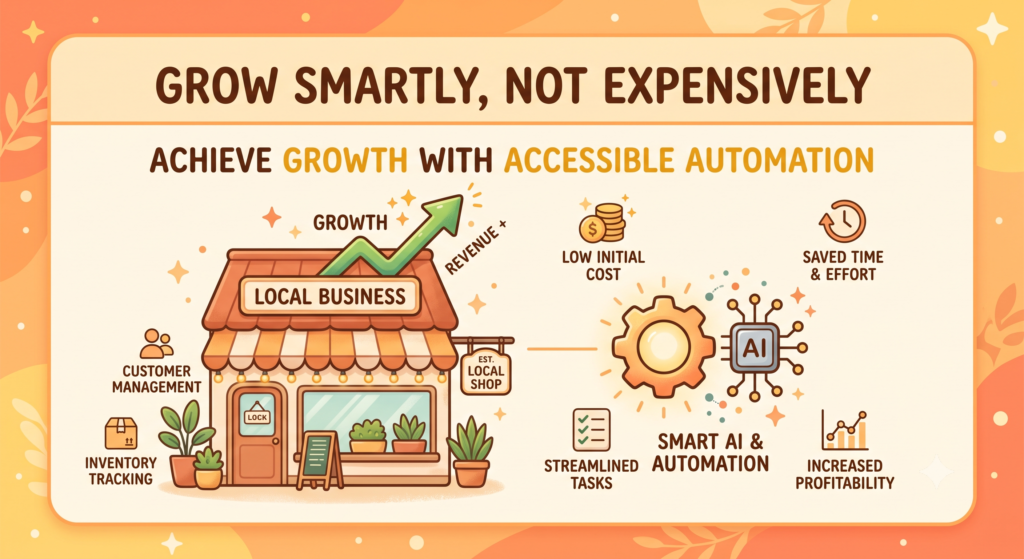
There’s a persistent myth that AI-powered advertising is something only big brands with big budgets can use well. It’s not true, and it was never really true — Performance Max, Advantage+, and Smart+ were built for automation, and automation doesn’t care how many zeros are in your budget. What it does care about is whether you give it enough data to learn from. That’s the actual constraint small businesses need to plan around, and it’s a solvable one.
The Real Rule: Budget Isn’t About Affordability, It’s About Data Volume
Every AI-driven bidding system — Google’s Smart Bidding, Meta’s Advantage+, TikTok’s Smart+ — needs a minimum volume of conversion events before its algorithm has enough signal to optimize well. Underfund that threshold and you’re not saving money; you’re paying for a campaign that never leaves its “learning phase,” where costs are highest and results are least predictable.
Rough 2026 benchmarks worth knowing before you set a budget:
- Google Search / Performance Max: aim for at least $1,000–$1,500/month to start; Smart Bidding strategies generally need 30+ conversions a month to optimize properly, which in most categories means budgeting closer to $3,000–$5,000/month once you’re ready to scale.
- Meta Advantage+: practically speaking, Advantage+ Shopping campaigns need roughly $100+/day to function well; for a true solo or side-project budget, $150–$900/month is workable if you keep to a single ad set and lean on retargeting warm audiences rather than spreading spend thin across many audiences.
- A useful formula for your minimum daily budget: (Target CPA × 50) ÷ 7. If your target cost per acquisition is $25, that’s roughly $179/day needed to exit the learning phase within a week. It’s a rough guide, not gospel, but it explains why a $10/day budget rarely produces meaningful results no matter how good the algorithm is.
The single biggest budget mistake small businesses make isn’t spending too little — it’s spreading a small budget across too many campaigns or ad sets. Five ad sets at $20/day each will consistently underperform two ad sets at $50/day each, because neither the algorithm nor you can tell what’s actually working when the data’s split six ways.
Step 1: Pick One Platform and Get It Out of the Learning Phase
Resist the urge to run Google, Meta, and TikTok simultaneously on a small budget. Pick the platform where your customers already spend time and your product photographs or explains well, fund one clean campaign structure properly, and get real signal before expanding. For most local service businesses and e-commerce brands starting out, that’s usually Google Search (high intent) or Meta Advantage+ (visual products, warm-audience retargeting).
Step 2: Let Automation Do What It’s Actually Good At
This is where the “enterprise-grade” part of AI advertising becomes accessible to anyone. You don’t need a media buyer manually adjusting bids anymore — that’s precisely the job Performance Max, Smart Bidding, and Advantage+ were built to automate. Your job shifts from “managing levers” to “setting guardrails”:
- Feed the system a clean conversion goal (purchase, lead form, phone call) instead of a vague engagement metric.
- Give it good creative inputs — product feeds, multiple image/video variants, clear headlines — because the algorithm can only optimize the assets you hand it.
- Let it run uninterrupted for at least one full learning cycle before judging results or making changes. Constant manual tinkering resets the learning phase and is one of the most common reasons small-budget campaigns underperform.
- Scale gradually: increase budget by no more than 20–30% every few days rather than doubling it overnight, which throws the algorithm back into learning mode and spikes your cost per result.
Step 3: Fix Your Data Before You Fix Your Bids
A small budget makes data quality more important, not less, because there’s less room for waste. Two changes cost nothing but code and pay off immediately:
- Install server-side conversion tracking (Meta’s Conversions API, Google’s Enhanced Conversions) so you’re not losing a meaningful share of your conversions to browser tracking restrictions before the algorithm even sees them.
- Add a one-question post-purchase survey (“How did you hear about us?”) — the cheapest, most reliable attribution data available, and it tells you which channel is actually working when platform-reported numbers disagree with each other.
Step 4: Use AI Tools for the Work You’d Otherwise Skip
Small businesses rarely have the bandwidth for A/B testing dozens of ad variants, writing weekly performance reports, or researching competitors — the exact tasks that used to require a full marketing team. This is where conversational AI tools like Claude or ChatGPT genuinely level the playing field: drafting a dozen headline variants for a single campaign takes minutes instead of an afternoon, and turning a spreadsheet export into a plain-English weekly summary is no longer a task you have to skip because there’s no time for it.
Step 5: Know When You’ve Outgrown “Shoestring”
The U.S. Small Business Administration generally recommends allocating 7–8% of revenue to marketing for growing businesses, and most small businesses spend well below that — over 66% spend less than $1,000 a year total. That’s not a moral failing; it’s usually a sequencing problem. The realistic path is: prove a small, well-funded campaign can hit a target cost per result, then reinvest a share of what it generates back into scaling it, rather than trying to fund five channels thinly from day one.
The Bottom Line
The tools running enterprise ad budgets — automated bidding, AI creative testing, predictive targeting — are the same tools available to a business spending $500 a month. What separates a good outcome from a wasted one at small scale isn’t access to better technology; it’s discipline about where the budget goes. One platform, one clean campaign, enough spend to clear the learning phase, and clean conversion data will consistently outperform a thin, scattered approach across five channels — no matter how sophisticated the algorithm running each one is.