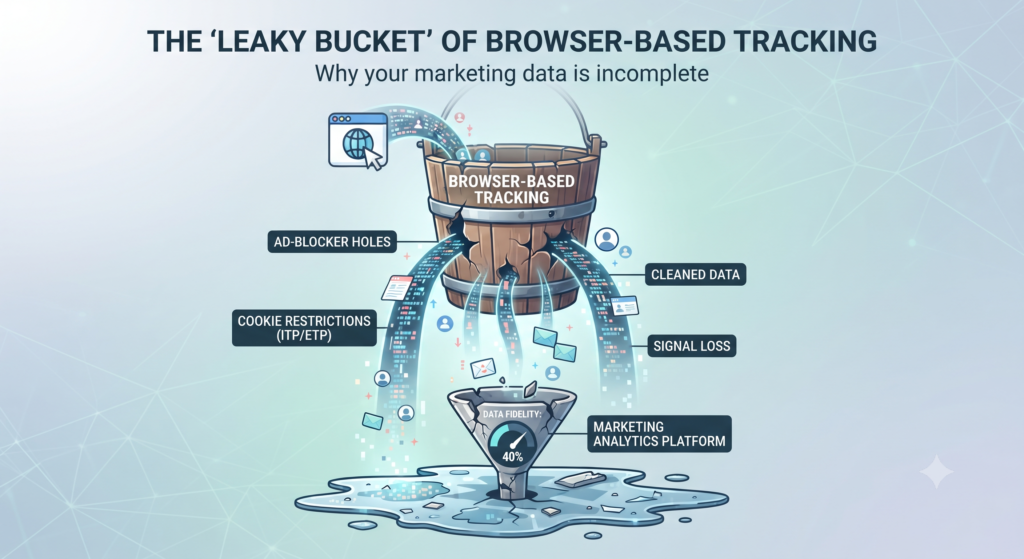
For years, B2B marketers have operated under a comfortable illusion: that the data they see in their ad managers and analytics dashboards is a near-perfect reflection of reality. We have grown accustomed to the “pixel-perfect” world where every click, scroll, and form submission is captured by a tiny snippet of JavaScript and relayed instantly to our optimization engines. However, that reality has fractured. As privacy regulations tighten and browser technologies evolve to protect users, the foundational tool of digital marketing—browser-based tracking—is failing.
We are currently witnessing what many in the industry call the “leaky bucket” phenomenon. Imagine spending thousands of dollars to fill a bucket with high-quality leads, only to realize that 30% to 40% of the water is draining out through holes you can’t see. In the context of Lead Ops and MarTech, these “holes” are the ad blockers, tracking preventions, and cookie restrictions that prevent your marketing stack from seeing the full journey of your customers. To fix the leak, revenue teams must move beyond the browser. The solution lies in **server-side attribution**, a method that moves the tracking responsibility from the user’s unstable browser to your own secure server, ensuring that every dollar spent is accounted for through true closed-loop measurement.
The Crushing Reality of Lead Leakage in the Browser
The primary cause of this data crisis is the inherent fragility of client-side (browser-based) tracking. For decades, we relied on third-party cookies to identify users across different websites and sessions. But the “walled gardens” and browser developers have effectively ended that era. Apple’s Intelligent Tracking Prevention (ITP) and Google’s ongoing phase-out of third-party cookies in Chrome have significantly shortened the lifespan of first-party cookies as well, often deleting them within 24 hours or seven days.
When a potential lead visits your site on a Monday but doesn’t convert until the following Tuesday, the browser has often already “forgotten” who they are. To your analytics platform, this appears as a new, anonymous visitor. This is the definition of **lead leakage**. You are losing the connective tissue between the initial ad click and the final conversion.
Beyond privacy updates, the rise of ad-blockers and privacy-centric browsers like Brave or Safari has created a massive blind spot. Many of these tools block common marketing scripts—like the Meta Pixel or Google Tag Manager—from ever loading. If the script doesn’t load, the conversion doesn’t exist in your dashboard. For B2B companies with long sales cycles and multiple touchpoints, this data gap makes it impossible to accurately calculate Customer Acquisition Cost (CAC) or determine which channels are actually driving pipeline.
What is Server-Side Attribution?
To understand the cure, we must understand the shift. Traditional tracking happens in the user’s browser (the client). When a user completes an action, the browser sends a signal directly to the ad platform. In contrast, **server-side attribution** introduces a middleman that you control: your server.
Instead of the browser sending data to Facebook or Google, the browser sends data to *your* server. Your server then processes that data, cleans it, enriches it with CRM information, and sends it to the ad platforms via an API. Because this communication happens “server-to-server,” it is invisible to ad-blockers and is not subject to the same restrictive browser policies that kill cookies.
By adopting ** server-side attribution **, you are essentially building a private, secure bridge for your data. This method ensures ** first-party data tracking ** integrity. Since the data is coming from your own domain, it is treated with much higher trust by both browsers and ad platforms. This shift is not just a technical upgrade; it is a strategic necessity for any B2B organization that relies on data-driven decision-making.
Rescuing Data with Conversions API (CAPI)
The most prominent implementation of server-side tracking is the **Conversions API (CAPI)**, most notably championed by Meta, but now mirrored by Google, LinkedIn, and Pinterest. CAPI allows you to share key web and offline events, or user actions, directly from your server to the ad platform’s server.
The power of CAPI lies in its ability to fill the gaps left by the pixel. When a pixel is blocked, CAPI acts as a safety net, sending the conversion data regardless of the browser’s settings. But the benefits go deeper than just bypassing blockers. Because CAPI connects your server to the ad platform, you can send “deep funnel” data that the browser could never see.
For example, a browser pixel can tell Meta that someone filled out a demo request form. However, a server-side setup can wait until that lead is qualified by your sales team in Salesforce and *then* send a signal back to Meta saying, “This wasn’t just a lead; this was a Qualified Opportunity.” This allows the ad platform’s algorithm to optimize for high-quality revenue rather than just cheap form fills. This is the cornerstone of **MarTech orchestration**: aligning your advertising signals with your actual business outcomes.
The Role of First-Party Data Tracking
As third-party data becomes less reliable, your first-party data becomes your most valuable asset. **First-party data tracking** involves collecting information directly from your audience based on their interactions with your owned properties.
When you implement server-side tracking, you gain full control over this data. In a client-side setup, the pixel often scrapes more data than you realize, which can create compliance headaches with GDPR or CCPA. With a server-side approach, you decide exactly what information is shared with third parties. You can redact PII (Personally Identifiable Information), hash email addresses, and ensure that only the necessary signals are transmitted.
This control also allows for better data enrichment. Before a conversion is sent to an ad platform, your server can check your internal database to see if this user is already a customer, what industry they are in, or their lifetime value. By the time the data reaches your attribution model, it is far richer and more accurate than anything a standard browser pixel could capture.
MarTech Orchestration: Connecting the Stack
For many B2B revenue teams, the marketing stack is a collection of silos. The CRM doesn’t talk to the ad platforms, and the website analytics are disconnected from the lead scoring system. **MarTech orchestration** is the process of synchronizing these systems to create a unified flow of information.
Server-side attribution acts as the “central nervous system” for this orchestration. By routing all interaction data through a server-side container (like Google Tag Manager Server-Side), you can distribute that data to multiple destinations simultaneously. A single “Lead Captured” event from your server can:
1. Update the contact record in HubSpot or Salesforce.
2. Trigger a “Conversion” in Google Ads.
3. Send a “Purchase” event to Meta CAPI.
4. Log a custom event in your internal data warehouse (BigQuery or Snowflake).
This level of synchronization eliminates the discrepancies that plague most marketing reports. When your CRM and your ad platforms are looking at the same server-verified data, you finally achieve a “single source of truth.”
Achieving True Closed-Loop Measurement
The ultimate goal of any Lead Ops specialist is **closed-loop measurement**. This is the ability to track a lead from the very first anonymous touchpoint through to a closed-won deal, and then attribute that revenue back to the specific marketing effort that generated it.
In a “leaky bucket” environment, closed-loop measurement is impossible. If 30% of your conversion data is missing, your ROI calculations are off by 30%. You might end up killing a campaign that is actually generating your best leads simply because the browser failed to report the conversions.
Server-side attribution plugs these leaks. By ensuring high **data fidelity**, it allows you to see the full picture. When you can confidently say that “Campaign A” generated $500k in pipeline because you have tracked every step of the journey via server-to-server calls, you can scale your budget with confidence. You stop guessing and start investing based on hard evidence.
FAQ: Understanding the Shift to Server-Side
Is server-side attribution harder to set up than a standard pixel?
Yes, it generally requires more technical expertise. While a standard pixel involves pasting a code snippet into the header of your website, server-side tracking requires setting up a server container (often via Google Cloud or AWS) and configuring APIs. However, tools like Octazing are designed to simplify this **MarTech orchestration**, making it accessible for growth teams without requiring a massive engineering overhaul.
Does this replace the browser pixel entirely?
Not necessarily. Most platforms currently recommend a “redundant” setup. This means you keep the browser pixel and add the **Conversions API (CAPI)**. The ad platforms use “deduplication” to ensure that if both the pixel and the server report the same conversion, it’s only counted once. This hybrid approach ensures you get the best of both worlds while you transition to a server-first strategy.
Is server-side tracking better for privacy and compliance?
Absolutely. Because you control the server, you have a “kill switch” for sensitive data. You can strip out any data points that shouldn’t be shared before they ever leave your environment. This makes it much easier to stay compliant with evolving global privacy laws compared to “black box” browser pixels.
Will this improve my ad performance?
In the long run, yes. Ad platforms like Google and Meta rely on machine learning to find your next customer. If you feed the algorithm incomplete or “leaky” data, the machine learns incorrectly. By providing high-fidelity, server-verified data (especially deep-funnel data), the algorithms can optimize much more effectively, leading to lower CPAs and higher-quality leads.
How does this impact attribution models?
It makes them accurate. Most attribution models (first-touch, last-touch, linear) fall apart when the underlying data is missing. By ensuring that the “connective tissue” of the user journey is preserved through first-party cookies and server-to-server hits, your attribution models finally reflect the true path to purchase.
Conclusion
The era of easy, browser-based tracking is over. The “leaky bucket” of lead data is not a temporary glitch; it is the new standard of the privacy-first internet. For B2B marketers, the choice is clear: continue to fly blind with incomplete browser data, or take control of the narrative through **server-side attribution**.
By implementing a robust server-to-server tracking strategy, you do more than just fix a technical error. You empower your Lead Ops and revenue teams with the data fidelity needed to drive real growth. You move from vanity metrics to **closed-loop measurement**, ensuring that every marketing dollar is tied directly to pipeline and revenue. It’s time to plug the leaks and build a foundation for the future of B2B MarTech.
Don’t let your marketing budget leak away through broken browser tracking. Octazing specializes in helping B2B organizations bridge the gap between their CRM and ad platforms with advanced server-side attribution and MarTech orchestration. **[Book a demo with Octazing today]** to see how we can help you achieve 100% data fidelity and turn your attribution into a competitive advantage.