Why Server-side Attribution is the New Standard for B2B Pipeline Growth
The modern B2B buyer journey has become an intricate web of dark social interactions, long sales cycles, and multi-device touchpoints. Yet, most marketing teams are still relying on a measurement infrastructure designed for the internet of 2010. For years, browser-based tracking—or client-side tracking—served as the industry standard. But today, between the aggressive rollout of Apple’s Intelligent Tracking Prevention (ITP), the rise of ad-blockers, and the looming deprecation of third-party cookies, the signal is fading. For revenue leaders, this isn’t just a technical hurdle; it is a blind spot that leads to wasted ad spend and misallocated budgets.
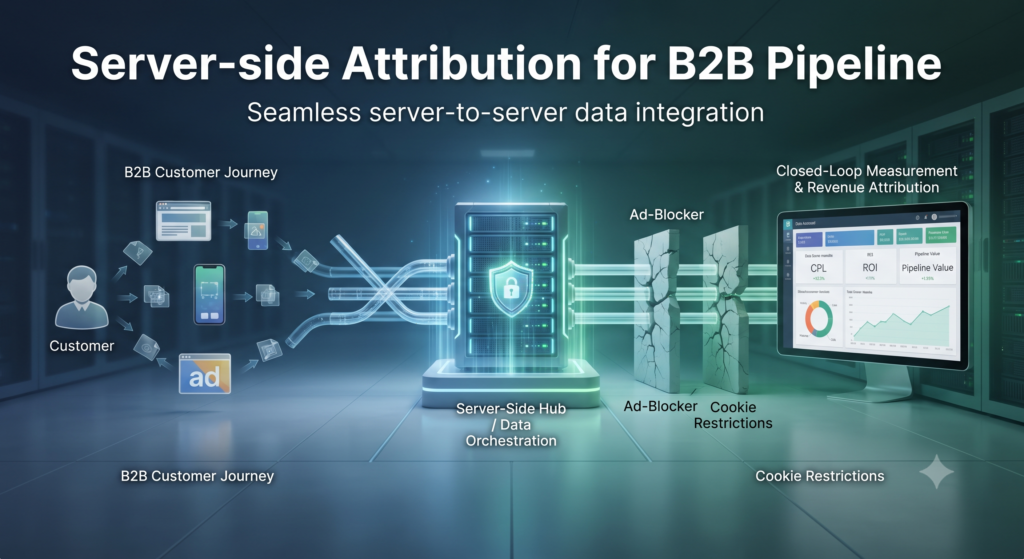
The solution lies in shifting the point of control from the user’s fickle browser to your own secure environment. Moving beyond browser-based tracking to capture the full customer journey by bypassing ad-blockers and cookie restrictions through server-to-server data orchestration is no longer a luxury—it is a requirement for survival. This is the era of server-side attribution, a methodology that ensures your pipeline data remains accurate, actionable, and resilient.
The Breakdown of Browser-Based Tracking
To understand why server-side attribution is essential, we must first acknowledge why the traditional model is failing. Client-side tracking relies on the user’s browser (the “client”) to execute snippets of JavaScript (pixels or tags) and send data directly to third-party platforms like Google Ads, Meta, or LinkedIn.
This model is inherently fragile. Ad-blockers, used by over 40% of tech-savvy B2B buyers, prevent these scripts from ever loading. Furthermore, privacy features like Safari’s ITP and Firefox’s Enhanced Tracking Protection significantly shorten the lifespan of first-party cookies, often deleting them within 24 hours or seven days. For a B2B company with a six-month sales cycle, this means a prospect who clicks an ad on Monday and converts on Friday may appear as a completely “new” organic visitor because the original tracking cookie was purged.
This erosion of data leads to a “leaky” funnel. When your tracking scripts are blocked or your cookies are prematurely deleted, your attribution model defaults to “Direct” or “Organic,” even if a paid campaign drove the initial interest. The result is a distorted view of ROI that makes it impossible to scale high-performing channels with confidence.
What is Server-side Attribution?
Server-side attribution represents a fundamental shift in how data is collected and processed. Instead of the browser sending information directly to an ad platform, the browser sends data to a dedicated server under your control. From there, that server cleans, enriches, and forwards the data to your MarTech stack via a conversion API.
By sitting between the user and the destination platform, server-side tracking acts as a sophisticated filter and relay station. Because the communication happens “server-to-server,” it is invisible to ad-blockers and resides outside the restrictive jurisdiction of browser-based privacy settings. This architecture allows you to maintain a persistent identity for your leads across the entire lifecycle, ensuring that the touchpoint that started the journey is correctly credited when the deal finally closes.
Enhancing Data Fidelity in the B2B Context
In B2B marketing, the quality of your data dictates the quality of your decisions. This is where the concept of data fidelity becomes paramount. Data fidelity refers to the accuracy, completeness, and reliability of the information flowing into your CRM and analytics platforms.
When you rely on client-side pixels, you are essentially at the mercy of the browser’s performance and the user’s settings. If a page loads slowly and a user bounces before the JavaScript executes, that visit is lost. If a user has a “Do Not Track” setting enabled, that data is obscured. Server-side attribution restores data fidelity by moving the heavy lifting away from the client’s device.
Because the server handles the data transmission, you can ensure that every event—from a whitepaper download to a demo request—is captured and sent with 100% accuracy. You can also enrich this data in real-time. For example, when a lead submits a form, your server can ping a firmographic database to append company size and industry before sending that information to your conversion API. This creates a richer, more reliable dataset for your attribution models to work with.
The Strategic Power of MarTech Orchestration
Transitioning to a server-side model isn’t just about technical plumbing; it’s about MarTech orchestration. Modern B2B stacks are often fragmented, with data siloed in LinkedIn Campaign Manager, Google Analytics 4, Salesforce, and Marketo. Without a unified way to sync these platforms, your view of the pipeline remains disjointed.
Server-side tracking serves as the central nervous system for your marketing technology. Through a process of orchestration, you can route the same event to multiple destinations simultaneously. A single “Sign Up” event on your website can be sent to:
1. Meta’s Conversion API to optimize your retargeting ads.
2. Google Analytics 4 for session reporting.
3. Your internal data warehouse for long-term modeling.
4. Your CRM to update a lead’s activity history.
This centralized control ensures that all platforms are working from the same “source of truth.” It eliminates the discrepancies often found between ad platform dashboards and CRM reports, allowing your growth team to focus on revenue rather than reconciling mismatched spreadsheets.
Achieving Closed-Loop Measurement
The ultimate goal of any B2B attribution strategy is closed-loop measurement. You need to be able to trace a “Closed-Won” deal in Salesforce back to the specific LinkedIn ad or search keyword that first entered the prospect into your ecosystem.
Client-side tracking usually loses the thread once the lead is passed from the website to the CRM. Server-side attribution bridges this gap. By utilizing a conversion API, you can send “offline” events—such as a Sales Qualified Lead (SQL) stage change or a signed contract—back to your advertising platforms.
This creates a feedback loop. When Google Ads or LinkedIn receives data about which leads actually turned into high-value opportunities, their machine-learning algorithms become much more effective at finding similar prospects. You stop optimizing for “cheap clicks” and start optimizing for “pipeline value.” This closed-loop measurement is the key to moving marketing from a cost center to a predictable revenue driver.
Implementing Server-side Attribution: The Path Forward
Adopting server-side attribution requires a strategic approach to your data infrastructure. It generally involves three primary components:
1. **A Server-side Container:** Tools like Google Tag Manager (GTM) Server-side or specialized B2B data platforms allow you to set up a cloud-based server (usually via Google Cloud or AWS) to receive and process events.
2. **Conversion APIs (CAPI):** Most major platforms now offer a conversion API. Integrating these is essential for bypassing browser restrictions and sending high-intent signals directly from your server to the ad platform.
3. **A First-Party Data Strategy:** Since you are now the steward of the data, you must ensure your tracking is compliant with global regulations like GDPR and CCPA. Server-side tracking actually makes compliance easier, as you can redact PII (Personally Identifiable Information) on your server before sending it to third-party vendors.
While the initial setup has a steeper learning curve than simply “pasting a pixel,” the long-term dividends are immense. You gain a competitive advantage by seeing the 30% of the journey that your competitors are missing.
Overcoming the “Cookie-less” Anxiety
The industry’s anxiety regarding the “death of the cookie” is often misplaced. The problem isn’t that tracking is disappearing; it’s that the *method* of tracking is evolving. B2B companies that lean into server-side attribution find themselves less vulnerable to the whims of browser developers.
By owning the data stream, you reclaim control over your attribution window. You are no longer limited by a seven-day ITP window. You can maintain first-party identifiers that persist for months, matching the reality of the B2B buying cycle. This stability allows for more sophisticated multi-touch attribution models that account for every stakeholder in a target account, rather than just the person who happened to fill out the final form.
FAQ: Server-side Attribution for B2B
Does server-side attribution replace client-side tracking entirely?
Not necessarily. Most organizations use a “hybrid” approach. Client-side tracking is still useful for simple UI interactions, while server-side attribution is used for critical conversion events and pipeline data where data fidelity is non-negotiable.
Is it harder to comply with GDPR using server-side tracking?
Actually, it’s often easier. With server-side tracking, you have a “kill switch” for data. You can filter out specific user data or anonymize IP addresses on your own server before that data ever reaches a third-party platform, giving you much tighter control over privacy compliance.
How does this impact site speed?
Server-side tracking significantly improves site speed. Instead of loading ten different third-party JavaScript pixels in the user’s browser (which slows down the page), you load one single stream to your server. This reduction in “script bloat” leads to better SEO and a better user experience.
Will this help me see “Dark Social” traffic?
While server-side attribution cannot track a private Slack message or a word-of-mouth recommendation, it does help significantly with “dark” traffic caused by ad-blockers and browser privacy settings. It ensures that when a lead does land on your site from a known source, that source is accurately recorded.
What is the primary difference between a pixel and a Conversion API?
A pixel is a browser-based tool that relies on the user’s device to report an action. A conversion API is a server-to-server connection that sends data directly from your backend to the ad platform’s backend, making it immune to browser-level interference.
Conclusion
The shift toward server-side attribution is a move toward maturity for B2B revenue teams. By bypassing the limitations of the modern browser, you ensure that your marketing decisions are based on a complete and accurate picture of the pipeline. High data fidelity, enabled by MarTech orchestration and robust conversion APIs, allows you to finally close the loop on your measurement and prove the true impact of your marketing efforts.
The future of B2B growth belongs to those who own their data. Don’t let your pipeline visibility be dictated by browser updates and ad-blockers. Move your tracking to the server and start building a more resilient, revenue-focused attribution strategy today.
**Ready to gain full visibility into your B2B pipeline? Contact Octazing today to learn how our server-side attribution and MarTech orchestration services can help you capture every touchpoint and scale your growth with precision.**