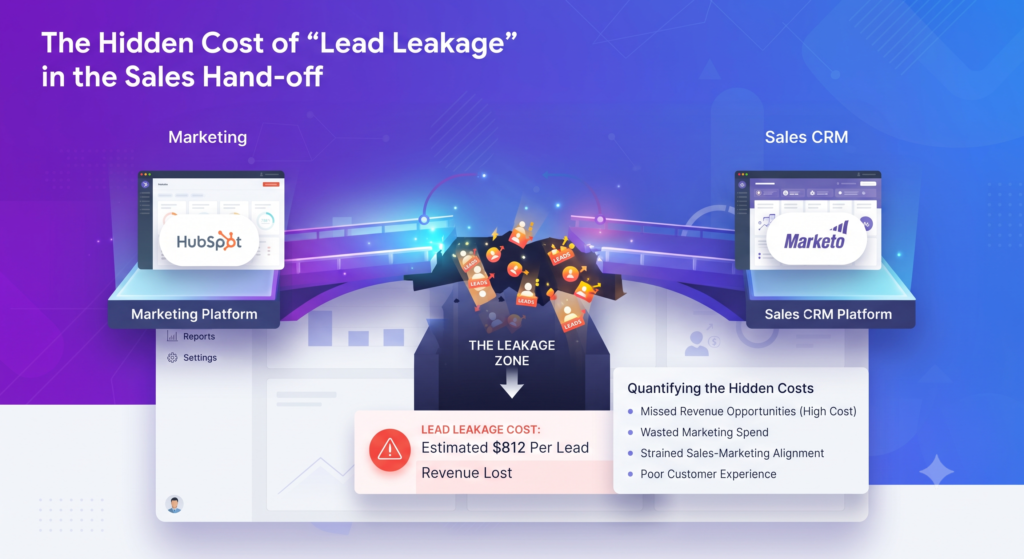
Imagine your demand generation engine is firing on all cylinders: your LinkedIn ads are seeing record-high click-through rates, your whitepaper downloads are surging, and your demo request form is more active than ever. To the CMO, the dashboard looks like a triumph. But downstairs, the sales team is complaining about a lack of volume, and the revenue numbers haven’t budged. Somewhere between the “Submit” button on your website and the “New Lead” notification in your CRM, your hard-earned pipeline is evaporating. This is the reality of lead leakage—the silent killer of B2B growth.
In the high-stakes world of B2B SaaS, the gap between a marketing touchpoint and a sales conversation is often a technical abyss. It is filled with broken webhooks, mismatched data schemas, and API rate limits that silently drop high-intent prospects into the digital void. For growth leaders, lead leakage prevention is no longer just a “nice-to-have” operational task; it is a fundamental requirement for maintaining a healthy Customer Acquisition Cost (CAC) and ensuring the integrity of the entire revenue funnel.
The Silent Revenue Killer: Defining Lead Leakage
Lead leakage refers to the loss of potential customers during the transition from marketing platforms to sales systems. While many teams focus on “top-of-funnel” conversion rates, they often ignore the “middle-of-the-stack” technical failures. If 100 people fill out a form, but only 85 appear in the CRM, you have a 15% leakage rate. In a B2B environment where a single lead can represent five or six figures in Lifetime Value (LTV), that 15% loss is catastrophic.
The challenge is that this leakage is usually invisible. Most standard MarTech stacks are built on fragile, “point-to-point” integrations. When a lead disappears, there is rarely an error message sent to the marketing manager. The lead simply ceases to exist in the system, creating a permanent gap in your closed-loop measurement and making it impossible to accurately calculate ROI. To fix this, we need to move beyond basic integrations and toward a robust Lead Ops OS—a centralized operating system designed to orchestrate every data point with precision.
The Technical Chokepoints: Where Leads Disappear
To implement effective lead leakage prevention, we must first map the technical chokepoints where data typically fails. The journey from a form submission to a CRM record is rarely a straight line. It involves multiple hops across the MarTech stack, each presenting a point of failure.
First, there is the “Form-to-Automation” hop. Many B2B websites rely on client-side scripts to capture lead data. If a user has an ad-blocker enabled or if the script fails to load due to a slow CDN, the lead data may never leave the browser. This is why server-side attribution and server-side data collection have become critical. By moving the logic away from the user’s browser and into a controlled server environment, you ensure that every interaction is captured, regardless of the user’s local settings.
Second is the “Validation and Enrichment” phase. Many leads are “leaked” because they fail basic validation rules in the CRM. If your CRM requires a “Company Size” field but your marketing form doesn’t provide it, the CRM may reject the record entirely. Without a sophisticated MarTech orchestration layer, these rejected leads often disappear into an error log that no one ever checks.
Finally, there is the “Sync Delay.” In B2B sales, time is the enemy of the deal. Research consistently shows that B2B response speed is a primary driver of conversion rates. If your integration stack only syncs data in batches every hour, you are leaking the “intent” of the lead, even if the data eventually arrives.
The Impact on B2B Response Speed and CRM Data Integrity
Lead leakage doesn’t just affect the quantity of leads; it degrades the quality of your entire sales operation. When data is lost or delayed, CRM data integrity suffers. Sales representatives begin to distrust the system. If a rep receives a lead three hours late, the prospect has likely already moved on to a competitor. If the lead arrives with missing contact information or broken attribution strings, the rep has to spend valuable time doing manual research instead of selling.
Furthermore, leakage destroys your ability to perform closed-loop measurement. If the lead that eventually closed for $50,000 was one of the few that “leaked” its original source data during the hand-off, your marketing team won’t know which campaign actually drove the revenue. This leads to poor budget allocation, as you might stop funding the very channels that are producing your best—but most technically complex—leads.
A true Lead Ops OS solves this by ensuring data fidelity at every step. It acts as a buffer and a validator, ensuring that no lead is sent to the CRM until it meets the required schema, and ensuring that every lead is delivered in near real-time.
Patching the Holes with n8n Workflow Automation
At Octazing, we believe the solution to lead leakage isn’t more “out-of-the-box” connectors, but rather sophisticated n8n workflow automation. n8n is a powerful, low-code tool that allows for complex logic, branching, and error handling that standard tools like Zapier simply cannot match.
By using n8n for MarTech orchestration, we can build “Air Traffic Control” for your leads. When a form is submitted, the data hits an n8n webhook. From there, the workflow can:
- Validate the data: Check if the email is a valid business address.
- Enrich the record: Ping services like Clearbit or Apollo to fill in missing details.
- Check for duplicates: Query the CRM to see if the lead already exists and update the record instead of creating a mess.
- Route intelligently: Use complex logic to assign the lead to the right territory or pod.
- Error Handling: This is the most crucial part of lead leakage prevention. If the CRM API is down, n8n doesn’t just lose the lead. It can “wait and retry” or send an emergency alert to a Slack channel so the lead can be handled manually.
This level of control ensures that your CRM data integrity remains pristine, as only “clean” and “complete” data is ever allowed into your primary system of record.
Server-Side Attribution and the Conversion API
A significant portion of lead leakage happens before the lead even reaches your automation tools. Modern privacy changes (like iOS 14 and the phasing out of third-party cookies) mean that browser-based tracking is increasingly unreliable. To maintain data fidelity, B2B companies must shift toward server-side attribution.
By implementing a conversion API (such as the ones offered by Google, Meta, or LinkedIn), you can send conversion data directly from your server (via n8n) to the ad platforms. This bypasses the browser entirely. When a lead is validated in your Lead Ops OS, the system sends a signal back to the ad platform confirming the conversion. This creates a highly accurate feedback loop. You aren’t just tracking “clicks”; you are tracking validated, high-intent hand-offs. This is the gold standard of closed-loop measurement.
Why Workflow-as-a-Service (WaaS) is the Future
The challenge for most B2B companies is that building and maintaining these complex n8n workflows is a full-time job. It requires a deep understanding of APIs, data structures, and SalesOps strategy. This is why the Workflow-as-a-Service (WaaS) model is gaining traction.
Instead of hiring an expensive, full-time Marketing Ops manager to build a custom stack, companies partner with experts like Octazing to manage their Lead Ops OS. We provide the infrastructure, the pre-built n8n logic, and the constant monitoring required to ensure that no lead ever falls through the cracks. As your business scales and your sales process changes, the WaaS model allows your automation to evolve without needing a total system overhaul.
FAQ
Q: What is the most common cause of lead leakage?
A: The most common cause is a lack of error handling in basic integrations. If an API call fails due to a temporary timeout or a validation error, most “standard” integrations simply drop the data. Without a system like n8n to catch these errors and retry, the lead is lost forever.
Q: How does server-side attribution help with lead leakage?
A: It ensures that the “source” data of a lead is captured accurately, even if the user has privacy settings that block traditional tracking. By using a conversion API, you connect your actual sales outcomes back to your marketing spend with much higher data fidelity.
Q: Isn’t n8n too complex for a standard marketing team?
A: It can be, which is why the Workflow-as-a-Service model is so effective. Marketing teams should focus on strategy and creative, while the technical orchestration is handled by Lead Ops specialists who ensure the plumbing is watertight.
Q: How fast should the “hand-off” be?
A: In an ideal world, the hand-off should be instantaneous. B2B response speed is a competitive advantage. Using n8n workflow automation, we can typically get a lead from a form submission into a CRM and a rep’s hands in under 30 seconds.
Q: Does lead leakage affect SEO or just paid media?
A: It affects every channel. If an organic lead disappears due to a technical glitch, you have wasted the long-term investment you made in content and SEO. Lead leakage prevention protects the ROI of your entire marketing department.
Conclusion
The technical “plumbing” of your sales hand-off is the foundation upon which your entire revenue engine is built. You can have the most brilliant marketing strategy in the world, but if your data is leaking out of broken integrations and silent API failures, you are burning money. By implementing a dedicated Lead Ops OS and leveraging the power of n8n workflow automation, you can ensure that every high-intent lead is captured, enriched, and delivered to your sales team with perfect accuracy.
Don’t let your hard-earned leads vanish into the technical void. Ready to seal the gaps in your funnel and maximize your B2B response speed? Contact Octazing today to see how our Workflow-as-a-Service model can transform your Lead Ops from a liability into a competitive advantage.