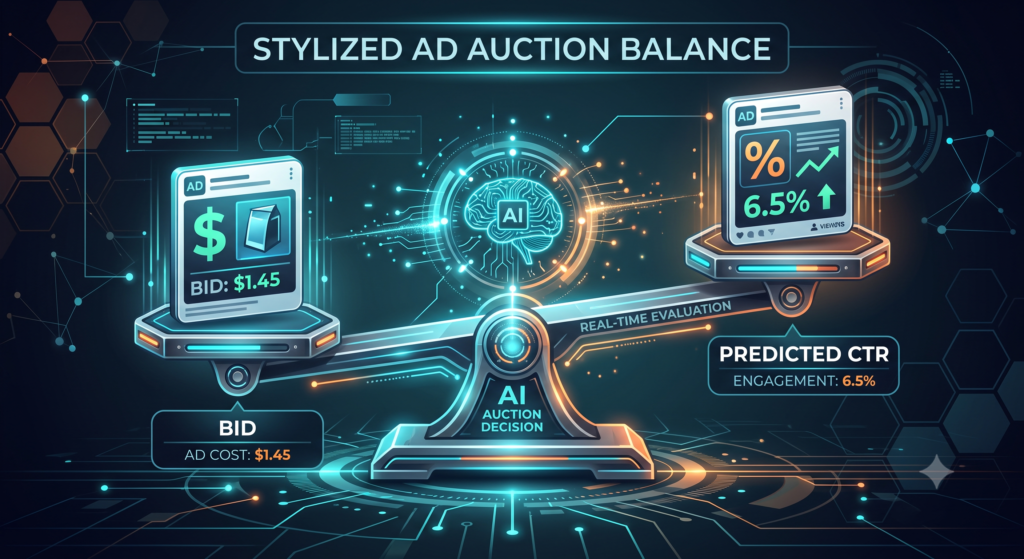
Every time a webpage loads, an app opens, or you scroll a feed, something remarkable happens in roughly 100 milliseconds: dozens of advertisers effectively bid against each other for the right to show you one ad, a winner is picked, and the page finishes rendering before you’d ever notice a delay. This is real-time bidding (RTB), and understanding what actually happens inside that split second explains almost everything about why some ads perform well and others quietly burn through budget.
It’s Not Just “Highest Bid Wins” — And Hasn’t Been for Years
The single biggest misconception about ad auctions is that the advertiser willing to pay the most gets the impression. That was closer to true in early display advertising. It’s not how modern auctions work, and understanding why is the key to understanding AI’s role in the whole system.
Most ad exchanges rank bidders using a score that combines the bid with the predicted probability the ad will get clicked — often expressed as eCPM (effective cost per thousand impressions): eCPM = predicted CTR × bid. An advertiser bidding $2 with a predicted click-through rate of 3% can outrank an advertiser bidding $5 with a predicted CTR of 0.5%, because the platform is optimizing for the value of the impression to everyone in the ecosystem — the publisher, the user’s experience, and its own long-term auction health — not just the advertiser’s willingness to pay. This is also the mechanism behind “Quality Score” in platforms like Google Ads: relevance and predicted performance directly lower what you have to bid to win the same position.
The Machine Learning Problem Underneath the Auction: Predicting a Click Before It Happens
This is where AI actually does the heavy lifting. Before any auction can rank bidders by predicted value, something has to generate that CTR prediction — for every ad, for every user, for every placement, in real time, at a scale of millions of bid requests per second.
How CTR prediction models work, in plain terms: the model is trained on historical data — which ads got shown to which kinds of users, in which contexts, and whether they were clicked — and learns to output a probability score for a brand-new combination it’s never seen before. Modern systems typically use gradient-boosted models (like XGBoost) or deep learning approaches, chosen because they’re strong at capturing interactions between features — time of day, device type, user interest signals, ad creative attributes — that a simpler model would miss. In published research comparing modeling approaches for this exact task, the more sophisticated gradient-boosted models measurably outperformed simpler baselines on accuracy, though at some cost to interpretability.
Why this matters for advertisers: the platform is constantly estimating how likely your specific ad is to earn a click from this specific person in this specific context — and that estimate, not your bid alone, is what determines whether you win the impression and what you actually pay for it.
The Auction Mechanics Themselves
Once a predicted-value score exists for every competing ad, the exchange runs the actual auction:
- Second-price auctions (the traditional model) charge the winner just enough to beat the second-highest score, not their full bid — theoretically encouraging advertisers to bid their true value rather than sandbagging.
- First-price auctions, which many exchanges have shifted toward in recent years for transparency reasons, charge the winner exactly what they bid — which changed bidding strategy across the industry, since bidding your maximum true value now means paying your maximum true value, not a discounted version of it.
- Bid optimization on the advertiser side (handled automatically by DSPs and platform-native bidding tools) constantly adjusts bids in response to predicted win probability and market price forecasts, trying to win the impressions worth winning without overpaying for the ones that aren’t.
What This Means for How You Should Actually Advertise
Understanding the mechanics changes what you optimize for, in some genuinely counterintuitive ways:
Creative quality is a bidding strategy, not just a branding decision. Because predicted CTR directly multiplies into the auction score, a more relevant, more engaging ad can win placements at a lower bid than a generic one competing on price alone. This is the actual mechanism behind why AI creative-generation tools that produce more variants for testing tend to lower cost per result — they’re not just “trying more things,” they’re improving the CTR prediction the auction rewards.
Feed the algorithm signal, not noise. Predictive models are only as good as the historical data feeding them. A campaign with erratic targeting, inconsistent creative, or fraudulent conversion data corrupts its own prediction quality over time — the platform’s model of “who clicks this” gets muddier, not clearer, the more inconsistent the inputs are.
“Learning phase” isn’t a marketing platitude — it’s a literal cold-start problem. New campaigns underperform initially because the CTR prediction model has no historical data specific to that ad yet; it’s working off broader signals until enough real interaction data accumulates to refine the prediction. This is exactly why constantly restarting campaigns (new creative, new targeting, new bid strategy all at once) keeps resetting you back into that cold-start phase.
Context and timing matter more than most advertisers assume, because they’re genuine input features to the prediction model — the same ad shown to the same person can have a meaningfully different predicted CTR depending on time of day, device, and surrounding content, which is part of why identical creative performs so differently across placements.
The Bottom Line
The auction most advertisers picture — highest bidder wins — hasn’t existed for a long time. What actually happens is a continuous machine learning prediction problem running underneath a real-time market: an algorithm estimates how likely you are to click on this specific ad right now, that prediction gets multiplied against the bid, and the resulting score decides who wins and what they pay. Understanding that changes the practical question from “how much should I bid?” to “how do I make this ad worth predicting a high click-through rate for?” — which is a question about creative relevance and audience fit, not just budget.