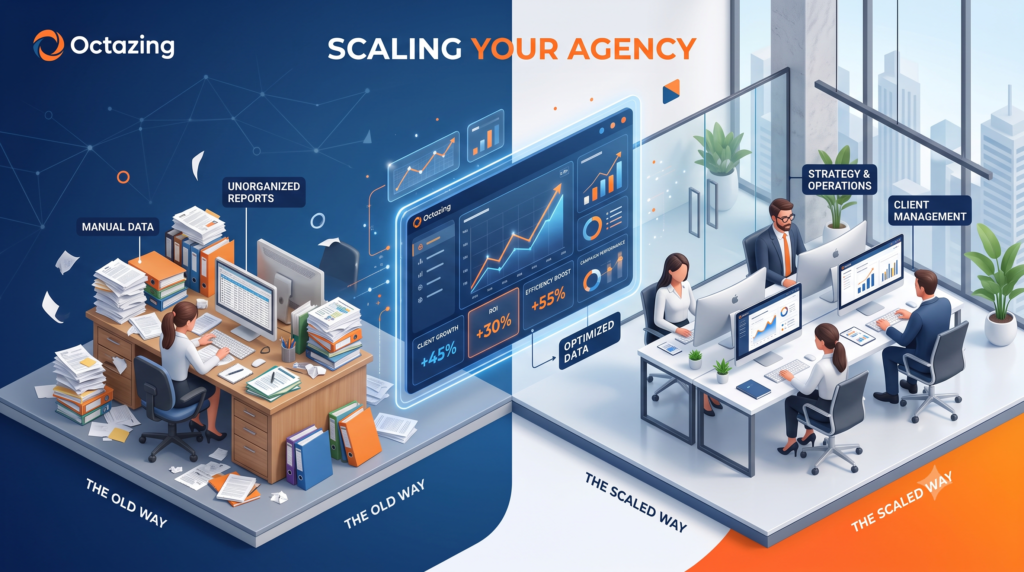
The transition from a boutique agency with 10 clients to a powerhouse managing 50+ is often where the “agency death spiral” begins. You’ve successfully acquired the talent, your marketing is working, and the revenue is flowing. But beneath the surface, your account managers are drowning in a manual reporting nightmare.
Data fragmentation, copy-paste errors, and endless hours spent in spreadsheets don’t just kill your team’s morale—they erode your profit margins.
If you want to scale an agency sustainably, you must move beyond the “manual grind.” In this guide, we’ll explore how to decouple your headcount from your workload, ensuring that as your client list grows, your reporting overhead stays flat.
The “Scaling Trap”: Why Manual Reporting Limits Your Growth
For most agencies, the math is simple: 10 clients = 10 hours of reporting. 50 clients = 50 hours of reporting. If you’re a 10-person agency, that’s an entire full-time employee dedicated solely to data entry every month.
According to a study by AgencyAnalytics, nearly 60% of marketing agencies report that manual data compilation is their biggest operational bottleneck. When your top-tier strategists are spending their time moving numbers from Google Ads to a PDF, they aren’t performing the high-value analysis that keeps clients long-term.
The True Cost of Manual Reporting
- The Opportunity Cost: Your team could be focusing on strategy, client relationships, or new business development.
- The Churn Risk: Inconsistent or delayed reporting is a leading cause of client dissatisfaction.
- The Profit Drain: When you charge a flat retainer, manual reporting turns that “profitable” client into a break-even project.
Phase 1: Standardizing Your Reporting Architecture
Before you can scale, you must standardize. Scaling a mess is just creating a faster way to fail. You need a centralized “Source of Truth.”
1. Define Your KPIs (The “Why”)
Stop sending “data dumps.” Clients don’t want 30 pages of vanity metrics; they want to know if their investment is paying off. Identify the 3–5 KPIs that actually correlate to your agency’s value proposition.
2. Implement a Unified Data Stack
Don’t use three different tools for social, SEO, and PPC. Consolidate your data collection. Whether you use a CRM like HubSpot or a specialized agency reporting tool, ensure that every client’s data is flowing into a single dashboard.
[Internal Link: Click here to view Octazing’s Agency Services Overview → /agency-services] – See how we help agencies optimize their tech stacks for maximum efficiency.
Phase 2: Automate or Die (The Scaling Strategy)
To hit 50+ clients without increasing headcount, automation is non-negotiable.
The Rule of Three for Automation:
- Direct Integrations: Use tools that pull data directly from APIs. Never export a CSV if an API can do it for you.
- Dynamic Templates: Build one master dashboard template. If a new client joins, apply the template, connect the API, and your report is ready in under 5 minutes.
- Automated Scheduling: If you are still manually emailing reports, you are wasting time. Use your reporting platform to auto-email stakeholders on a set schedule.
Scaling Your Agency Operations: The “POD” Structure
As you scale toward 50 clients, you need a structural shift. The “Generalist” model fails at scale. Instead, adopt the POD structure:
- The Strategist: High-level planning and client communication.
- The Technician: Hands-on-keyboard execution.
- The Analyst: Focused strictly on reporting and performance optimization.
Strategy Tip: By having an Analyst or an automated reporting system support the Strategist, you ensure the client always receives high-level insights, not just raw numbers.
Need help streamlining your workflow?
Book a consultation with Octazing’s agency growth experts to audit your current operations.
Phase 3: The Art of Client Communication
Scaling isn’t just about software; it’s about managing expectations.
Use the “Exception-Based” Reporting Model
Don’t send a comprehensive report every single time if nothing has changed. Adopt an exception-based model:
- Green (On track): Send a brief automated dashboard link.
- Yellow/Red (Underperforming): This triggers a manual, high-touch video loom or call from the Account Manager.
Leveraging Data for Retention
When you scale to 50+ clients, the biggest threat to your agency isn’t new business—it’s churn. Studies show that increasing customer retention rates by just 5% can increase profits by 25% to 95% (Bain & Company). Your reporting should be a retention tool.
[Internal Link: Read more on Client Retention Strategies for Marketing Agencies → /blog/retention-strategies]
Conclusion: Build for 100, Manage for 10
The goal of scaling is to create a business that functions independently of your constant intervention. By automating your reporting, adopting a POD structure, and focusing on high-value client communication, you can move from a “manual workshop” to a scalable, high-profit machine.
The final question isn’t whether you have enough people to handle 50 clients—it’s whether you have the right systems to make it look effortless.