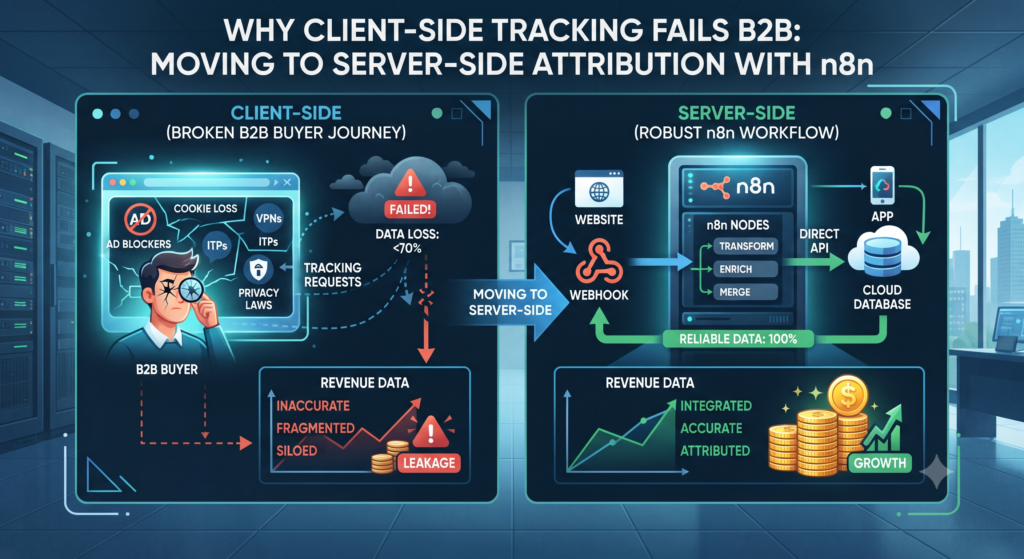
In the complex B2B sales cycle, the path from first click to closed-won isn’t a straight line; it’s a fragmented journey that client-side tracking is no longer equipped to follow. For years, digital marketers relied on the relative simplicity of browser-based cookies and tracking pixels to measure success. You’d place a snippet of code on your header, wait for a conversion event, and see the data reflected in your Google Ads or LinkedIn Campaign Manager dashboard. But in a landscape defined by privacy regulations, intelligent tracking prevention (ITP), and buyer journeys that span six to twelve months, that traditional model has broken.
For modern B2B organizations, the gap between what is happening in reality and what is being reported in the browser is widening. This “data black hole” makes it impossible to achieve true closed-loop measurement. If you cannot accurately tie a high-value “Closed-Won” opportunity in your CRM back to the original LinkedIn ad that sparked the interest six months ago, your marketing spend is essentially a guessing game. This is where server-side attribution becomes the non-negotiable standard for any organization serious about data-driven lead ops. By moving the tracking logic from the user’s volatile browser to a controlled server environment—specifically using n8n workflow systems—revenue teams can finally regain 100% data integrity.
The Death of Client-Side Tracking in B2B
The decline of client-side tracking is not a single event but a slow erosion caused by three converging forces: privacy-centric browser updates, the rise of ad-blockers, and the inherent complexity of the B2B buyer’s journey. Browser features like Apple’s Intelligent Tracking Prevention (ITP) and Firefox’s Enhanced Tracking Protection (ETP) have drastically shortened the lifespan of first-party cookies. In many cases, a tracking cookie that used to last for 30 days is now deleted after just seven days—or even 24 hours.
For B2B companies, a seven-day window is catastrophic. The typical B2B sale involves multiple stakeholders and dozens of touchpoints across several months. If a prospect clicks an ad on Monday, downloads a whitepaper on Friday, but doesn’t request a demo until two weeks later, client-side tracking has already lost the thread. The “demo request” will appear as direct traffic, and the original ad campaign will receive zero credit. This lack of data fidelity leads to poor budget allocation, as growth teams end up cutting campaigns that are actually driving high-quality pipeline simply because the browser “forgot” the initial touchpoint.
Furthermore, the prevalence of ad-blockers and privacy extensions among tech-savvy B2B audiences means that up to 30% of your conversion events may never be fired at all. When the tracking script is blocked at the browser level, the data never reaches your analytics platform. This isn’t just a reporting nuance; it’s a fundamental failure of MarTech orchestration. Without a reliable way to capture every interaction, your lead scoring models, attribution reports, and optimization efforts are built on a foundation of incomplete information.
What is Server-Side Attribution?
Server-side attribution represents a paradigm shift in how we collect and process marketing data. Unlike client-side tracking, where the user’s browser sends data directly to third-party platforms (like Facebook or Google), server-side attribution introduces an intermediary: your own server. In this model, the browser sends a single stream of data to your server. From there, your server processes that information, enriches it, and then distributes it to various marketing and analytics endpoints.
By moving this logic away from the client, you regain control. Because the communication happens “server-to-server,” it is invisible to browser-based ad-blockers and immune to the restrictive cookie policies of ITP. This architecture allows for a more robust method of identifying users across long sales cycles. Instead of relying on a fragile browser cookie, you can use persistent identifiers—such as hashed email addresses or internal CRM IDs—to stitch together a user’s history over months or even years.
In a B2B context, server-side attribution is the key to unlocking “Conversion APIs” (CAPIs). Platforms like LinkedIn and Google now offer these APIs to allow companies to send conversion data directly from their backend systems. This ensures that even if a user switches devices or clears their cache, the server can still associate the eventual conversion with the original click. This transition is the cornerstone of data-driven lead ops, moving away from “best guess” metrics toward a definitive source of truth.
The Advantage of Data Fidelity
In the world of Revenue Operations (RevOps), data fidelity is the difference between a scaling company and a stagnating one. When your attribution data is 70% accurate, you aren’t just missing 30% of the picture; you are actively making wrong decisions. You might over-invest in top-of-funnel channels that drive high click volume but zero bottom-of-funnel revenue, simply because those short-term clicks are the only things the browser can track.
Server-side attribution ensures that every “hand-off” in the lead lifecycle is documented. In B2B, the most important conversions often happen offline—a discovery call is booked, an SQL is qualified, or a contract is signed. Client-side pixels cannot see these events because they occur inside a CRM like Salesforce or HubSpot, not on a thank-you page. By implementing a server-side framework, you can bridge this gap. You can trigger an attribution event the moment a deal stage changes in your CRM, sending that “Conversion” signal back to the ad platform that initially acquired the lead.
This level of precision allows for much more sophisticated MarTech orchestration. When you have high data fidelity, you can feed cleaner data into the machine-learning algorithms of ad platforms. Instead of telling Google Ads to “find more people who visit the site,” you can tell it to “find more people who actually become Closed-Won customers.” This creates a virtuous cycle where your marketing spend becomes increasingly efficient as the platforms learn to identify your true ideal customer profile (ICP) based on actual revenue, not just web traffic.
Implementing Server-Side Attribution via n8n
While the benefits of server-side tracking are clear, the implementation can often feel daunting for non-technical marketing teams. This is where n8n workflow systems come into play. n8n is a powerful, low-code automation tool that acts as the “brain” of your MarTech orchestration. It allows you to build complex logic to handle data routing between your website, your CRM, and your marketing platforms without needing a massive engineering budget.
To implement server-side attribution using n8n, you typically set up a webhook that captures data from your site’s forms or a dedicated tracking server. When a user submits a lead form, the data is sent to an n8n workflow. Within n8n, you can then perform several critical steps:
-
Data Normalization: Ensure that names, emails, and company data are formatted correctly.
-
Identity Stitching: Check your CRM to see if this user has interacted with you before and append their unique identifier.
-
Enrichment: Use tools like Clearbit or Apollo (integrated via n8n nodes) to add firmographic data to the lead in real-time.
-
Multi-Platform Routing: Simultaneously send this cleaned, enriched data to the Google Ads Conversion API, LinkedIn CAPI, and your internal data warehouse.
The beauty of using n8n for this process is the transparency and flexibility it offers. Unlike “black box” attribution tools, you can see exactly how every piece of data is being transformed and routed. If you need to change your attribution logic—perhaps moving from a first-touch to a linear model—you can simply update your n8n nodes. This level of control is essential for modern Lead Ops teams who need to remain agile in a shifting privacy landscape.
Building a Closed-Loop Measurement System
The ultimate goal of server-side attribution is the creation of a closed-loop measurement system. In a closed loop, the marketing department is no longer measured by “leads” or “MQLs” (Marketing Qualified Leads), but by their direct contribution to the bottom line. This requires a seamless flow of data from the first touchpoint all the way to the final transaction.
By utilizing server-side attribution and n8n, you can effectively “close the loop” by syncing your CRM data back to your marketing platforms. For example, when a lead moves to the “Closed-Won” stage in Salesforce, an n8n workflow can trigger. This workflow retrieves the original click ID (like a GCLID or WBID) associated with that lead and sends a conversion event back to the original ad platform with the actual contract value attached.
This provides two massive benefits. First, it allows for true ROAS (Return on Ad Spend) reporting. You can finally see that a $5,000 ad spend on a specific LinkedIn campaign resulted in $50,000 of actual revenue. Second, it enables “Value-Based Bidding.” Most B2B companies optimize for lead volume because they don’t have the infrastructure to optimize for revenue. With a closed-loop system, you can train your ad platforms to prioritize the specific types of leads that have historically resulted in high-value contracts. This shifts marketing from a cost center to a predictable revenue driver.
Overcoming Common Implementation Hurdles
Transitioning to server-side attribution is a strategic move, but it does come with technical hurdles. The most common challenge is the “identity resolution” problem. Since you are no longer relying solely on cookies, you must have a consistent way to identify users. This usually requires a strong emphasis on capturing “hard” identifiers, like email addresses, early in the journey and ensuring those identifiers are passed consistently through every stage of the funnel.
Another hurdle is the initial technical setup of the server-side environment. While n8n simplifies the orchestration, you still need a way to collect the initial data. Many organizations use a “Server-Side Google Tag Manager” (sGTM) container or a dedicated event collection tool like Segment as the entry point, which then feeds the data into n8n. There is also the matter of data privacy compliance (GDPR/CCPA). Because you are processing personal data on your own server, you must ensure your n8n workflows include logic to respect user consent flags and anonymize data where necessary.
Finally, there is the internal cultural shift. Moving to server-side attribution often reveals uncomfortable truths—like the fact that certain “star” campaigns weren’t actually driving revenue. Teams must be prepared to act on this new, high-fidelity data. However, the long-term rewards far outweigh these growing pains. By investing in the right infrastructure today, you protect your measurement strategy against future browser changes and give your RevOps team the tools they need to succeed in a data-driven world.
Frequently Asked Questions (FAQ)
-
Q: Is server-side attribution more expensive than client-side tracking?A: While there are minor costs associated with hosting an n8n instance or a server-side container, the “cost” of inaccurate data is significantly higher. The efficiency gained from better ad spend allocation usually pays for the infrastructure many times over.
-
Q: Do I still need cookies if I use server-side tracking?A: Yes, but the way you use them changes. You still use first-party cookies to identify a session, but the server takes over the task of communicating that ID to third parties, making the tracking much more resilient and persistent.
-
Q: How does n8n compare to other automation tools like Zapier for attribution?A: n8n is often preferred for server-side attribution because it can be self-hosted (ensuring data privacy), offers more complex conditional logic, and handles high volumes of technical data (JSON payloads) more cost-effectively than Zapier.
-
Q: Can server-side attribution help with GDPR compliance?A: Absolutely. Because the data passes through your server before going to third parties (like Facebook), you can use n8n to strip out personally identifiable information (PII) or stop the data flow entirely if the user has not provided consent.
-
Q: How long does it take to see results from switching to server-side?A: You will see improvements in data volume (capturing blocked events) almost immediately. However, the full benefits for attribution and optimization usually take one full sales cycle to realize, as the system begins to track leads from first click to closed-won.
Conclusion
The shift toward server-side attribution is no longer a luxury for B2B brands—it is a requirement for survival in a privacy-first world. By moving beyond the limitations of the browser and embracing n8n workflow systems for MarTech orchestration, organizations can finally achieve the level of data fidelity required for true closed-loop measurement. This transition allows Lead Ops teams to stop guessing and start growing based on the only metric that matters: revenue.
Ready to fix your attribution and start tracking revenue accurately? Contact Octazing today to see how we build robust n8n workflow systems that turn fragmented data into a clear map for growth.