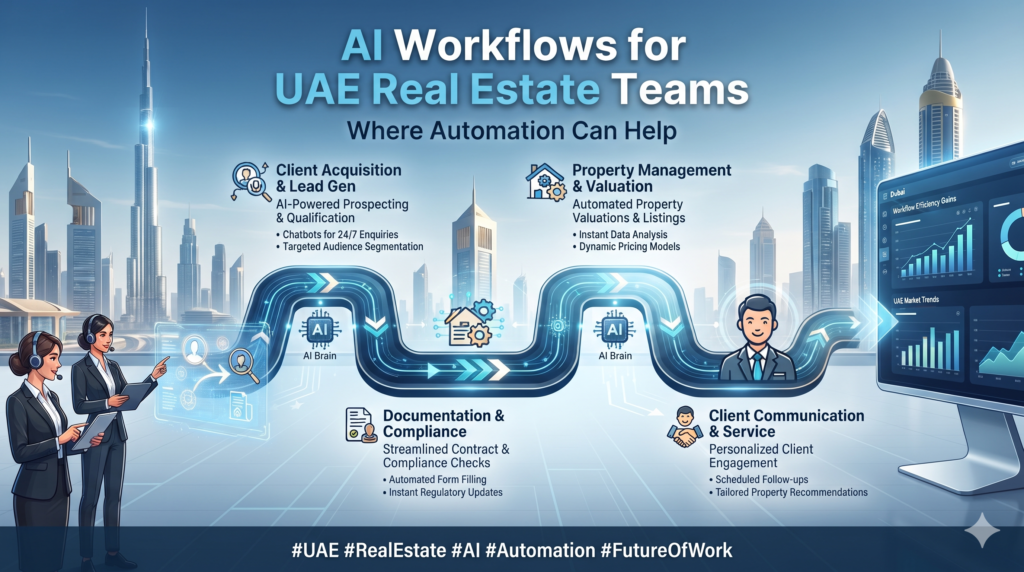
Real estate teams manage enquiries across listings, developments, campaigns and salespeople. AI workflows can help organise repetitive information, but they need clear rules and human review to be useful in a customer-facing sales process.
For a brokerage, developer or builder in the UAE, a practical AI workflow might classify incoming enquiries, summarise a conversation for an agent or suggest a CRM update. It should not invent a prospect’s intent, promise availability or send an unreviewed answer about a property.
Choose a bounded task first
Start with one repetitive task that has a clear input and a verifiable output. Examples include:
- Categorising enquiries by the project or listing mentioned
- Summarising a long enquiry for an assigned agent
- Flagging records that lack a location or next action
- Drafting an internal follow-up note for review
- Comparing CRM records against agreed completeness rules
Avoid starting with an open-ended agent that can change records, contact prospects and make decisions without oversight. A narrow workflow is easier to test and correct.
Design the workflow around human review
A controlled process can follow five steps:
- Receive an enquiry through an approved channel.
- Check that the required fields are present.
- Ask the AI component to classify or summarise only the supplied information.
- Show the result to a team member for approval.
- Save the approved information to the CRM and record the action.
If the workflow cannot confidently classify a record, it should send it to a review queue. Do not force a guess simply to keep automation moving.
Keep the CRM as the source of record
Define which system owns contact details, listing or project information, assignment and sales outcomes. AI-generated suggestions should not silently overwrite a verified CRM field. Keep a record of changes and make it easy for staff to correct them.
Before using AI with business data, review the provider’s data handling, permissions and retention settings with the appropriate adviser. Limit inputs to the information needed for the task, and do not send confidential or sensitive data to tools that are not approved for it.
Measure usefulness, not AI activity
Track whether the workflow reduces manual sorting, improves record completeness or helps agents find the next action. Also review errors, corrections, duplicate records and cases sent to human review. A high number of AI-generated summaries is not itself evidence that the process is working.
Octazing helps businesses plan marketing workflow automation, lead management and AI marketing workflows with clear handoffs and reporting. For more on choosing between automation and AI agents, read AI Agents vs Workflow Automation. Explore Octazing’s services.