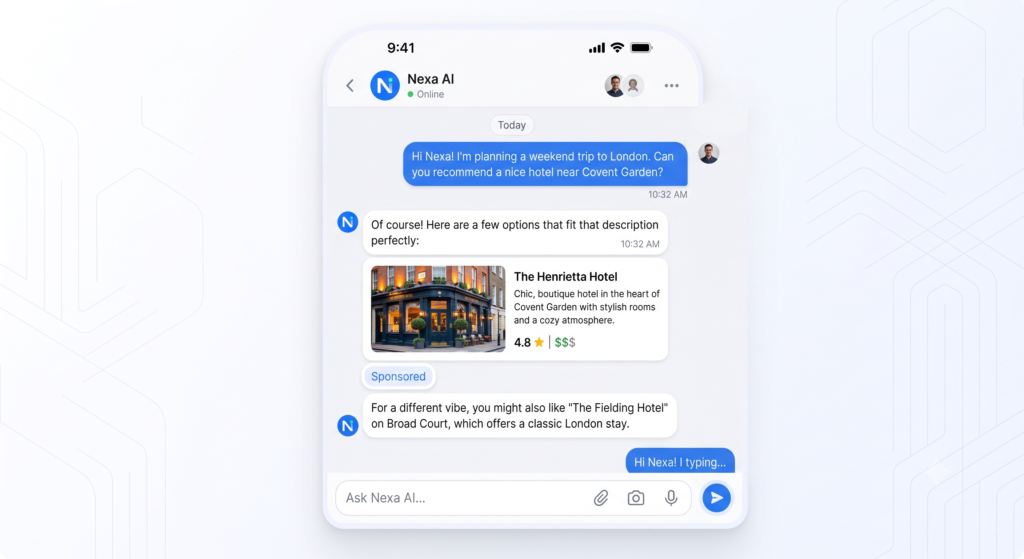
For twenty years, “search advertising” meant one thing: bidding on keywords so your link appeared next to Google’s blue links. That model is being rebuilt in real time. In 2026, advertising has moved inside the AI-generated answer itself — as a sponsored citation inside an AI Overview, a labeled placement below a ChatGPT response, or a product carousel embedded in a conversational answer. This is a genuinely new advertising surface, not a repackaged version of search ads, and the rules for winning attention inside it are still being written.
The Landscape, Platform by Platform
Google — AI Overviews and AI Mode. Google has integrated commercial placements directly into its generative search results rather than building a separate advertising universe. Ads now appear as embedded citations woven into the AI’s written response (a sponsored link cited as a recommended source within the summary) and as product carousels beneath transactional queries. Because this extends Google’s existing advertising infrastructure — Performance Max, Shopping feeds — brands already running Google Ads are often eligible for these placements without building anything new, and Alphabet has indicated AI Overviews and AI Mode are already monetizing at a rate comparable to traditional search.
ChatGPT — sponsored placements inside conversations. OpenAI launched an advertising pilot in early 2026 for logged-in users on free and lower-cost tiers; paying subscribers on higher plans remain ad-free. Ads appear clearly labeled as “Sponsored” below ChatGPT’s response — not woven into the answer itself, which OpenAI has stated does not influence the underlying response. Self-serve access opened in mid-2026 with no minimum spend requirement, running through a relevance-weighted second-price auction where creative quality affects ranking alongside the bid — meaning, much like traditional search auctions, a more relevant ad can win at a lower cost than a generic one. Reported entry pricing runs several dollars per click, with CPMs generally higher than a typical social platform, reflecting the high purchase-intent context of the placements.
Perplexity — an instructive exception. Perplexity tested advertising and then pulled it entirely, choosing to reposition around subscriptions instead, on the reasoning that sponsored answers would undermine the trust a citation-first product depends on. It’s a useful reminder that not every AI platform is converging on the same advertising model, and policies in this space remain genuinely unsettled.
Why This Channel Is Growing Faster Than Any Previous Ad Format
Generative search advertising is being described by some media forecasters as the fastest-scaling ad channel ever tracked — traditional search took over two decades to reach $100 billion in annual spend, social took about fourteen years, and current projections put generative search on pace to hit that scale in roughly six. The revenue base is still small in absolute terms relative to the broader digital ad market, but the growth curve and the underlying user behavior are what’s driving advertiser interest: hundreds of millions of people now discover products through conversations with AI assistants every month, and that number keeps climbing.
Why This Is a Fundamentally Different Kind of Advertising
It’s not keyword matching — it’s intent matching. Traditional search ads compete for a keyword. AI-native placements are matched to the meaning and context of an entire conversation — what the person is actually trying to figure out, not the specific words they typed. That’s a genuinely different creative problem: ad copy written like a traditional search ad interrupts the conversational flow and reads as jarring inside a chat interface, whereas copy written to answer the person’s implicit next question fits naturally.
Attribution is harder, not easier. The path from an AI-assisted discovery to an eventual purchase often spans multiple sessions and devices in ways platform tracking alone doesn’t fully capture yet. This is part of why a simple first-party tactic — asking customers directly how they found you, with an explicit option for “ChatGPT” or “Google AI” in the list — has become a meaningful measurement tool for this specific channel, filling a gap that pixel-based tracking can’t currently close.
Early conversion data looks genuinely strong. Independent clickstream analysis has found referral traffic from AI assistants converting at rates approaching those of traditional paid search — well ahead of organic search, email, or social referral traffic — though this is early-stage data from a small number of advertisers and should be read as directional rather than a settled benchmark.
What This Means If You’re Deciding Whether to Test It
A few grounded considerations before allocating budget here:
- The auction isn’t crowded yet, and that won’t last. Early advertisers in any new ad channel typically get better pricing and less competition than the market will offer once awareness catches up — which is exactly the dynamic that made early Facebook and early TikTok advertising so efficient for the brands that moved first.
- This rewards genuine relevance over polished traditional ad copy. Because ranking in these placements weighs creative quality alongside bid, an ad that reads like it belongs in the conversation will outperform one that reads like a banner ad dropped into a chat window.
- Don’t treat it as a replacement for traditional search spend yet. The absolute scale is still small relative to Google Search and Meta, and policies around ad load, placement, and targeting remain fluid across every platform offering this — Perplexity’s about-face is a useful caution against over-committing to any single assistant’s ad program.
- Pair paid tests with organic visibility work. Structuring your own content so AI assistants are more likely to reference or cite it (sometimes called Generative Engine Optimization) works alongside paid placement rather than competing with it — being cited organically and appearing as a sponsored placement are different visibility mechanisms serving the same goal.
The Bottom Line
Advertising inside AI assistants isn’t a future trend anymore — it’s live, growing fast, and structurally different enough from keyword-based search advertising that copying your existing search ad playbook into it won’t work well. The advertisers getting real value out of this channel early are the ones treating it as its own discipline: writing for a conversation instead of a search results page, measuring it with the added scrutiny an early-stage channel deserves, and staying aware that the rules here — unlike the well-worn norms of Google and Meta advertising — are still actively being figured out.