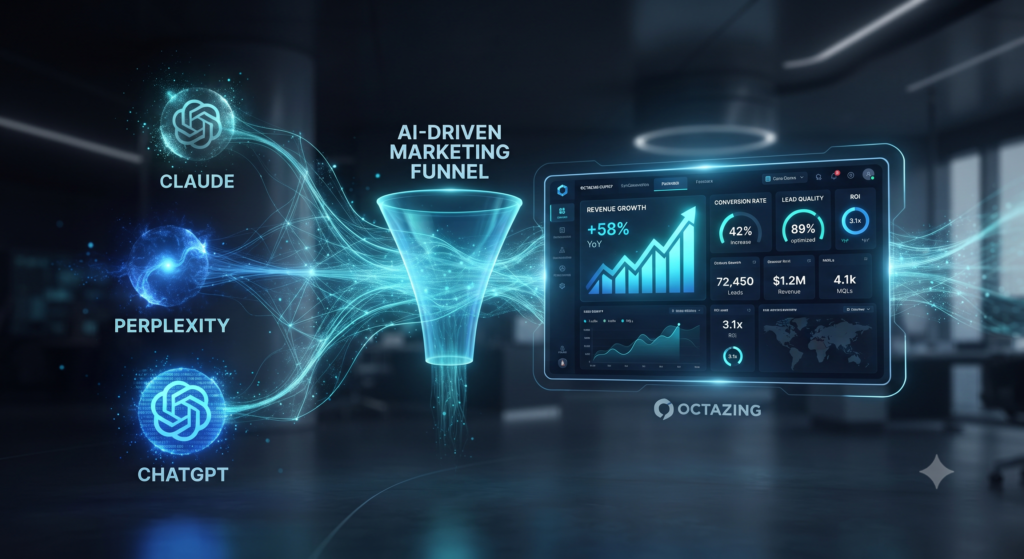
The way we search is changing. For years, the digital marketing funnel relied on Google as the primary gatekeeper of intent. Today, the rise of LLMs—Claude, Perplexity, and ChatGPT—has introduced a “black box” into the buyer’s journey.
If a prospective customer uses Perplexity to compare your software against a competitor, or asks ChatGPT for an expert recommendation, does your analytics platform register that touchpoint? For most businesses, the answer is a resounding “no.”
This represents a massive blind spot in modern marketing. As we move from a search-driven web to an AI-driven web, AI attribution has become the most critical frontier for performance marketers. If you aren’t tracking your influence within these models, you’re missing the data you need to scale your ROI.
What is AI Attribution and Why Does it Matter?
AI attribution is the process of identifying, tracking, and measuring the impact of Large Language Models (LLMs) on your customer acquisition journey. It moves beyond standard click-based tracking to understand how AI-generated content—whether it’s a summary in Perplexity, a chatbot recommendation in ChatGPT, or a code-snippet generation in Claude—influences a user’s decision to convert.
The Death of the “Last-Click” Attribution Model
The traditional marketing funnel assumes a linear path: Impression → Click → Landing Page → Conversion. In the AI era, this is obsolete. Users now consume “zero-click” content. They get their answers directly inside the LLM interface. By the time they reach your website, they aren’t searching for a solution; they are looking to validate a recommendation they already received.
If you can’t attribute that conversion to the AI interaction, you are flying blind.
Learn how Octazing bridges the gap between traditional and modern attribution
The Big Three: Tracking Claude, Perplexity, and ChatGPT
Each platform operates differently, requiring a tiered approach to tracking and attribution.
1. Tracking Perplexity: The New Search Engine
Perplexity is the most direct successor to traditional search engines. It provides citations and links, making it the easiest of the three to track.
- How to track: Perplexity’s citations behave similarly to organic search. You can monitor traffic from
perplexity.aiin your Google Analytics or Adobe Analytics dashboard. - The Pro Move: Implement custom UTM parameters on the links within your thought-leadership content. When Perplexity crawls your content and cites your site, ensure the outbound link includes tracking that marks the source as “AI-Search.”
2. Tracking ChatGPT: The Influencer Problem
OpenAI’s ChatGPT is a closed environment. It doesn’t always provide links, and it acts as an “expert advisor” rather than a search engine.
- How to track: You cannot rely on direct traffic referrals. Instead, use Brand Lift and Referral Surveys. Ask users in your checkout flow or lead forms: “How did you first hear about us?” and include “AI/ChatGPT” as an option.
- The Pro Move: Optimize for “Model Presence.” Ensure your brand is well-represented in the training data (or RAG sources) so that when a user asks for a solution in your niche, your brand is the one being recommended.
3. Tracking Claude: The Productivity Engine
Claude is heavily used for document analysis and technical problem solving. If a developer uses Claude to refactor code or write a project requirement document based on your documentation, that is a high-intent touchpoint.
- How to track: Focus on Documentation Analytics. If Claude directs users to your API docs or whitepapers, use unique, gated landing pages for these technical resources. If you see a spike in traffic to these pages without a corresponding spike in organic search, you are likely seeing the “Claude Effect.”
Strategies to Master AI Attribution
To build a robust attribution framework, you need to combine technical tracking with psychological insights.
Leverage Synthetic Data Modeling
Since AI platforms often strip referrer data, use Media Mix Modeling (MMM). By correlating spikes in AI-related brand searches with changes in your overall conversion rate, you can statistically infer the impact of AI referrals.
Optimize for “LLM-SEO”
If you aren’t being cited, you can’t be tracked. Ensure your content is:
- High-Value & Data-Rich: AI models prioritize original data, statistics, and expert insights.
- Structured for RAG: Use clear H2/H3 headings and concise, answer-first formatting.
- Authoritative: Models look for domain authority. Consistent publication of high-quality content helps you become the “source of truth” for the AI.
The ROI of AI Attribution
Companies that master AI attribution gain a significant competitive advantage. You will know exactly which platforms are driving your most qualified leads.
| Metric | Traditional SEO | AI-Driven Attribution |
|---|---|---|
| Visibility | Keyword-based | Intent-based |
| Attribution | Direct Referrals | Model-influenced / Sentiment |
| Optimization | Link building | Knowledge-base authority |
According to Gartner, by 2026, traditional search volume is expected to drop by 25% as users pivot to AI-powered search. The companies that survive will be the ones who treat AI platforms as a primary acquisition channel.
Ready to Master the Future of Attribution?
AI attribution is not a set-it-and-forget-it task. It requires an evolving strategy that balances technical data collection with human-centered brand awareness. At Octazing, we help brands navigate the shift from search-first to AI-first marketing.
Frequently Asked Questions
Q: Can I use Google Analytics for AI attribution?
A: You can track Perplexity traffic, but ChatGPT and Claude remain elusive. You must supplement GA4 with CRM-based surveys and Media Mix Modeling.
Q: Is “AI-SEO” different from “Traditional SEO”?
A: Yes. Traditional SEO focuses on ranking in SERPs. AI-SEO focuses on becoming the primary data source for LLMs to cite when answering user queries.
Q: How does Octazing help with this?
A: We provide full-funnel auditing, AI-content optimization, and data-modeling services designed to capture and measure traffic that standard tools miss.