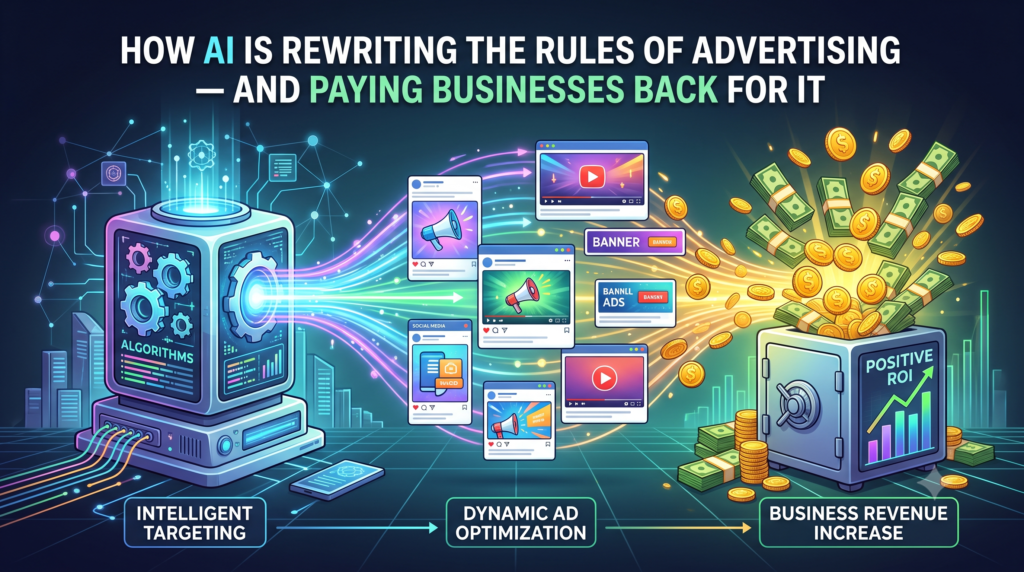
A decade ago, running a profitable ad campaign meant hiring a media buyer, guessing at audience segments, and waiting weeks to know if the money was well spent. Today, an AI system can build the audience, write the copy, design the creative, set the bid, watch the results in real time, and reallocate budget before a human even opens the dashboard. That shift — from marketing as craft to marketing as a continuously optimizing system — is the real story behind the AI advertising boom, and it’s showing up in the numbers, not just the hype.
This post walks through how AI advertising platforms actually work, which industries are seeing the biggest returns, what the current generation of tools (from programmatic ad engines to conversational AI like ChatGPT and Claude) can and can’t do, and what a sensible ROI framework looks like if you’re deciding where to invest next.
Why AI Changed Advertising’s Economics, Not Just Its Workflow
Traditional advertising ran on batch cycles: plan a campaign, launch it, wait for results, then adjust. AI collapses that cycle into something closer to a live feedback loop. Machine learning models can test thousands of creative and audience combinations simultaneously, learn which ones convert, and shift spend toward winners within hours instead of weeks.
The market has followed the results. The global AI-in-advertising market was valued at roughly $16.3 billion in 2024 and is projected to grow to more than $107 billion by the early 2030s, expanding several times faster than digital ad spend as a whole. That’s not a niche upgrade — it’s a rebuild of the advertising stack from the ground up.
On the performance side, businesses using AI across their marketing functions report meaningfully higher returns than peers who don’t. Multiple 2026 industry surveys put AI-driven campaigns at roughly 20–30% higher ROI, 30%+ more conversions, and double-digit reductions in customer acquisition cost compared with traditional approaches. Some longer-horizon estimates for AI-driven marketing automation put three-year ROI as high as 5x the initial investment, though — as with any statistic this attractive — the real number depends heavily on how well the tool is implemented, not just which tool is chosen.
The Platforms Actually Running the Ads
It helps to separate AI advertising tools into three distinct categories, because they solve different problems and get lumped together far too often.
1. Automated bidding and campaign engines (the “autopilot” layer)
These are the platforms that actually buy and place ads, using AI to decide who sees what, when, and for how much.
- Google Ads — Performance Max and Smart Bidding: Google’s AI blends search, display, YouTube, Gmail, and Maps inventory into a single campaign type, automatically shifting budget toward the highest-converting channel combination.
- Meta Advantage+: Meta’s answer to the same problem — one system handles audience targeting, placement, and creative variation testing across Facebook and Instagram.
- Amazon Ads AI tools: Amazon’s AI-powered ad placements have shown notably higher returns and click-through rates than manually configured campaigns, largely because the system has direct access to real purchase-intent data.
- TikTok Smart+ and LinkedIn’s predictive audiences: Similar automated bidding logic, tuned for short-form video engagement and B2B decision-maker targeting respectively.
- Programmatic DSPs (The Trade Desk, DV360, Criteo): These handle AI-driven real-time bidding across the open web, useful for brands that want reach beyond the walled gardens of Google and Meta.
Across this category, AI-managed bidding has been shown to cut wasted ad spend substantially while lifting return on ad spend — one recurring benchmark shows wasted spend dropping by roughly a third when bidding decisions are handed to the algorithm.
2. AI creative and content generation
A second layer of tools doesn’t buy media at all — it generates or optimizes the assets that go into the ads.
- Creative-generation platforms (like Omneky, AdCreative.ai, and similar tools) use AI to produce dozens or hundreds of ad variants — different images, headlines, and formats — then let the bidding engines above figure out which ones perform. Brands using this kind of AI creative generation report substantially higher click-through rates than manually designed ads, and in large-scale A/B tests, AI-generated variants beat human-designed ones a clear majority of the time.
- Personalization and recommendation engines dynamically swap creative based on the individual viewer — this is the technology behind “the ad that seems to know what you were just looking at,” and it drives real lifts in both conversion rate and average order value.
3. Conversational AI as a strategy and creative partner
This is where tools like ChatGPT (OpenAI) and Claude (Anthropic) fit in — and it’s worth being precise about their role, because they are not ad-buying platforms in the way Google Ads or Meta Advantage+ are. Instead, they function as a layer above the media-buying systems:
- Drafting and iterating ad copy, headlines, and scripts across dozens of variations for human review
- Analyzing campaign data pulled from ad platforms and summarizing what’s working
- Building audience personas, messaging frameworks, and creative briefs
- Powering internal marketing agents that automate reporting, competitive research, and campaign QA
- Assisting with the underlying strategy — positioning, offer design, and testing plans — that determines whether the automated bidding layer even has good material to optimize
There is also a genuinely new frontier emerging: advertising placements inside AI assistants themselves. ChatGPT has begun testing sponsored product links within chat responses, and Google’s AI Mode and AI Overviews are surfacing product cards to hundreds of thousands of brands. Millions of people now discover products through conversations with AI assistants each month, and this channel is growing quickly — though it currently behaves more like brand-awareness advertising than direct-response performance marketing, and reliable ROI benchmarks for it are still being established.
The practical takeaway: generative AI tools like Claude and ChatGPT make businesses faster and sharper at the thinking behind a campaign — copy, strategy, analysis — while platforms like Google, Meta, and Amazon remain the systems that actually place and optimize the ads. The best-performing marketing teams in 2026 use both layers together rather than treating them as competitors.
Industry by Industry: Where AI Advertising Is Delivering Results
AI advertising isn’t a one-size-fits-all story — the value shows up differently depending on the business model.
E-commerce and retail Product-feed-driven AI campaigns (Performance Max, Amazon’s AI ads, Advantage+ Shopping) are the most mature use case in the entire category. Dynamic creative and recommendation engines here have produced some of the largest lifts in the data — recommendation-driven personalization has been linked to conversion increases well above 100% in some deployments, alongside sizable growth in average order value.
Retail and hospitality brands with loyalty data Companies with rich first-party purchase history (coffee chains, grocery, hotel loyalty programs) are using AI to personalize offers at the individual level, turning loyalty apps into always-on micro-targeted ad channels.
Financial services Banks, insurers, and fintechs use AI-driven audience modeling to balance two competing needs: precise targeting for products like credit cards or loans, and strict compliance around what can be shown to whom. AI’s predictive scoring is especially valuable here because acquisition costs in finance are high and small efficiency gains translate into large absolute savings.
Healthcare and wellness AI-personalized outreach — appointment reminders, targeted wellness content, insurance plan matching — is growing, but this is also the industry where privacy regulation constrains what targeting and data-matching AI systems are allowed to do, so adoption is more cautious than in retail.
B2B and SaaS LinkedIn’s AI-personalized creative has shown notably higher engagement than generic B2B ad creative, and predictive lead-scoring models are widely credited with shortening B2B sales cycles by helping ad spend focus on accounts closest to a buying decision.
Automotive Dealerships and manufacturers use AI bidding to manage highly localized, inventory-driven campaigns — matching ads to a specific vehicle sitting on a specific lot, updated automatically as stock changes.
Travel and hospitality Dynamic pricing and personalized itinerary ads (flights, hotels, experiences) benefit heavily from AI’s ability to respond to real-time demand and individual browsing signals.
Media, entertainment, and gaming Streaming services and mobile games rely on AI for creative testing at massive scale — hundreds of ad variants tested against small user cohorts before a winning combination gets full budget.
Small and local businesses This is arguably the most underrated shift: AI has taken campaign types that used to require a dedicated media buyer — smart bidding, automated audience discovery, AI-drafted ad copy — and made them accessible through self-serve dashboards, letting a single-location business run something close to enterprise-grade optimization.
A Practical ROI Framework
Given how much of this space is still evolving, the businesses seeing genuine returns tend to follow a similar discipline rather than simply “turning AI on.”
- Feed the algorithm good data first. AI bidding and personalization systems are only as good as the conversion data and creative assets they’re given. Garbage inputs produce confidently wrong optimization.
- Separate the media-buying AI from the content-generation AI. Use platform-native tools (Performance Max, Advantage+, DSPs) for spend allocation, and use conversational AI tools for the strategic and creative thinking that feeds those systems.
- Keep a human in the loop on brand voice and compliance, especially in regulated industries like finance and healthcare — automation failures in these categories are disproportionately expensive.
- Measure incrementality, not just attributed conversions. A meaningful share of marketers currently admit they can’t reliably track the ROI of their AI tools; the platforms will happily report improved metrics that don’t always reflect true incremental revenue.
- Expect a learning curve, not instant results. Automated bidding systems typically need a real volume of conversion data — often several weeks — before their optimization stabilizes.
The Honest Caveats
It’s worth resisting the temptation to treat every AI advertising statistic as gospel. Adoption is genuinely high — the large majority of marketers now use generative AI in at least one workflow — but consumer trust hasn’t kept pace: only a minority of consumers say they trust brands to use AI responsibly, and comfort with AI-personalized advertising has actually declined year over year in some surveys. Attribution is also getting harder, not easier, as AI-driven discovery (inside search, inside chat assistants, inside recommendation feeds) blurs the line between where a customer first learned about a product and where they finally converted.
None of that erases the upside. It does mean the businesses winning with AI advertising right now are the ones pairing the technology with real measurement discipline — not the ones assuming the algorithm will handle everything on its own.
The Bottom Line
AI advertising has moved from experimental to foundational faster than almost any other marketing technology shift in the last twenty years. The winning approach isn’t picking one platform — it’s building a stack: automated bidding engines like Google’s and Meta’s AI systems to place and optimize spend, creative-generation tools to keep a pipeline of fresh assets flowing, and conversational AI like Claude or ChatGPT to sharpen the strategy, copy, and analysis behind all of it. Businesses that combine these layers thoughtfully — and keep measuring honestly — are the ones consistently showing up in the ROI numbers above.