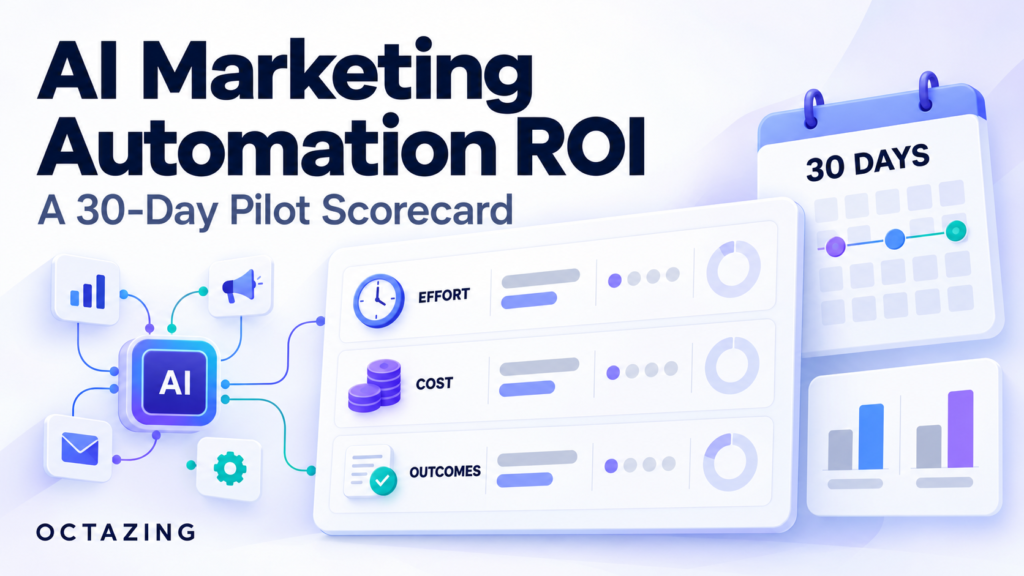
Measure AI marketing automation ROI by comparing the value of successful work with the complete cost of producing it. Include human review, corrections, maintenance, and setup effort. Keep reclaimed team capacity separate from cash savings and keep pipeline estimates separate from realised revenue.
Choose one workflow using the agentic marketing automation guide, then agree on the scorecard before building.
Measure the current process
Observe how long the team spends on comparable tasks, including rework and exception handling. Define what counts as successful completion. For reporting, that could be a reviewed report with reconciled figures. For a lead workflow, it could be an accurate record with an accountable owner.
A lead workflow audit helps identify missing steps in the baseline. Counting only the time spent copying fields can omit the time spent correcting the resulting record.
Track all pilot costs
- One-time workflow design, implementation, and initial testing.
- Recurring subscriptions, hosting, model usage, and integration costs.
- Human review and correction effort.
- Maintenance, monitoring, and incident recovery.
Measure actual model and tool usage per successful outcome. Include unsuccessful runs in the cost total. If review time is already included in the new process’s labour estimate, do not add it again.
Separate the kinds of value
| Value | How to assess it |
|---|---|
| Reclaimed capacity | Time no longer required for the process and how it is redeployed |
| Cash savings | Expenses that actually decrease |
| Quality improvement | Fewer verified errors or more complete handoffs |
| Pipeline impact | Observed downstream outcomes with attribution limits stated |
Saving salaried staff time does not automatically reduce payroll. It may create capacity for better analysis or follow-up. Track that operational value without describing it as cash already saved.
Work through an illustrative example
The following numbers are hypothetical. They show the calculation method and are not Octazing client results or a forecast for your business.
| Input | Illustrative amount |
|---|---|
| Existing process effort per month | 30 hours |
| New process effort including review and corrections | 10 hours |
| Reclaimed capacity | 20 hours |
| Assigned value per hour | INR 1,000 |
| Estimated capacity value | INR 20,000 |
| Software and hosting | INR 4,000 |
| Model and integration usage | INR 2,000 |
| Maintenance separate from the 10 hours above | INR 3,000 |
| Total recurring cost | INR 9,000 |
| Estimated monthly net value | INR 11,000 |
With one-time setup of INR 30,000, simple payback would be approximately 2.7 months if the estimated net value continues and the reclaimed capacity is worth the assigned rate. Including setup, the first month’s estimated net value would be negative INR 19,000.
These are capacity-value estimates. A cash payback claim needs evidence that expenses decrease or incremental cash contribution is realised.
Use a consistent 30-day pilot
- Days 1–7: map the process, measure the baseline, and define quality requirements.
- Days 8–14: run proposals in shadow mode and review disagreements.
- Days 15–21: operate a small pilot with the required human gates.
- Days 22–30: reconcile outcomes, effort, costs, and unresolved cases.
Compare similar task volumes and case types. A lighter week of simple enquiries should not be attributed entirely to automation. For longer sales cycles, a 30-day pilot may establish workflow performance while revenue outcomes remain unresolved.
Decide whether to expand
Expand only when quality requirements are met, the exception workload is manageable, and the complete operating cost is justified. If the workflow saves little time, investigate whether the bottleneck moved into review or whether the task was already efficient.
Use the AI workflow testing checklist as the quality gate. The reporting workflow offers an example where completion and review effort can be measured clearly.
Frequently asked questions
Should we include more leads as an ROI benefit?
Include verified incremental outcomes with a clear comparison method. Avoid assuming that every lead entering an automated workflow was created by it.
What if the pilot has too little volume?
Report the limitation and extend observation if needed. A small sample may support an operational finding without supporting a reliable revenue estimate.
Evaluate one workflow before expanding your AI budget. Request a review from Octazing with your current process effort, task volume, and the outcome you want to improve.