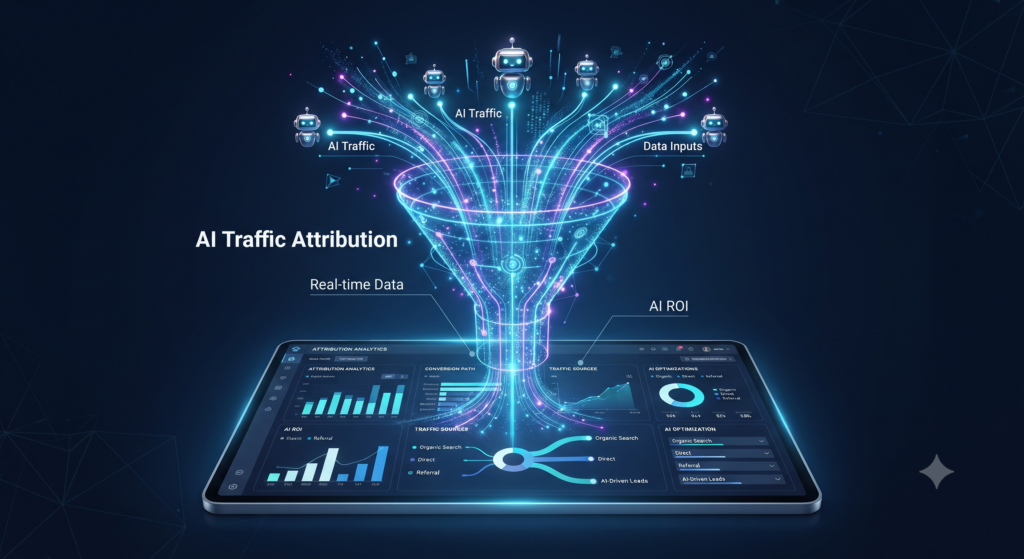
The search landscape is undergoing its most significant shift since the birth of Google. As users migrate from traditional search engines to AI-powered platforms like ChatGPT, Claude, and Perplexity, the “Dark Social” problem has evolved into a new challenge: The AI Attribution Gap.
For digital marketers and SEO professionals, the core question has shifted: If a user discovers your brand through a conversation with an LLM, how do you track that AI traffic?
In this guide, we will break down the complexities of AI attribution, the current state of referral data, and actionable strategies to ensure your traffic isn’t disappearing into a black hole.
The AI Attribution Crisis: Why Is It So Hard?
Traditional web analytics tools, such as Google Analytics 4 (GA4), rely on HTTP referrers. When a user clicks a link from a website, the browser sends a “Referrer” header, telling the destination site where the visitor came from.
AI platforms function differently. When ChatGPT or Claude provides an answer, the link is often rendered in a way that strips referrer data or treats it as “Direct” traffic. Because these interactions happen inside a walled garden, standard attribution models are failing to capture the full customer journey.
- The “Direct” Traffic Inflation: Much of your “Direct” traffic today is actually organic AI discovery.
- Lack of standardized headers: Unlike Google Search, which passes search query data, AI chatbots are under no obligation to pass clear referrer strings.
- The Growth of SGE/AI Overviews: As Google incorporates AI Overviews, the line between “Search Traffic” and “AI Traffic” blurs even further.
How to Track AI Traffic: Proven Strategies
While there isn’t a single “plug-and-play” button in GA4, there are sophisticated workarounds to bridge the gap. Here is how you can begin to quantify your AI-driven growth.
1. Implement UTM Parameters Strategically
The most reliable way to track traffic is to control the link. While you cannot control how ChatGPT links to your site, you can control how you promote your own content within AI-generated assets or documentation.
Action: If you are using AI tools to create newsletters, social posts, or press releases, ensure every single link includes UTM parameters (e.g., utm_source=chatgpt&utm_medium=referral).
2. Leverage “Direct” Traffic Analysis
Since most AI traffic currently falls under the “Direct” category in GA4, you need to look for anomalies.
- The Landing Page Test: If you see a sudden spike in “Direct” traffic to a specific, high-intent educational page, investigate the timestamps.
- Segment by User Behavior: Analyze user journeys that start on landing pages and show high engagement. If these users show patterns similar to organic search but lack a search referrer, it’s a strong indicator of AI-driven traffic.
3. Use Server-Side Tracking
Client-side tracking is easily blocked or stripped by privacy-focused AI wrappers. By moving to Server-Side Tagging, you gain more control over the data payload before it reaches your analytics platform.
Need professional help implementing these changes? Advanced Analytics & Tracking Solutions
Understanding the AI Ecosystem: Who Drives Traffic?
Not all AI platforms behave the same way. Understanding the nuances of each is vital for accurate reporting.
- ChatGPT (OpenAI): Its “Browse with Bing” feature is effectively a proxy for a search engine. When it surfaces a link, it may appear as a standard referral, but often, the transition occurs through a redirect that masks the origin.
- Perplexity AI: This is the most transparent platform. It often includes clear citations. Tip: Monitor your referral reports specifically for
perplexity.ai. - Claude (Anthropic): Claude is currently more “closed” and prioritizes privacy, making traffic difficult to capture. Tracking here requires a heavy reliance on “Brand Lift” studies.
The Role of Brand Authority in AI Rankings
If you cannot track the traffic directly, you must track the influence. AI models act as sophisticated recommendation engines. If your brand is mentioned repeatedly in high-authority contexts, the AI is more likely to cite you as a source.
Optimization Strategies for AI Discovery:
- Focus on Entity SEO: Ensure your brand is clearly defined in Schema markup.
- Conversational Content: Use H2/H3 headings as “questions” and follow them with concise, data-driven answers.
- Third-Party Validation: Get your brand mentioned on sites like G2, Capterra, or authoritative industry blogs.
Check out our SEO Auditing Services at Octazing to optimize your site for AI discovery.
Advanced Attribution: Bridging the Gap
To truly master AI attribution, you need to move beyond standard web analytics:
- Customer Surveys: Add a simple “How did you hear about us?” question in your lead-capture forms.
- Synthetic Monitoring: Use tools to track how often your brand is mentioned by various LLMs.
- Octazing’s Custom Attribution Models: We help clients build proprietary tracking layers that identify “hidden” traffic sources by cross-referencing server logs.
Are you ready to stop guessing where your traffic comes from?
At Octazing, we specialize in cutting-edge analytics and SEO strategies that adapt to the changing search landscape. Let’s help you decode your traffic and dominate the AI search era.