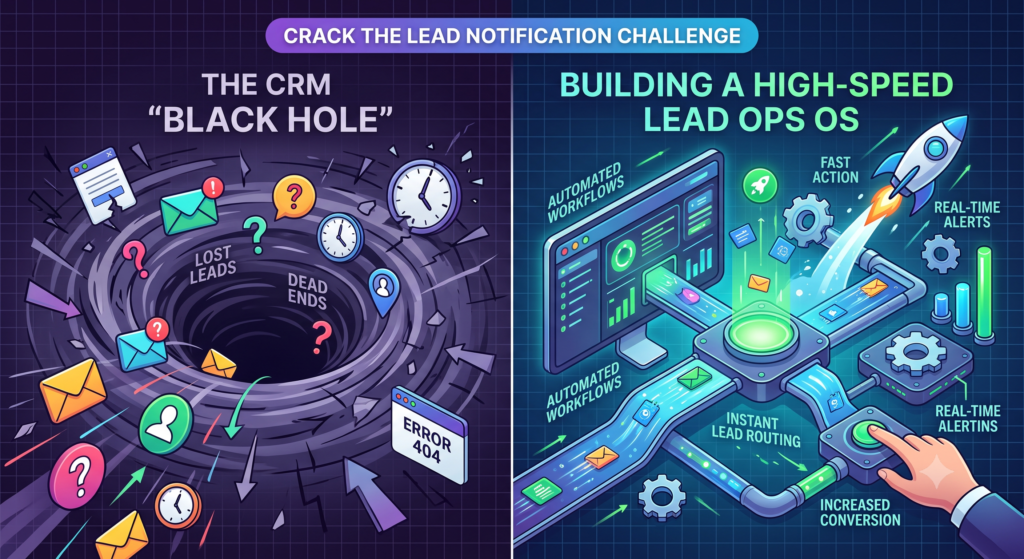
In the high-stakes world of B2B SaaS, the most expensive asset you own is a high-intent lead. You’ve spent months on content strategy, thousands on targeted LinkedIn ads, and weeks perfecting your landing page copy. But the moment a prospect clicks “Submit” on your demo request form, they enter a perilous zone known as the “Black Hole.” In many organizations, that lead is instantly swallowed by a CRM notification system that is, at best, a delayed email buried under a mountain of internal noise. By the time a sales development representative (SDR) notices the alert, ninety minutes have passed. In the digital economy, ninety minutes is an eternity.
Research consistently shows that the odds of connecting with a lead drop by over 10x if you wait longer than five minutes to respond. Yet, standard CRM notifications are notoriously unreliable. They are often throttled by sync cycles, limited to basic email alerts, or lacks the necessary context for a rep to take immediate action. To survive and thrive, modern revenue teams are moving away from native CRM alerts and toward a robust Lead Ops OS. By leveraging n8n lead orchestration, organizations can build high-speed, multi-channel notification systems that trigger in real-time, ensuring that B2B response speed remains under the critical 120-second threshold.
The Structural Failure of Standard CRM Notifications
The primary issue with relying on a CRM like Salesforce or HubSpot for lead alerts is that these platforms were built as systems of record, not systems of action. Their internal notification engines are often secondary features. When a lead is captured, it frequently undergoes a series of internal sync processes before a notification is ever dispatched. If your tech stack relies on a bridge between a marketing automation platform and a CRM, you are likely facing “sync latency”—a delay that can range from two to fifteen minutes.
Furthermore, email is where productivity goes to die. An SDR’s inbox is a chaotic environment filled with internal updates, calendar invites, and automated reports. When a high-priority lead notification arrives as just another line item in an Outlook or Gmail window, it is easily overlooked. This lack of urgency is the “Black Hole” in action. Without a specialized Lead Ops OS to pull these leads out of the standard flow and into a high-visibility channel, your Speed-to-Lead will inevitably suffer.
The standard CRM alert also lacks data fidelity. A typical notification might tell a rep that “John Doe from Acme Corp” filled out a form, but it fails to mention that Acme Corp just raised a Series C or that John Doe spent thirty minutes on your pricing page. Without this context, the rep has to spend five minutes researching the lead before they even pick up the phone—adding more delay to the response time.
Defining the Lead Ops OS with n8n
To solve the latency and visibility problem, growth leaders are turning to n8n lead orchestration. Unlike rigid, pre-built integrations, n8n functions as a flexible middleware—a “Lead Ops OS”—that connects your entire MarTech stack through a visual, logic-based interface. n8n allows you to intercept lead data at the source (the form submission) and process it instantly, rather than waiting for it to trickle through the CRM’s internal logic.
A Lead Ops OS built on n8n acts as the central brain of your revenue operations. It doesn’t just pass data from point A to point B; it orchestrates a complex sequence of events. It can trigger a server-side attribution call to identify the original marketing source, query a third-party data provider like Apollo or Clearbit for firmographic enrichment, and apply a proprietary lead score—all in less than a second. This ensures that the notification sent to the sales team isn’t just fast; it’s loaded with actionable intelligence.
By moving your lead processing to a dedicated orchestration layer, you gain total control over the flow of information. You are no longer at the mercy of your CRM’s API limitations or sync schedules. You can build custom logic that routes leads based on territory, intent, or current SDR availability, creating a truly responsive environment that prioritizes B2B response speed above all else.
The Technical Blueprint for Multi-Channel Notifications
Building a high-speed notification system requires a shift toward multi-channel notifications. While email is a passive medium, platforms like Slack or SMS are active. They command attention. Through n8n lead orchestration, you can design a workflow that utilizes these channels based on the quality of the lead.
The workflow begins with a webhook. Instead of waiting for a CRM sync, your web form sends data directly to an n8n webhook URL the millisecond the user hits “Submit.” Once the data is in n8n, the “orchestration” begins. The system checks the lead’s email domain against your current customer list and open opportunities. If the lead is from a high-value account, the Lead Ops OS can trigger an immediate SMS alert to the assigned Account Executive. For mid-tier leads, it might post a formatted message into a dedicated “Sales-Huddle” Slack channel.
These Slack alerts are far more effective than emails because they can be interactive. Using n8n, you can include “Claim Lead” buttons directly in the Slack message. When a rep clicks the button, n8n updates the CRM record to assign the lead to that rep and posts a confirmation back to Slack, preventing two reps from calling the same person. This level of MarTech orchestration turns lead response into a collaborative, high-velocity team sport rather than a solitary, sluggish task.
Real-Time Lead Scoring: Filtering for High-Fidelity Action
Not every lead deserves a 120-second response. In fact, sending an SMS to a rep for every “student” or “competitor” who downloads a whitepaper will quickly lead to notification fatigue. This is where real-time lead scoring becomes an essential component of your Lead Ops OS.
As the lead data flows through n8n, you can implement conditional logic to filter and prioritize. For example, if the lead’s company size is greater than 500 employees and they visited the “Request a Quote” page, they are flagged as “Priority A.” If they have a Gmail address and no LinkedIn profile can be found, they are routed to a standard email nurture sequence without bothering the sales team.
This automated filtering ensures that your high-value reps are only interrupted for leads that have a high probability of conversion. By combining this scoring with closed-loop measurement, you can also see which lead sources are producing the fastest-responding opportunities. This creates a feedback loop where marketing can optimize for lead quality while operations optimizes for speed. The result is a system where data fidelity is high, and every alert sent is worth the rep’s immediate attention.
Achieving the 120-Second Response Goal
Why is the 120-second mark so important? In modern B2B buying, the prospect is often researching multiple solutions simultaneously. The company that calls first doesn’t just get the first conversation; they often set the agenda for the entire evaluation process. By achieving ultra-fast Speed-to-Lead, you demonstrate a level of operational excellence and commitment to customer service that immediately differentiates you from the competition.
Using n8n lead orchestration makes this speed possible by eliminating the “human research” phase. When the notification hits Slack or SMS within 30 seconds of the form fill, it should contain everything the rep needs: the person’s title, their recent website activity, their company’s tech stack, and the original ad campaign they clicked on. Because n8n can pull this from your server-side attribution data and enrichment tools instantly, the rep can pick up the phone with confidence just 60 seconds after the lead was created.
This “Speed-to-Lead” isn’t just about being fast; it’s about being relevant. When a prospect is still on your website, your brand is at the top of their mind. Calling them while they are still thinking about your solution creates a seamless transition from “marketing lead” to “sales conversation.” This is the pinnacle of B2B response speed, and it is only achievable through a dedicated Lead Ops OS.
The Role of Server-Side Attribution in Lead Orchestration
To truly optimize a Lead Ops OS, you must understand where your best leads are coming from. This is where server-side attribution plays a critical role. Traditional browser-based tracking is increasingly unreliable due to ad blockers and privacy changes. By moving your attribution logic to the server side and integrating it into your n8n workflows, you ensure that every lead notification is tagged with accurate source data.
This conversion API integration allows you to pass high-fidelity data back to your ad platforms (like Google or Meta) while simultaneously informing your sales team of the lead’s journey. When an SDR knows that a lead came from a specific “Bottom of Funnel” search term, they can tailor their opening pitch accordingly. This level of MarTech orchestration ensures that the “Black Hole” is replaced by a transparent, data-driven pipeline where every touchpoint is measured and every high-intent signal is acted upon instantly.
FAQ
What is n8n lead orchestration?
n8n lead orchestration is the process of using the n8n automation platform to connect various marketing and sales tools. It acts as a middleware that captures lead data, enriches it with third-party information, scores it, and routes it to the appropriate sales channels (like Slack or SMS) in real-time, bypassing the delays of traditional CRM systems.
How does a Lead Ops OS improve Speed-to-Lead?
A Lead Ops OS improves Speed-to-Lead by removing manual steps and system latency. Instead of waiting for a CRM to sync or a rep to check their email, the OS triggers alerts instantly through high-visibility channels. It also provides the rep with all the necessary context (enrichment data) so they can respond immediately without doing manual research.
Why is 120 seconds the target for B2B response speed?
While the industry standard was once five minutes, the “120-second” goal is emerging as the new benchmark for top-tier revenue teams. At this speed, you catch the prospect while they are still engaged with your brand on your website, significantly increasing the chances of a successful connection and a booked meeting.
Can I use n8n with my existing CRM?
Yes, n8n has robust integrations with major CRMs like Salesforce, HubSpot, and Pipedrive. It doesn’t replace your CRM; it sits “on top” of it to handle the high-speed logic and multi-channel notifications that CRMs are often too slow or too rigid to manage effectively.
What are multi-channel notifications?
Multi-channel notifications refer to sending lead alerts across various platforms beyond just email. This typically includes Slack or Microsoft Teams messages for general visibility and SMS or phone alerts for high-priority, “ready-to-buy” leads that require an instant response.
Conclusion
The “Black Hole” of CRM lead notifications is a silent killer of B2B growth. When high-intent leads are met with silence or delayed responses, conversion rates plummet and marketing spend is wasted. By building a Lead Ops OS powered by n8n lead orchestration, you can reclaim those lost opportunities. This architecture allows you to transcend the limitations of standard CRM alerts, delivering multi-channel notifications enriched with high-fidelity data in under 120 seconds.
At Octazing, we specialize in helping high-growth revenue teams build the infrastructure necessary for this level of performance. From server-side attribution and conversion API setups to complex MarTech orchestration, we ensure your data flows smoothly and your sales team never misses a beat. If you are ready to eliminate the black hole and turn your lead response into a competitive advantage, it is time to rethink your orchestration strategy. Reach out to Octazing today to learn how we can help you build a Lead Ops OS that scales with your ambition.