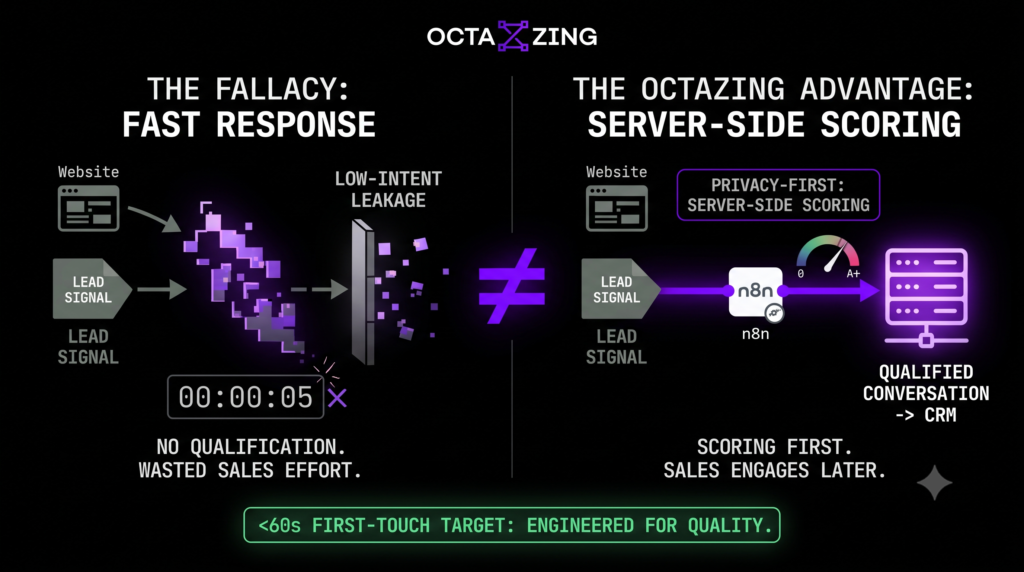
The clock is ticking. For years, the B2B gospel has preached a singular commandment: you must respond to a lead within five minutes. The logic is simple—the faster you strike, the higher the conversion rate. Every MarTech stack is now optimized for this frantic race. Slack channels roar with notifications, SDRs drop their lunches to place calls, and automated sequences trigger before the user has even closed the browser tab. Yet, despite hitting these aggressive “speed-to-lead” benchmarks, revenue teams are still struggling with low-quality pipeline and burnt-out sales reps.
This is the speed-to-lead fallacy. In the rush to be first, companies have sacrificed the most critical component of the revenue engine: lead quality. When you optimize for speed without context, you are essentially asking your sales team to sprint toward every fire alarm, regardless of whether it is a massive structural blaze or just a piece of burnt toast. To fix this, high-growth companies are moving away from reactive notifications and toward a more robust architecture. By implementing a Lead Ops OS that leverages server-side attribution and sophisticated n8n workflow systems, Lead Ops can finally prioritize high-intent “hand-raisers” over low-value window shoppers before a single notification ever hits an SDR’s screen.
The 5-Minute Myth: Why Speed Isn’t a Strategy
The obsession with B2B response speed began with legitimate data. Studies showed that the odds of qualifying a lead drop by 4x after just ten minutes. However, in the modern landscape, the volume of noise has increased exponentially. Not every form fill is a buyer. In a world of “free tools,” gated whitepapers, and bot traffic, a blind pursuit of speed leads to “The SDR Treadmill”—a state where your most expensive human resources are spending 80% of their day chasing leads that will never close.
When you optimize purely for time, you treat a CEO of a Fortune 500 company the same as a college student researching a thesis. Both triggered the “speed” threshold, but only one has the potential to impact the bottom line. Without a layer of intelligence that filters and scores these leads in real-time, your speed is actually a liability. It creates a “boy who cried wolf” scenario where SDRs stop trusting their notifications because they are so frequently irrelevant. To break this cycle, we need to rethink how data enters our ecosystem, moving from the flaky world of browser cookies to the reliable infrastructure of server-side data.
The Technical Gap: Why Client-Side Data Fails Lead Ops
For a long time, B2B companies relied on client-side attribution. A user visits your site, a cookie is placed in their browser, and when they fill out a form, that cookie data is passed to your CRM. But this system is crumbling. Ad-blockers, privacy regulations like GDPR, and the “death of the third-party cookie” mean that the data arriving in your CRM is often incomplete or entirely missing. If your routing logic depends on this “leaky” data, your lead routing automation is essentially flying blind.
This is where server-side attribution changes the game. Unlike client-side tracking, which happens in the user’s volatile browser environment, server-side tracking happens on your own server. This ensures a much higher level of data fidelity. When a lead submits a form, your server captures the information and queries your internal databases and enrichment tools directly. You aren’t hoping a browser script fires correctly; you are creating a direct, reliable pipeline of truth.
By shifting to a server-side model, Lead Ops can capture the full journey of a lead—what they searched for, which ads they clicked, and how many times they visited the pricing page—and tie it to the lead record with 100% accuracy. This isn’t just about better tracking; it’s about providing the necessary context for your Lead Ops OS to make an informed decision on whether that lead deserves a 5-minute response or a 24-hour nurture sequence.
Building the Lead Ops OS: The Future of Revenue Operations
A Lead Ops OS is not a single piece of software; it is a framework of MarTech orchestration that acts as the central nervous system of your revenue engine. Most companies have a fragmented stack where the CRM, the marketing automation platform (MAP), and the enrichment tools talk to each other through brittle, native integrations. These integrations are often “black boxes” that offer little control over the logic of how data flows.
In a Lead Ops OS, you take control of that logic. You create a middle layer—an orchestration layer—that intercepts data the moment it is captured. This layer is responsible for three things:
- Validation: Is this a real person with a real email address?
- Enrichment: Who do they work for, what is their revenue, and what is their tech stack?
- Attribution: Where did they come from, and what is their intent level?
By the time a lead reaches your CRM, it is already enriched and scored. The “OS” has already decided the routing path. This removes the “guesswork” from the sales process and ensures that your lead routing automation is based on hard data rather than just the time of day.
Orchestrating Intent with n8n Workflow Systems
To build this Lead Ops OS, you need a tool that is flexible enough to handle complex logic but powerful enough to process data at scale. This is why n8n workflow systems have become the preferred choice for sophisticated Lead Ops teams. Unlike basic automation tools, n8n allows you to build “branching logic” that can handle the nuances of B2B buying cycles.
Imagine a workflow where a lead enters via a demo request form. Instead of a direct “Post to Slack” action, n8n initiates a multi-step process. First, it sends the email to a conversion API to verify its validity. Second, it pulls server-side attribution data to see if this lead has visited the “Enterprise Pricing” page three times in the last 48 hours. Third, it pings an enrichment service like Clearbit or Apollo to check the company’s employee count.
If the lead is from a target account with high-intent behavior, n8n triggers an “Instant Alert” in Slack and assigns it to an Account Executive. If the lead is from a small business just looking for a free trial, n8n routes them to a self-serve onboarding sequence. This is MarTech orchestration in its purest form—using data to dictate the speed of the human response, rather than letting the stopwatch dictate the strategy.
Achieving Closed-Loop Measurement and Data Fidelity
One of the biggest advantages of integrating server-side attribution into your n8n workflows is the ability to achieve closed-loop measurement. In a typical setup, marketing sees a “conversion” when a form is filled. But they often don’t see what happens next. Did that lead turn into an Opportunity? Did it result in a Closed-Won deal?
With a server-side approach, you can send “offline” conversion data back to your ad platforms (like Google or LinkedIn) via their respective Conversion APIs. When a lead moves from “Qualified” to “Closed-Won” in your CRM, n8n can automatically trigger a signal back to the ad platform, telling it exactly which campaign produced a high-value customer. This creates a feedback loop that trains the ad platform’s algorithms to find more buyers, not just more “form-fillers.”
This level of data fidelity is impossible with standard client-side tracking. By ensuring the data is clean, enriched, and accurately attributed at the server level, you stop the “garbage in, garbage out” cycle that plagues most CRM systems. Your reporting becomes a source of truth rather than a collection of best guesses.
Prioritizing the “Hand-Raisers” Over Window Shoppers
Not all leads are created equal, and treating them as such is an insult to your sales team’s time. By using your Lead Ops OS to filter leads through a server-side intent filter, you can identify “hand-raisers”—those individuals who are actively showing signs of a readiness to buy.
High-intent signals might include:
- Searching for “Competitor A vs. Your Product”
- Downloading a security whitepaper (indicating deep funnel research)
- Multiple visits to the “Talk to Sales” page without a conversion (captured via server-side logs)
When these signals are combined, the n8n workflow can elevate these leads to a “Priority 1” status. These are the leads where the 5-minute response time actually matters. Conversely, for “window shoppers”—those looking for free educational content—the “speed” can actually be a deterrent. A frantic call from an SDR two minutes after someone downloads a basic eBook can feel invasive and desperate. By slowing down for the low-intent leads and accelerating for the high-intent ones, you create a better experience for the prospect and a more efficient workflow for the rep.
FAQ: Understanding the Lead Ops OS and Server-Side Attribution
What is the main difference between client-side and server-side attribution?
Client-side attribution relies on the user’s browser to track actions via cookies and scripts. This is often blocked by browsers or lost if a user clears their cache. Server-side attribution happens on the web server, making it invisible to ad-blockers and much more reliable for capturing the full customer journey.
Why use n8n for lead routing instead of just using my CRM’s native tools?
While CRMs have basic routing, they lack the ability to easily integrate multiple third-party APIs, perform complex data transformations, or handle advanced logic across different platforms. n8n workflow systems offer an open, flexible environment where you can build custom logic that connects your entire MarTech stack without being locked into a single ecosystem.
Does “speed-to-lead” still matter in B2B?
Yes, but only for qualified leads. Responding quickly to a high-intent buyer is a competitive advantage. Responding quickly to a bot or an unqualified lead is a waste of time. The goal is “Smart Speed”—prioritizing response time based on the value and intent of the lead.
How does server-side attribution improve my ad spend?
By using a conversion API to send accurate, down-funnel data (like “Sales Qualified Lead” or “Contract Signed”) back to ad platforms, the platforms can optimize their targeting. Instead of spending money on people who just fill out forms, the algorithms learn to target people who actually generate revenue.
What is a Lead Ops OS?
A Lead Ops OS is a centralized system (usually built with an orchestration tool like n8n) that manages the flow, enrichment, scoring, and routing of leads. It ensures that data is consistent across all platforms and that sales teams only interact with leads that meet specific quality thresholds.
Conclusion
The era of blind speed is over. In a saturated market, the companies that win are not the ones who respond the fastest to every ping, but the ones who respond the most intelligently to the right opportunities. By moving away from the “Speed-to-Lead” fallacy and embracing a Lead Ops OS powered by server-side attribution, you empower your revenue team to work with precision.
Integrating n8n workflow systems into your strategy allows for a level of MarTech orchestration that turns raw data into actionable intelligence. You gain data fidelity, achieve closed-loop measurement, and—most importantly—you give your sales team the gift of time, allowing them to focus on the high-intent hand-raisers who are actually ready to buy.
Stop racing against the clock and start building an architecture that works for you. At Octazing, we help B2B organizations build the infrastructure required to scale without the noise. Ready to transform your lead operations from a frantic race into a precision engine?
Optimize your revenue engine with Octazing. Let’s build your Lead Ops OS together.