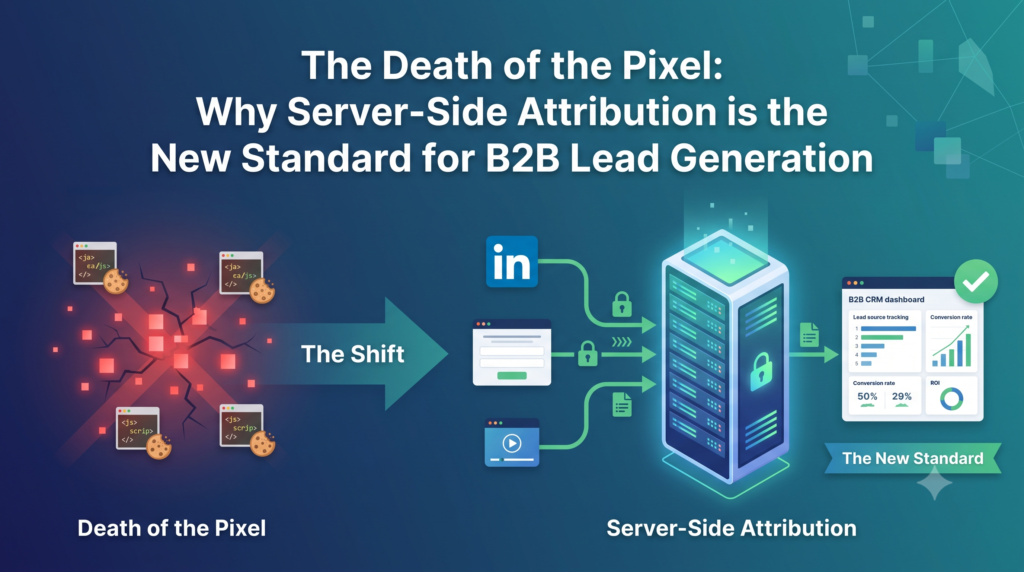
For years, the B2B marketing world has relied on a fragile piece of code: the client-side tracking pixel. It was the “easy button” for digital marketers. You dropped a snippet of JavaScript from Google or Meta into your header, and like magic, your dashboard lit up with conversion data. But the era of the reliable browser pixel is over. Between the rise of ad blockers, Apple’s Intelligent Tracking Prevention (ITP), and the broader shift toward user privacy, client-side tracking has become a sieve, leaking critical data that B2B teams need to survive.
For high-ticket B2B companies, the stakes are higher than a simple missed e-commerce transaction. When your sales cycle lasts six months and your average contract value is in the six or seven figures, losing visibility into which campaign generated a “Closed-Won” deal isn’t just an inconvenience—it’s a catastrophic failure of your MarTech stack. This is where server-side lead attribution enters the fray, moving the point of data collection from the volatile environment of the user’s browser to the controlled environment of your own server.
The Erosion of Client-Side Tracking and the B2B Blind Spot
The fundamental problem with traditional tracking is its reliance on the “client”—the user’s web browser. Browsers are no longer neutral parties; they are actively working against third-party scripts. Safari and Firefox already block most third-party cookies by default, and Chrome is progressively tightening the noose. When a prospect clicks an ad, visits your landing page, and fills out a form, there is a high probability that the tracking pixel never even fires.
In a B2B context, this creates a massive blind spot. Unlike B2C, where the click and the purchase often happen in the same session, B2B leads are nurtured over time. If the initial tracking signal is lost because of a browser restriction, the entire thread of attribution is severed. You might see a “form fill” in your CRM, but your ad platforms see nothing. This leads to a vicious cycle: your ad algorithms optimize for cheap, low-quality clicks because they can’t see the high-value conversions happening further down the funnel.
Furthermore, client-side pixels are notoriously susceptible to “signal noise.” Slow page loads, script interference, and heavy “Thank You” pages can all prevent a pixel from firing before the user closes the tab. For a Lead Ops team, this lack of data fidelity makes it impossible to report on true ROI. You are left guessing which channels are driving revenue and which are simply burning budget.
Why B2B Needs Server-to-Server (S2S) Events
If the browser is no longer a reliable narrator, we must look to the source of truth: the server. In a server-side lead attribution model, the communication happens directly between your server (or CRM) and the ad platform’s server. This is commonly referred to as Server-to-Server (S2S) tracking.
For B2B teams, the primary advantage of S2S is the ability to track the “untrackable.” Most of the critical milestones in a B2B buyer’s journey happen far away from the website. A lead becomes a Sales Qualified Lead (SQL) in HubSpot; a discovery call is logged in Salesforce; a contract is signed in DocuSign. A client-side pixel cannot see these events.
By implementing an S2S architecture, you can send “offline” events back to your ad platforms. When a deal stage changes in your CRM, your server sends a signal to Google or Meta saying, “The user with this specific hashed email just moved to the ‘Negotiation’ stage.” This creates a closed-loop measurement system that bridges the gap between a superficial web visit and actual revenue. Without this bridge, you are optimizing your marketing spend based on top-of-funnel volume rather than bottom-of-funnel value.
Bridging the Gap with Conversion API (CAPI)
The most prominent manifestation of server-side tracking today is the Conversion API (CAPI), pioneered by Meta but now adopted in various forms by Google (Enhanced Conversions), LinkedIn (Conversions API), and others. CAPI allows you to share key web and offline events directly from your server.
The beauty of CAPI for B2B lead generation lies in its resilience. Because the data is sent server-side, it bypasses browser-based ad blockers and ITP restrictions. But more importantly, it allows for much more sophisticated lead lifecycle mapping. You can choose exactly which data points to send and when.
For example, instead of just sending a “Lead” event when someone downloads a whitepaper, you can wait until that lead has been vetted by your SDR team. Once the lead is marked as “Qualified” in your internal systems, the Conversion API (CAPI) triggers an event. This tells the ad platform’s algorithm: “Find more people like this person, not just people who download free PDFs.” This level of precision is only possible when you move beyond the limitations of the browser.
Building a Robust First-Party Data Strategy
The shift to server-side tracking is not just a technical fix; it is a strategic pivot toward a first-party data strategy. In a world without third-party cookies, your own data is your most valuable asset. Server-side attribution forces you to take ownership of that data.
When you collect data on your own server, you have full control over how it is cleaned, hashed, and transmitted. This improves your “match rate”—the ability of an ad platform to link a conversion back to a specific user. Client-side pixels often struggle with match rates because they rely on fragmented cookie data. Server-side systems, however, can leverage durable identifiers like hashed email addresses, phone numbers, and Lead IDs.
A strong first-party data strategy also addresses the growing concerns around data privacy and compliance. By centralizing your data flow through a server-side container (like Google Tag Manager Server-Side), you can strip out sensitive PII (Personally Identifiable Information) before it ever reaches a third-party vendor. You become the gatekeeper of your prospects’ data, ensuring that you are compliant with GDPR, CCPA, and other evolving regulations while still maintaining high data fidelity.
Mastering Lead Lifecycle Mapping
To truly unlock the power of server-side tracking, B2B organizations must master lead lifecycle mapping. This is the process of defining every stage of the funnel and determining which of those stages should be fed back into your attribution system.
In a typical high-ticket B2B environment, the stages might include:
- Initial Inquiry: The first form fill.
- Marketing Qualified Lead (MQL): Meets demographic criteria.
- Sales Qualified Lead (SQL): Handed off to the sales team.
- Opportunity Created: A dollar value is attached to the lead.
- Closed-Won: The deal is signed.
With offline conversion imports, you can upload data from these later stages back into your advertising platforms. This allows you to move from “Cost Per Lead” (CPL) bidding to “Cost Per Opportunity” or even “Return on Ad Spend” (ROAS) bidding. Imagine being able to tell Google Ads to prioritize the keywords that resulted in actual signed contracts six months ago. That is the ultimate goal of MarTech orchestration: aligning your technical infrastructure with your business outcomes.
The Role of MarTech Orchestration in Data Fidelity
Success in server-side attribution requires more than just a single API connection; it requires deliberate MarTech orchestration. Your website, your CRM, your CDP (Customer Data Platform), and your advertising accounts must all speak the same language.
Many B2B companies suffer from “data silos,” where the marketing team sees one set of numbers and the sales team sees another. A server-side approach forces these silos to break down. You need a unified way to track a user from their first anonymous touchpoint through to their final conversion. This often involves capturing a unique “Click ID” (like GCLID for Google or FBCLID for Meta) at the moment of the form fill and storing it in your CRM.
When that lead eventually converts, your server uses that ID to tell the ad platform exactly which click led to the revenue. This level of data fidelity ensures that your reporting is grounded in reality. No more “double counting” conversions or losing track of leads as they move through different platforms. You are creating a single, verifiable thread of truth.
FAQ: Server-Side Lead Attribution
How is server-side attribution different from a regular pixel?
A regular (client-side) pixel runs in the user’s browser. It can be blocked by ad blockers or deleted by browser privacy settings. Server-side attribution happens on your server, sending data directly to the ad platform, making it much more reliable and harder to block.
Does server-side tracking replace Google Tag Manager?
Not necessarily. Many teams use “Google Tag Manager Server-Side.” You still use GTM to manage your tags, but instead of the tags firing in the browser, the browser sends one “stream” of data to your server-side container, which then distributes it to your various vendors.
Is it difficult to set up offline conversion imports?
The technical setup requires some coordination between your CRM and your ad accounts. However, most modern CRMs like Salesforce and HubSpot have native or third-party integrations that simplify the process of sending stage-change data back to Google and Meta.
Will this help improve my Lead Quality?
Yes. By feeding “Closed-Won” or “Qualified” data back into ad platforms via Conversion API (CAPI), the platforms’ AI can better understand who your ideal customers are. Over time, the algorithms will stop chasing cheap clicks and start finding prospects who resemble your actual buyers.
Is server-side tracking compliant with privacy laws?
Generally, yes—and often more so than client-side tracking. Because you control the server, you can redact or hash sensitive information before it is sent to third parties, giving you greater control over data privacy than a standard pixel allows.
Conclusion
The shift toward server-side lead attribution is no longer a luxury for the most advanced tech companies; it is a necessity for any B2B organization that wants to remain competitive in a privacy-first world. Relying on client-side pixels in an era of ITP and ad blockers is like trying to fill a bucket with a massive hole in the bottom. You are losing the very data you need to make informed decisions and optimize your growth.
By embracing a first-party data strategy and utilizing tools like Conversion API (CAPI) and offline conversion imports, you can finally bridge the gap between “form fill” and “closed-won.” You move from guessing to knowing, and from basic lead generation to sophisticated revenue orchestration.
Ready to fix your attribution and close the loop on your B2B lead data? Contact Octazing today to learn how we can help you implement a robust server-side tracking infrastructure that turns your CRM data into a competitive advantage.