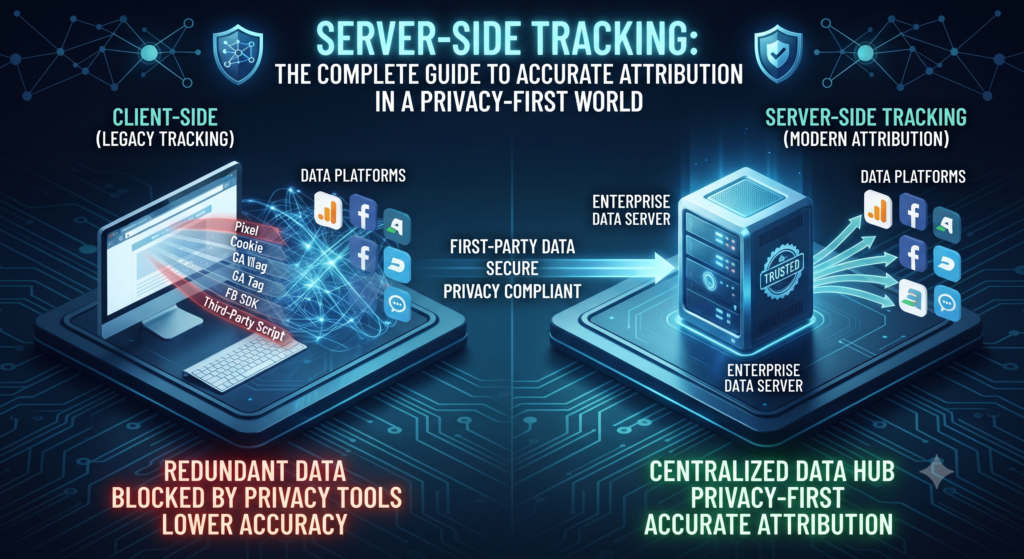
In 2026, the old rules of digital measurement no longer apply. Browser-based pixels that once delivered reliable conversion data now routinely miss 25–40% of real outcomes. Ad blockers, Intelligent Tracking Prevention, consent frameworks, and mobile privacy restrictions have turned traditional client-side tracking into an incomplete picture. The result is distorted ROAS figures, under-optimized campaigns, and marketing teams flying partially blind.
Server-side tracking has emerged as the practical solution. By moving event capture and transmission from the user’s browser to infrastructure you control, businesses recover lost conversions, improve match quality with ad platforms, and regain ownership over their measurement data. This is not a minor technical upgrade. It is a fundamental shift in how modern growth teams collect, process, and act on conversion signals.
This guide explores server-side tracking in depth: what it is, why it matters, how the major architectures work, implementation patterns for different business models, common pitfalls, and the practices that separate average setups from high-performing ones. Whether you run e-commerce, lead generation, or B2B SaaS, the principles remain consistent. The goal is reliable, privacy-conscious data that actually reflects reality.
What Server-Side Tracking Actually Means
Client-side tracking relies on JavaScript running in the visitor’s browser. When a user completes a purchase or submits a form, a pixel or tag fires and sends data directly to Google, Meta, TikTok, or analytics platforms. The browser is both the sensor and the messenger. Any interference—ad blockers, cookie restrictions, network failures, or the user closing the tab—can drop the event.
Server-side tracking changes the flow. The browser may still send a lightweight first-party request or the backend may record the event independently. Your server then becomes the central processor. It validates the event, enriches it with first-party data (order value, hashed email, lead score, CRM stage), applies consent rules, and forwards the payload to advertising and analytics destinations via their official APIs.
The key distinction is control and reliability. Because the final transmission happens server-to-server, it cannot be blocked by browser extensions or privacy features that target third-party scripts. Confirmed business events—payment success, lead creation, subscription activation—become the source of truth rather than fragile browser signals.
This does not mean cookies disappear entirely. Many implementations still use first-party cookies or identifiers for session continuity. What changes is that the critical conversion signal no longer depends on the browser successfully executing third-party code.
Why Client-Side Tracking Is No Longer Enough
Several forces have eroded the reliability of pure browser-based measurement.
Ad blockers are widespread. Industry estimates place adoption above 30% on desktop in many markets. Popular blockers maintain lists that specifically target tracking domains. When those domains are blocked, the pixel never fires.
Safari’s Intelligent Tracking Prevention and similar features in Firefox and other browsers limit the lifespan of cookies, especially those set via JavaScript. Attribution windows that once stretched weeks now collapse to days or hours for a significant portion of traffic.
iOS App Tracking Transparency requires explicit user permission for cross-app tracking. Many users decline. The result is reduced signal for campaigns running on Meta and other platforms that previously relied on device-level identifiers.
Consent banners and privacy regulations add another layer. Even when users accept analytics, they may reject advertising cookies. Client-side tags often struggle to respect granular consent in real time across every destination.
Network and timing issues compound the problem. A user who completes checkout and immediately closes the browser may leave before pixels finish loading. On slower connections or single-page applications, race conditions are common.
Collectively, these factors create a systematic undercount. Marketing platforms report fewer conversions than the business actually records. Bidding algorithms receive incomplete feedback. Attribution models assign credit based on partial journeys. Decision-making suffers.
Server-side tracking does not solve every measurement challenge, but it directly addresses the largest and most consistent sources of data loss for confirmed outcomes.
How Server-Side Tracking Works: Core Architecture
A modern server-side setup typically follows this sequence:
- A user interacts with the site or completes a key action.
- Relevant context (click IDs, UTM parameters, session identifiers, first-party cookies) is captured and associated with the user or session.
- When a conversion occurs, the backend records the definitive event—order confirmation, lead record creation, payment webhook success.
- The server constructs a payload containing the event name, timestamp, value, currency, product or lead details, and matching identifiers.
- Sensitive personal data is hashed (usually SHA-256) before transmission.
- The payload is sent via HTTPS to the destination platform’s conversion API or measurement endpoint.
- The platform attempts to match the event to prior ad interactions using the provided signals.
- Optionally, the same event stream is also written to a warehouse or analytics tool for independent analysis.
The most common implementation layer is a server-side tag manager, particularly Google Tag Manager’s server-side container. In this model, the browser sends a single first-party request to a subdomain you control (for example, metrics.yourdomain.com). The server container receives the data, runs validation and enrichment logic, and fans out the events to multiple destinations. This reduces the number of third-party scripts on the page while giving the marketing team a familiar interface for managing tags.
Direct API integrations are another path. Teams with engineering resources may call Meta’s Conversions API, Google’s Measurement Protocol or Enhanced Conversions, TikTok’s Events API, and others directly from their application backend or a dedicated worker. This approach offers maximum control but requires more ongoing maintenance as APIs evolve.
Hybrid implementations remain the practical standard. Client-side tags continue to capture rich behavioral signals that only exist in the browser (scroll depth, form interactions, video engagement). Server-side handles the high-value conversion events that must not be lost. Deduplication logic ensures the same outcome is not counted twice.
Key Techniques That Drive Accuracy
Several specific techniques separate effective server-side systems from basic ones.
Click ID persistence is foundational. When a user arrives from a paid ad, the platform appends a unique identifier (gclid for Google, fbclid for Meta, and equivalents for other networks). Capturing and storing these identifiers server-side—either in a first-party cookie set via HTTP headers or in a backend session or database—preserves the attribution link even if browser cookies are restricted or cleared. On conversion, the original click ID is included in the server payload so the platform can match the event deterministically.
Event ID deduplication prevents double counting in hybrid setups. A unique identifier is generated once for each conversion (often as a UUID). The same identifier is sent with both the browser pixel event and the server-side event. Platforms that support deduplication, such as Meta, use the combination of event name and event ID to recognize duplicates and count the conversion only once.
Data enrichment improves matching rates. Platforms match server events to users more effectively when multiple high-quality signals are provided. Hashed email and phone numbers, first-party cookie values (fbp/fbc for Meta), IP address, user agent, and external IDs all contribute. The richer and more consistent the user data, the higher the Event Match Quality score and the more reliable the attribution.
Consent-aware forwarding is non-negotiable in regulated markets. The server must receive and respect the user’s consent state. Events should only be sent to advertising platforms when the appropriate consent has been granted. Analytics destinations may operate under different rules depending on the legal basis. Centralizing this logic on the server makes compliance more consistent than scattering consent checks across dozens of client-side tags.
Retry and delivery monitoring add resilience. Network issues or temporary API errors can cause individual events to fail. Production-grade systems log delivery status, retry within platform-accepted windows, and alert when success rates drop. Some platforms retain events for matching for days or weeks, giving retries a meaningful chance of success.
CRM and order system stitching closes the loop for longer sales cycles. For lead generation and B2B, the initial form submission is only the beginning. Storing attribution context (source, medium, campaign, click IDs) with the lead record allows later revenue events to be attributed accurately when the deal closes. The same principle applies to e-commerce when offline or delayed revenue must be linked back to the original digital touchpoint.
Implementation Approaches by Business Type
E-commerce implementations usually center on the order confirmation event. Payment webhooks (Stripe, PayPal, Shopify, WooCommerce) provide the most reliable trigger. The server receives confirmation that payment succeeded, constructs the purchase event with line items, value, and currency, attaches stored click IDs and user identifiers, and sends it to the relevant platforms. Deduplication with any remaining browser events is essential. Mapping the platform’s order or transaction ID consistently across systems prevents fragmentation.
Lead generation and SaaS focus on form submissions and subsequent stage changes. The initial lead event is captured server-side as soon as the form is processed. Attribution parameters are stored with the lead. Later, when the lead progresses to opportunity or closed-won, additional events can be sent or offline conversions imported. This approach recovers the many leads that never complete a browser-based “thank you” page pixel because of blockers or rapid navigation.
Multi-channel and agency setups benefit from a centralized server container that can route events for multiple client domains or brands. White-label reporting and consistent naming conventions become important. Some teams use a single sGTM instance with client-specific variables and destinations; others maintain separate containers for isolation.
Regardless of model, the principle is the same: treat the backend record of the business outcome as authoritative, then feed that outcome to the platforms that need the signal for optimization and reporting.
Benefits Beyond Simple Data Recovery
Recovering lost conversions is the most visible benefit, but the advantages extend further.
Ad platforms receive higher-quality signals. Higher Event Match Quality and more complete conversion data improve the performance of automated bidding systems. Many advertisers observe meaningful improvements in reported CPA and ROAS after a well-implemented server-side layer stabilizes, not because actual business performance changed overnight, but because the algorithms finally see a fuller picture.
Attribution windows become more durable. First-party identifiers and server-set cookies often persist longer than their client-side counterparts, supporting multi-day or multi-week journeys that previously broke.
Privacy posture improves through centralization. Instead of every third-party tag independently collecting and transmitting data, the server becomes the control point. Unnecessary fields can be stripped, PII can be hashed consistently, and consent can be enforced uniformly.
Page performance benefits. Reducing the number of third-party scripts that load and execute in the browser improves Core Web Vitals and user experience. The server handles the heavier lifting after the critical path.
Independent analysis becomes possible. When events flow into a warehouse, teams can build transparent multi-touch models, reconcile platform-reported numbers against actual revenue, and diagnose discrepancies systematically rather than relying solely on platform black-box attribution.
Common Challenges and How to Address Them
Server-side tracking is more robust than pure client-side approaches, but it introduces its own complexities.
Deduplication failures are frequent early on. If event IDs are not consistently generated and passed, or if event names differ slightly between browser and server, platforms may count the same conversion twice or fail to match at all. Rigorous testing with platform debug tools is required.
Identifier capture gaps undermine matching. If click IDs are not stored reliably on first landing, later conversions arrive without the critical linking signal. Solutions include server-side capture on the initial request, first-party cookie strategies that respect ITP limits, and fallback to other matching parameters.
Consent and compliance misalignment can create legal risk or data loss. Sending events without proper consent is unacceptable. Overly aggressive filtering can discard valid consented data. The server logic must accurately reflect the consent framework in use (Consent Mode v2, custom CMP signals, etc.).
Infrastructure and cost require planning. Hosting a server container involves cloud compute, bandwidth, and monitoring. For most mid-sized businesses the cost is modest relative to the value of improved measurement, but high-traffic sites need capacity planning and cold-start mitigation (keeping minimum instances running).
Engineering and marketing collaboration is essential. Pure marketing-owned implementations can stall when backend changes are required. Clear ownership, shared event schemas, and documentation reduce friction.
Over-reliance on platform attribution remains a risk. Even with better data delivery, platform-reported numbers are still modeled and subject to their own attribution rules. Independent reconciliation against order and CRM systems is the only way to know the true picture.
Best Practices for Production-Grade Systems
Start with the highest-value conversion events rather than attempting to server-side everything at once. Purchase or qualified lead events deliver the largest immediate return.
Generate and propagate a single canonical event or transaction identifier across all systems.
Capture and persist click IDs and UTM parameters as early as possible in the user journey.
Hash all PII before it leaves your infrastructure.
Implement comprehensive logging and alerting around delivery success rates and volume anomalies.
Test thoroughly in platform debug environments before going live, then validate that production volumes align with backend records.
Document the event schema, identifier strategy, and consent rules so the system remains maintainable as the team changes.
Treat the warehouse or order system as the ultimate source of truth for revenue and pipeline, using platform data primarily for optimization feedback.
Review match quality metrics regularly and expand the set of matching parameters when scores lag.
Plan for retries and eventual consistency. Not every event will succeed on the first attempt.
The Role of Server-Side Tracking in a Broader Measurement Strategy
Server-side tracking is a powerful collection and delivery technique, not a complete attribution philosophy on its own. It improves the quality and completeness of the signals that reach ad platforms and analytics tools. Those signals still need thoughtful modeling, business context, and human judgment.
Complementary practices include:
- Clear definition of conversion events that map to actual business outcomes.
- Consistent naming and taxonomy across channels.
- Regular reconciliation between platform reports, analytics, and financial systems.
- Experimentation frameworks that account for measurement lag and residual bias.
- Investment in first-party data relationships that reduce dependence on any single identifier.
When these elements work together, measurement becomes a durable competitive advantage rather than a recurring source of uncertainty.
Looking Ahead
Privacy regulations and browser policies will continue to evolve. Third-party cookies are already largely gone in practice. New browser APIs and aggregate reporting mechanisms are emerging. Server-side architectures are well positioned for this environment because they reduce reliance on fragile client-side identifiers and give organizations direct control over data flows.
The organizations that treat measurement as a core systems problem—rather than a collection of disconnected tags—will maintain clearer visibility into performance. Server-side tracking is one of the most practical and high-leverage steps available today toward that clarity.
Accurate data does not guarantee better decisions, but incomplete data almost guarantees worse ones. In a landscape where 30% or more of conversions can vanish before they reach the platforms that need them, recovering that signal is no longer optional for serious growth teams.
Ready to Recover the Conversions You’re Currently Losing?
If your reported numbers consistently lag behind actual orders or pipeline, if match quality scores are mediocre, or if you suspect ad blockers and privacy features are quietly distorting your optimization loops, a properly implemented server-side layer can close a large part of the gap.
The difference between average and excellent implementation lies in the details: identifier strategy, deduplication discipline, consent handling, enrichment quality, and ongoing monitoring.
Whether you need an architecture review, a full implementation, or help diagnosing an existing setup that is underperforming, the next step is a clear-eyed assessment of your current measurement stack against the reality of your backend data.
Start the conversation today. Reach out to explore how a robust server-side tracking foundation can restore visibility, improve platform performance, and give your team measurement you can actually trust. The data you’re missing is already happening. The only question is whether you will capture it.