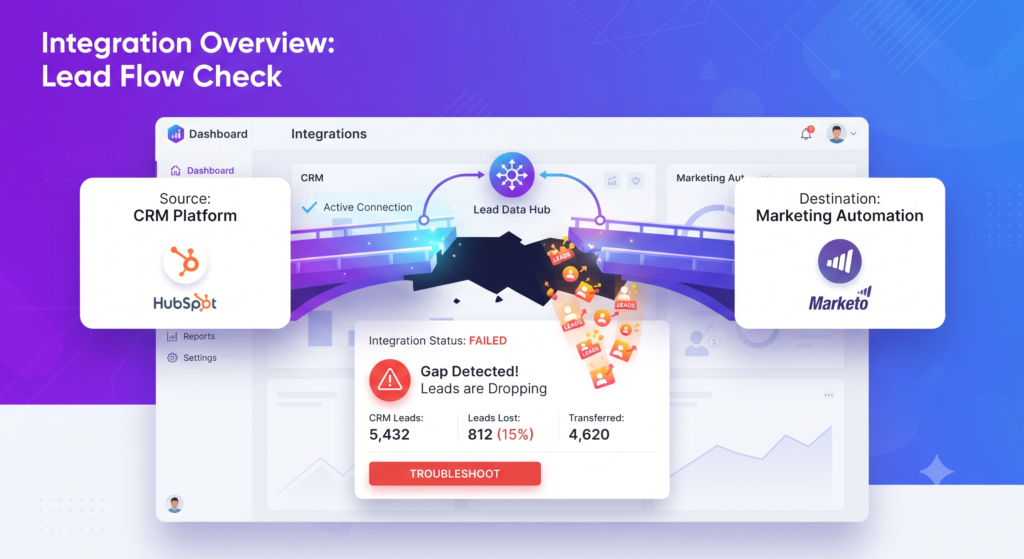
The lead just hit your website. They are high-intent, coming from a specific LinkedIn ad campaign you’ve been optimizing for months. They fill out the demo request form, their data hits your CRM, and a generic notification pops up in your sales team’s Slack channel. Five minutes pass. Then ten. Then an hour. By the time an Account Executive sees the notification amidst a sea of other “New Lead” alerts and internal chatter, the prospect has already booked a demo with a competitor who responded in ninety seconds.
This is the reality of lead leakage, and it is the silent killer of B2B growth. Most revenue leaders believe that because their CRM “integrates” with their communication tools, their lead flow is optimized. They trust the native “Post to Slack” checkbox in HubSpot or Salesforce, assuming it’s a bridge. In reality, it’s often a funnel with a massive hole in the bottom.
Standard CRM-to-Slack integrations are designed for basic connectivity, not for high-velocity MarTech orchestration. They lack the context, the routing logic, and the urgency required to convert modern B2B buyers. To stop the bleed, organizations must move away from simple notifications and toward a custom Lead-ops OS built on robust n8n workflow systems.
The Myth of the “Seamless” Native Integration
The word “native” carries a lot of weight in the SaaS world. It implies stability, ease of use, and a perfect handshake between two platforms. However, when it comes to the critical path between a lead submission and a sales conversation, native integrations are often the primary source of lead leakage.
The fundamental problem is that native integrations are built to be “one size fits all.” A CRM’s native Slack app typically triggers a message every time a record is created. It doesn’t account for the nuance of your business. It doesn’t know if the lead is a “whale” account or a student researching a paper. It doesn’t check if the assigned owner is currently active or if the lead has been sitting uncontacted for thirty minutes.
This lack of filtering creates “notification fatigue.” When your sales team receives a Slack alert for every single newsletter sign-up, ebook download, and contact form, they stop prioritizing the alerts. The high-intent demo requests—the leads that actually drive revenue—get buried under the noise of low-intent signals. This is where lead leakage thrives; not in the absence of information, but in the dilution of it.
Furthermore, native integrations often fail to provide the necessary data fidelity. They push a name and an email, but they rarely pull in the rich context needed for an effective first touch. Without knowing which specific product feature the prospect was looking at, or their recent engagement history, the sales rep is flying blind. This friction delays the B2B response speed, and in a market where the first responder wins 50% of the time, that delay is fatal.
Transitioning to a Lead-Ops OS
To solve these systemic failures, growth-stage companies are adopting what we call a Lead-ops OS. This isn’t just a single tool; it is a philosophy of revenue operations that treats the lead lifecycle as a managed process rather than a series of disconnected events.
A Lead-ops OS functions as the central nervous system of your revenue stack. Instead of letting the CRM dictate how information flows, you build an orchestration layer that sits on top of your stack. This layer is responsible for the heavy lifting: data enrichment, sophisticated routing, and ensuring that every piece of information is captured for closed-loop measurement.
The goal of a Lead-ops OS is to ensure that by the time a human sees a lead, that lead is qualified, enriched, and presented with a clear “next best action.” This moves the needle from “we have a lead” to “we have a high-value opportunity ready for immediate engagement.” By centralizing this logic outside of the rigid confines of a CRM, you gain the agility to adjust your strategy as your market changes.
Why n8n Workflow Systems are the Foundation of Modern Lead Ops
While there are many automation tools on the market, n8n workflow systems have emerged as the gold standard for building a custom Lead-ops OS. Unlike simpler “if-this-then-that” platforms, n8n offers the technical depth required for true MarTech orchestration.
The power of n8n lies in its ability to handle complex logic and deep API integrations. It allows you to build workflows that don’t just “move data,” but actually “process” it. For example, an n8n workflow can:
- Receive a webhook from a form builder.
- Query the CRM to see if the lead exists.
- Ping a third-party enrichment tool like Clearbit or Apollo to get the company’s head-count and tech stack.
- Check a Google Sheet or an internal database for the current SDR rotation.
- Send a highly formatted Slack message to the correct rep with “click-to-call” buttons and a summary of the lead’s intent.
This level of customization is impossible with native integrations. By using n8n workflow systems, you are no longer limited by what HubSpot or Salesforce thinks your notification should look like. You can build a system that fits your specific sales motion, ensuring that no lead is left behind and that lead leakage is virtually eliminated.
The Critical Role of B2B Response Speed
In the B2B world, time is the one variable you cannot afford to waste. Research consistently shows that responding to a lead within five minutes increases the likelihood of a successful qualification by over 10x compared to responding after thirty minutes. This is the “Speed to Lead” metric that every growth leader obsesses over, yet few actually master.
Lead leakage occurs when the gap between the lead’s “moment of intent” and the salesperson’s “moment of action” becomes too wide. Standard integrations contribute to this gap by providing poor-quality alerts that require the salesperson to do manual research before they can even reach out. They have to open the CRM, look at the lead history, find the LinkedIn profile, and then craft an email.
A custom Lead-ops OS accelerates B2B response speed by doing that research automatically. When the Slack alert contains the prospect’s LinkedIn URL, their company’s recent funding round, and the exact keywords they searched for to find your site, the rep can act instantly. The “speed” isn’t just about the notification arriving fast; it’s about the rep being able to act fast.
Solving Attribution Gaps with Server-Side Attribution
One of the most overlooked aspects of lead leakage is the loss of marketing data. When a lead moves from a browser to a CRM and then to a sales alert, critical attribution data often gets stripped away. This makes it impossible for marketing teams to know which campaigns are actually driving revenue, leading to a break in closed-loop measurement.
This is where server-side attribution becomes a critical component of your orchestration layer. Traditional client-side tracking is increasingly unreliable due to ad blockers, cookie restrictions, and privacy updates like iOS 14. If you rely solely on the browser to pass attribution data to your CRM, you are losing a significant percentage of your data.
By implementing server-side attribution within your n8n workflow systems, you can capture lead data directly at the server level. This ensures higher data fidelity because the information is sent from your server (or your lead-gen tool) directly to your attribution engine or CRM via a conversion API.
When your Lead-ops OS handles this, it ensures that every Slack notification isn’t just an alert for sales, but a data-rich event for marketing. You can see, in real-time, that a “Closed/Won” deal originated from a specific mid-funnel whitepaper. This creates a feedback loop where marketing knows exactly what to spend on, and sales gets the highest quality leads, effectively plugging the leak from both ends of the funnel.
Building the Orchestration Layer: From Theory to Practice
Implementing a Lead-ops OS requires a shift in how you view your tech stack. It requires moving away from “native-first” thinking and toward an “orchestration-first” mindset. You need a centralized hub where your business rules live.
The first step is mapping your “Ideal Lead Flow.” This means documenting every step a lead takes from the first click to the first discovery call. You must identify where the friction points are. Where does the data get lost? Where does the delay happen? Usually, the “leak” is found in the hand-off between the marketing automation platform and the CRM’s notification engine.
Once the flow is mapped, you build the logic in n8n. Instead of a linear path, you create a branched system. For example, if a lead is from a Fortune 500 company, the workflow might trigger an immediate SMS alert to a Senior AE and automatically create a personalized research brief. If the lead is from a smaller company, it might go into an automated nurturing sequence first.
This level of MarTech orchestration ensures that your human resources (your sales team) are only spent on the highest-value activities. It turns your lead-ops from a cost center into a competitive advantage.
The ROI of Plugging the Leak
The financial impact of reducing lead leakage is immense. If your current system has a 20% “leakage” rate—leads that are never contacted, contacted too late, or contacted without proper context—plugging that hole is equivalent to increasing your marketing budget by 20% without spending an extra dime on ads.
By improving B2B response speed and ensuring data fidelity through server-side attribution, you are optimizing the most expensive part of your funnel: the human interaction. A Lead-ops OS ensures that your reps are happier (because they have better data), your prospects are more impressed (because of the fast, relevant response), and your marketing team is more effective (because they have closed-loop measurement).
In the end, stopping lead leakage isn’t about buying more tools. It’s about building a better system. It’s about taking control of your data flow and ensuring that every high-intent prospect is met with a high-intent response.
FAQ
1. Why is a custom n8n workflow better than a native HubSpot-to-Slack integration?
Native integrations are often rigid and provide too much “noise” without enough context. n8n allows for custom logic, such as lead enrichment, conditional routing based on company size or intent, and time-based escalations (e.g., notifying a manager if a lead isn’t claimed in 10 minutes). This ensures sales reps only see high-priority alerts with all the context they need to act immediately.
2. What is “Lead leakage” exactly?
Lead leakage refers to the loss of potential revenue when high-intent prospects fall through the cracks of a sales process. This can happen due to slow response times, leads being assigned to the wrong reps, data being lost between systems, or notifications being ignored due to alert fatigue.
3. How does server-side attribution help sales teams?
While it sounds like a marketing term, server-side attribution improves data fidelity for sales. It ensures that the original source, campaign, and keyword data are accurately captured and passed into the CRM and Slack alerts. This gives the salesperson a clear picture of the prospect’s journey and intent before they ever pick up the phone.
4. Is n8n difficult to maintain compared to Zapier?
n8n is a professional-grade MarTech orchestration tool. While it has a slightly higher learning curve than Zapier, it offers significantly more power for complex workflows and is more cost-effective at scale. For organizations building a serious Lead-ops OS, the flexibility and data privacy of n8n make it the superior choice.
5. How does a Lead-ops OS improve closed-loop measurement?
A Lead-ops OS acts as the central hub for all lead data. By using a conversion API and orchestrated workflows, it ensures that every outcome (like an opportunity created or a deal closed) is mapped back to the original marketing touchpoint. This creates a perfect loop of data that allows for accurate ROI reporting.
Conclusion
Standard CRM integrations might be easy to set up, but they are often the root cause of lead leakage and missed revenue targets. By moving toward a custom Lead-ops OS powered by n8n workflow systems, B2B organizations can ensure high data fidelity, master server-side attribution, and achieve the B2B response speed necessary to win in today’s market. Don’t let your best prospects disappear into the noise of a generic Slack channel.
Ready to plug the leaks in your lead flow? Octazing specializes in building high-performance Lead-Ops OS and custom n8n orchestration layers that turn your MarTech stack into a revenue engine. Contact us today to audit your current integrations and start capturing every opportunity.