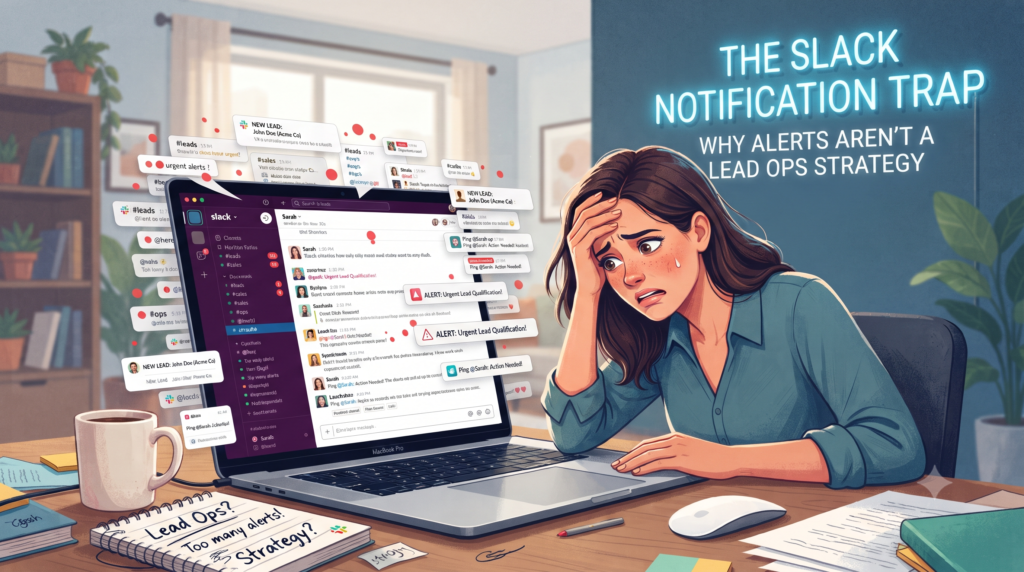
Every growth-focused B2B company has a “leads” channel in Slack. You know the one: a steady stream of notifications from HubSpot, Calendly, or Typeform, announcing that a new prospect has entered the funnel. To the untrained eye, this looks like progress. The sales team sees the notification, the marketing team feels a sense of accomplishment, and the revenue leaders assume the machinery is working.
But there is a dangerous fallacy hidden within that “ping.”
For most organizations, a Slack notification is the end of the technical workflow and the beginning of a manual, high-friction human process. We call this the Slack Notification Trap. It creates a false sense of security while simultaneously facilitating lead leakage and destroying your B2B response speed. In an era where buyers expect immediate gratification, relying on a human to see a message, log into a CRM, and draft a manual response is no longer a viable strategy. It is a recipe for missed opportunities.
At Octazing, we believe that true Lead Ops maturity requires moving from passive notifications that rely on human memory to first-touch automation. By leveraging n8n workflow systems, you can engage leads the millisecond they express interest, ensuring that your team is alerted not to start the process, but to continue a conversation that is already underway.
The Illusion of Speed: Why Passive Notifications Fail
The fundamental problem with Slack-based lead management is that notifications are passive. They inform, but they do not act. When a high-intent lead fills out your demo request form, the clock starts ticking. In the B2B world, the “speed to lead” isn’t just a metric; it is the primary predictor of conversion success.
When you rely on Slack alerts, your response time is tethered to human availability. If your SDR is in a meeting, at lunch, or simply focused on another task, that lead sits in a digital purgatory. This delay creates a vacuum that your competitors are more than happy to fill. This is where lead leakage occurs—prospects who were ready to talk today lose interest or find a faster alternative by tomorrow.
Furthermore, a Slack alert lacks the necessary context for immediate action. A notification might tell you that “John Doe from Acme Corp” filled out a form, but it doesn’t give you the full picture of server-side attribution. It doesn’t tell you which high-intent keyword brought them there, what their previous touchpoints were, or where they sit in the current market landscape. Without this data fidelity, the human responder is starting from zero, further slowing down the engagement process.
The Science of B2B Response Speed
Research has consistently shown that the odds of qualifying a lead drop by 10x if the first contact happens more than five minutes after the initial inquiry. In the B2B SaaS world, a 30-minute delay might as well be a 30-day delay. Modern buyers are often researching 3-4 solutions simultaneously; the company that provides the fastest, most relevant response often sets the tone for the entire sales cycle.
Relying on “human-first” outreach is inherently unscalable. Humans have “latency.” They have biases. They might prioritize a lead from a recognizable brand while ignoring a potentially massive “dark horse” account because the notification didn’t look impressive enough at a glance.
First-touch automation removes this latency. It ensures that the moment a form is submitted, a personalized, contextually relevant response is triggered. This isn’t about sending a generic “We’ll get back to you soon” email. It’s about using MarTech orchestration to deliver a “I saw you were looking at our enterprise pricing and wanted to share this specific case study regarding your industry” message within seconds. This level of responsiveness is only possible when you move beyond the Slack notification and into a fully integrated Lead Ops OS.
Enter the Lead Ops OS: Transitioning to First-Touch Automation
To escape the Slack Notification Trap, organizations need to view their lead flow as a technical system rather than a series of manual tasks. This is the core philosophy of a Lead Ops OS. In this model, the CRM is not just a database, but a hub for automated execution.
The transition begins with first-touch automation. Instead of the lead journey relying on manual handoffs, it should be structurally redesigned:
- Legacy Model: Lead → Slack Alert → Human Action
- Lead Ops OS: Lead → Automated Engagement + Enrichment → Slack Alert for Follow-up
When a lead enters the system, your n8n workflow systems should immediately trigger a series of events:
- Data Fidelity Check: The system verifies the email, enriches the lead with firmographic data, and checks for existing records in the CRM.
- Server-Side Attribution: The system pulls the original source data, ensuring that the conversion API captures the event for closed-loop measurement.
- Instant Engagement: An automated (but highly personalized) email or SMS is sent to the lead based on their specific behavior on the site.
- Strategic Alerting: Only after the initial engagement has occurred is the sales team alerted in Slack, now with a rich profile of the lead and the knowledge that the “first touch” has already been handled.
Why n8n Workflow Systems are the Engine of Modern Lead Ops
While tools like Zapier have their place, sophisticated B2B organizations are increasingly turning to n8n workflow systems for their MarTech orchestration. The reason is simple: complexity and control.
n8n allows for the kind of branching logic and data manipulation that a Lead Ops OS requires. For example, if a lead comes in from a Tier 1 account, you might want an n8n workflow to check your internal database for an existing account executive, find their latest LinkedIn post, and reference it in an automated email. This level of sophisticated first-touch automation is what separates market leaders from those stuck in the “alert trap.”
Moreover, n8n provides better visibility into the data flow. When you are dealing with server-side attribution and complex conversion API integrations, you cannot afford “black box” automation. You need to see exactly how data is being transformed as it moves from your website to your CRM and your marketing platforms. This ensures data fidelity and allows for the closed-loop measurement that marketing leaders need to justify their ad spend.
From Passive Alerts to Active Orchestration
The goal isn’t to delete Slack; the goal is to redefine its purpose. Slack should be your “command center,” not your “to-do list.”
In an active orchestration model, your Slack notifications should provide high-value insights that a human can actually use.
Instead of this passive alert:
“New Lead: Sarah Jenkins, Google”
The notification should read:
“First-touch completed for Sarah Jenkins (Google). She arrived via the ‘Attribution Software’ search campaign (Server-side verified). An automated intro was sent referencing her recent whitepaper download. Click here to view her LinkedIn profile and take over the conversation.”
This shift moves the salesperson from being a data entry clerk to being a strategic closer. It eliminates the anxiety of “missing a lead” because the system has already secured the perimeter. It solves the lead leakage problem by ensuring no prospect is ever left waiting.
FAQ
Is first-touch automation too impersonal for B2B?
Quite the opposite. When powered by n8n workflow systems and high-quality enrichment data, automated first touches can be more personalized than a rushed manual email. By using the data captured through server-side attribution, you can reference specific pages visited or keywords searched, making the outreach feel highly relevant and timely.
How does this affect our CRM data fidelity?
Automation actually improves data fidelity. Humans are prone to skipping fields or entering inconsistent data in the CRM. A Lead Ops OS ensures that every lead is cleaned, enriched, and logged with perfect consistency before a human ever touches the record.
Why do we need server-side attribution for this?
Standard browser-based tracking is increasingly unreliable due to ad blockers and privacy changes. Server-side attribution ensures that your first-touch automation is working with accurate data. It also allows you to feed cleaner data back into your conversion API, which optimizes your ad platforms for higher-quality lead generation.
Isn’t setting up n8n workflows complicated?
While n8n workflow systems offer more power than basic automation tools, they are designed to be the backbone of a professional Lead Ops OS. For most B2B companies, the initial investment in setting up these systems is quickly offset by the reduction in lead leakage and the increase in sales team productivity.
Does this replace the need for an SDR team?
No. It empowers them. First-touch automation handles the “speed” aspect of the funnel, while your SDRs handle the “substance.” By automating the initial outreach, your team can spend more time researching accounts and crafting high-level strategies for leads that have already been engaged.
The “ping” of a Slack notification should be the sound of a system working, not a desperate cry for human intervention. If your lead response strategy relies on someone seeing a message before a prospect gets an answer, you are leaving revenue on the table. Moving toward a Lead Ops OS built on first-touch automation and robust n8n workflow systems is the only way to ensure 100% lead coverage and maximum B2B response speed.
By prioritizing data fidelity and integrating server-side attribution into your automated flows, you aren’t just sending emails faster—you are building a more resilient, scalable revenue engine. It’s time to stop reacting to alerts and start orchestrating growth.
Stop letting leads slip through the cracks of your Slack channels. Contact Octazing today to audit your current lead flow and build a high-fidelity Lead Ops OS that turns notifications into measurable revenue.