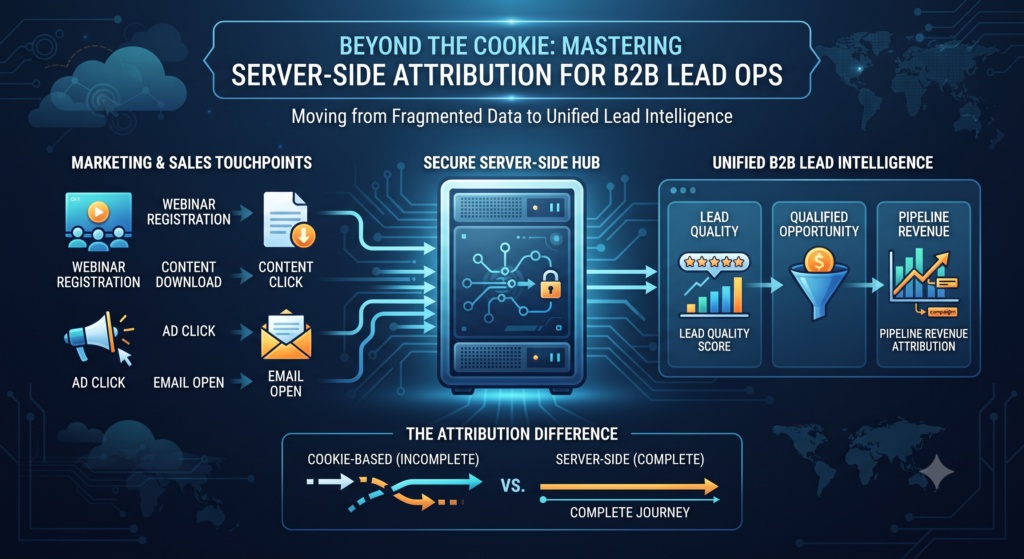
The landscape of B2B digital marketing is currently undergoing its most significant shift since the invention of the tracking pixel. For years, demand generation teams and Lead Ops professionals relied on a fragile ecosystem of third-party cookies and browser-side scripts to understand where their leads were coming from. However, that foundation has crumbled. With the implementation of Apple’s Intelligent Tracking Prevention (ITP), the rise of ad blockers, and the increasing stringency of global privacy regulations, the traditional “client-side” model of tracking is no longer sufficient. When 30% to 40% of your conversion data is blocked before it even reaches your CRM, your ability to calculate Marketing ROI becomes a guessing game.
To survive this shift, sophisticated B2B organizations are moving toward server-side attribution. By shifting the responsibility of data collection from the user’s browser to a secure, controlled server environment—often orchestrated through powerful tools like n8n—companies can recapture 100% visibility into their lead sources. This transition is not just about technical compliance; it is about establishing a robust first-party data strategy that ensures every marketing dollar spent is accurately accounted for, regardless of browser restrictions or tracking opt-outs.
The Crisis of Browser-Side Tracking in B2B
For a long time, the standard operating procedure for B2B tracking involved placing a “pixel” or a “tag” on a website. When a prospect visited a landing page and filled out a form, the browser would send a signal directly to platforms like Google Ads, Meta, or LinkedIn. This is known as client-side tracking. While simple to implement, it relies entirely on the browser’s willingness to execute that script and the user’s lack of ad-blocking software.
In the modern B2B environment, this reliance has become a liability. Prospects today are increasingly privacy-conscious, using browsers like Brave or Safari that aggressively block third-party tracking by default. Furthermore, IT-savvy B2B buyers often use corporate networks that filter out tracking scripts entirely. When a high-value lead from a Fortune 500 company interacts with your whitepaper but their browser blocks your LinkedIn Insight Tag, that lead enters your CRM as “Direct” or “Unknown.” This lack of data fidelity creates a massive blind spot for Lead Ops teams, leading to skewed reports and poorly informed budget allocations.
The result is a broken feedback loop. If your attribution system cannot “see” the source of your best leads, you cannot optimize your campaigns. You might find yourself scaling down the very channels that are driving your highest-quality pipeline simply because the browser-side pixels failed to report the conversion. Server-side attribution solves this by removing the browser from the equation, ensuring that the data flows directly from your infrastructure to your measurement tools.
What is Server-Side Attribution?
Server-side attribution is the process of collecting user interaction data on your own server and then sending that data directly to your marketing and analytics platforms via an API. Unlike client-side tracking, which happens in the “open air” of the user’s browser, server-side tracking happens behind the scenes. When a user interacts with your website, your server captures the relevant identifiers—such as IP address, click IDs (GCLID, FBCLID), and email addresses—and stores them as first-party data.
Once this data is captured, it is processed through what we call MarTech orchestration. A server-side environment (like n8n or a dedicated tagging server) acts as a traffic controller. It receives the data, cleans it, enriches it, and then transmits it to various destinations like your CRM, your data warehouse, and the Conversion API (CAPI) of your advertising platforms.
The primary keyword here, server-side attribution, represents a move toward total ownership of the data stream. By managing the data on your own server, you bypass the restrictions placed on browsers. You are no longer asking permission from Apple or Google to track a conversion; you are simply reporting a business event that happened on your own property. This ensures that even if a user is using an ad blocker, your server can still record the form submission and attribute it back to the original ad click using the identifiers stored in your first-party cookies.
Why B2B Lead Ops Needs a Server-Side Strategy
Lead Operations (Lead Ops) is the engine room of a B2B organization. Its job is to ensure that leads move seamlessly from marketing to sales with all the necessary context. In a client-side world, that context is often stripped away. Server-side attribution provides Lead Ops teams with several critical advantages that directly impact the bottom line.
First and foremost is the improvement in data fidelity. In B2B, sales cycles are long and involve multiple touchpoints. A prospect might click an ad on Tuesday, return via an organic search on Friday, and finally convert three weeks later after receiving an email. Browser-side cookies are often cleared or expire within 24 hours under modern privacy settings. Server-side tracking allows you to extend the life of your first-party data, maintaining a consistent ID for that user throughout their entire journey. This leads to much more accurate lead source tracking, allowing you to see the full path to conversion rather than just the final click.
Secondly, server-side attribution enables closed-loop measurement. Because the data is being handled on the server, you can merge website interaction data with backend CRM data before sending it back to your advertising platforms. For example, you don’t just want to tell Google Ads that a “form was filled.” You want to tell Google Ads that “this specific lead turned into a $50,000 Opportunity.” By using a Conversion API, you can send these down-funnel signals back to the ad platforms, allowing their algorithms to optimize for actual revenue rather than just cheap clicks.
Building the Infrastructure with n8n
At Octazing, we believe that n8n is the ultimate tool for B2B MarTech orchestration. Implementing server-side attribution doesn’t require a massive, expensive CDP (Customer Data Platform). Instead, you can build a custom, transparent, and highly flexible workflow that handles your attribution logic directly.
The process begins by setting up a first-party collector on your website. When a lead fills out a form, instead of the browser sending data to LinkedIn or Google, it sends a webhook to your n8n instance. This webhook contains all the “client-side” context that is still available, such as the URL parameters, the user agent, and the first-party cookie ID. Because this request is going to your own domain or a sub-domain you control, it is not blocked by standard ad-blocking lists.
Once n8n receives this data, the orchestration begins. The workflow can simultaneously:
1. Check your CRM (e.g., HubSpot or Salesforce) to see if the lead already exists.
2. Append the correct lead source tracking information based on the captured UTM parameters.
3. Format the data for the Facebook Conversion API or Google’s Enhanced Conversions.
4. Send a high-fidelity signal back to the ad platforms with hashed personal identifiers (like email) to ensure a high match rate.
This approach ensures that your tracking is “bulletproof.” Even if the user’s browser blocks the initial LinkedIn pixel, n8n ensures that LinkedIn still receives the conversion data through the server-to-server connection. This is the essence of modern Lead Ops: building resilient systems that prioritize data integrity.
Maximizing Marketing ROI through Precision
The ultimate goal of any attribution project is to improve Marketing ROI. When your attribution is broken, your ROI calculations are essentially fictional. You might see a “Cost Per Lead” (CPL) of $50 in your Google Ads dashboard, but in reality, if 30% of your leads aren’t being tracked, your real CPL might be $35. Conversely, you might be over-valuing channels that appear to be performing well on a last-click basis but are actually just capturing leads that were already in your funnel.
Server-side attribution allows for a more granular understanding of the customer journey. When you have 100% lead source visibility, you can begin to move away from simplistic attribution models and toward more complex, multi-touch models that reflect the reality of B2B buying committees. You can see how a specific LinkedIn campaign influenced a group of leads that eventually converted through a direct search, even if those sessions were weeks apart and on different devices.
Furthermore, by feeding high-quality data back into ad platforms via a Conversion API, you are training the AI models of those platforms to find more people like your best customers. In the era of “Automated Bidding” and “Performance Max” campaigns, the quality of the data you feed the machine is the only lever you have left to pull. If you feed the machine incomplete, browser-based data, the machine will produce mediocre results. If you feed it clean, server-side, first-party data, your ROI will inevitably climb.
Steps for a Successful Implementation
Transitioning to server-side attribution is a journey, not a one-time setup. To succeed, Lead Ops teams should follow a structured roadmap:
1. **Audit Current Data Loss:** Use your server logs to compare the number of form submissions in your database against the number of conversions reported in your ad platforms. The gap you see is your “tracking tax.”
2. **Establish First-Party Data Collection:** Ensure your website is capturing and storing UTM parameters and click IDs in first-party cookies that your server can access.
3. **Deploy an Orchestration Layer:** Set up n8n to act as the bridge between your website, your CRM, and your marketing APIs. This allows you to transform and clean data before it is sent to third parties.
4. **Activate Conversion APIs:** Move beyond the pixel. Start by sending “Lead” events via the Google and Meta Conversion APIs. Once that is stable, begin sending down-funnel “Qualified Lead” or “Opportunity” events.
5. **Monitor and Optimize:** Continuously check the “Match Quality” scores in your ad platforms. High match rates mean your server-side attribution is working correctly and the platforms can accurately link your data to their users.
By following these steps, you shift from a reactive posture—wondering why your data doesn’t match—to a proactive one where you own the entire data pipeline.
FAQ
**What is the difference between client-side and server-side attribution?**
Client-side attribution happens in the user’s browser using scripts (pixels). It is easy to block and prone to data loss. Server-side attribution happens on your own server. It sends data directly to marketing platforms via API, making it invisible to ad blockers and more resilient to privacy restrictions.
**Does server-side tracking bypass GDPR or CCPA?**
No. Server-side tracking is a method of data transport, not a way to avoid consent. You must still obtain user consent for tracking. However, server-side tracking gives you *more* control over what data is shared, allowing you to redact sensitive PII (Personally Identifiable Information) before it ever leaves your server, which actually improves your privacy posture.
**Do I need to replace my existing GTM (Google Tag Manager) setup?**
Not necessarily. You can move to “GTM Server-Side,” or better yet, use a MarTech orchestration tool like n8n to handle the logic. Many companies use a hybrid approach where the browser handles basic analytics, but all critical conversion and lead source tracking are handled server-side for maximum data fidelity.
**How does n8n help with lead source tracking?**
n8n acts as the “brain” of your attribution system. It can receive a webhook from your website, query your CRM to get historical context on a lead, and then decide exactly which marketing platforms need to be notified of the conversion. It provides a level of customization and transparency that “black-box” attribution tools cannot match.
**How long does it take to see an improvement in Marketing ROI?**
Once the Conversion API is active and receiving high-fidelity data, most ad platform algorithms take 2 to 4 weeks to optimize. You will likely see an immediate improvement in your data accuracy, followed by a gradual decrease in your Cost Per Acquisition (CPA) as the ad platforms become more efficient at targeting.
Conclusion
The era of relying on browser-side pixels is over. For B2B organizations, the stakes are too high to settle for incomplete data and “Unknown” lead sources. By embracing server-side attribution, you reclaim control over your first-party data, ensure 100% visibility into your marketing performance, and build a resilient Lead Ops infrastructure that can withstand the evolving privacy landscape.
Implementing a server-side strategy isn’t just a technical upgrade; it’s a competitive advantage. When your competitors are guessing which channels drive their pipeline, you will have the data fidelity needed to scale with confidence.
Ready to eliminate your attribution blind spots? **[Contact Octazing today](https://octazing.com)** to see how we can help you implement a robust, n8n-powered server-side attribution system that turns your lead data into a strategic asset.