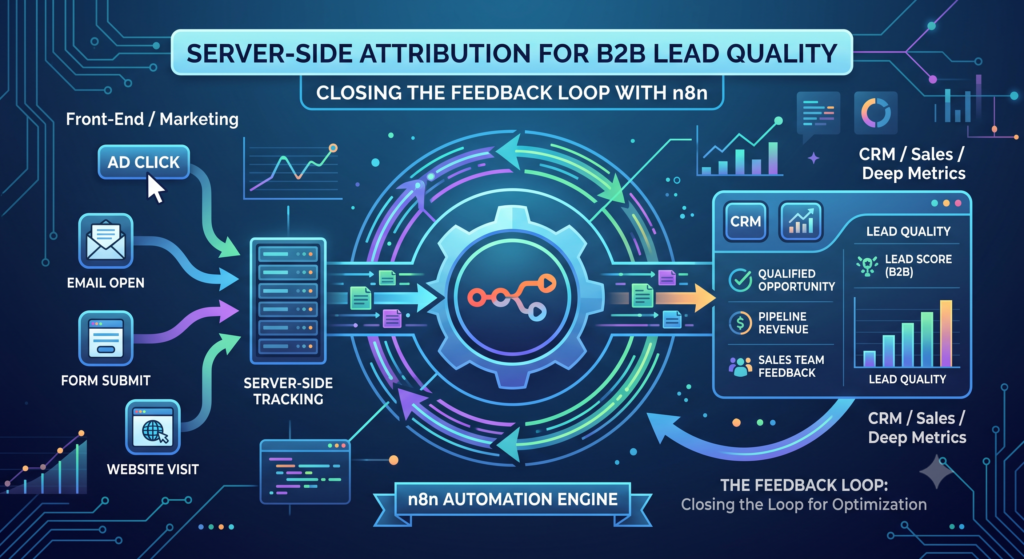
For years, B2B marketers have been trapped in a hall of mirrors. Your Google Ads dashboard shows a surge in conversions, your Meta Business Suite reports a record-low cost-per-lead, and yet, the sales team is complaining that the pipeline is bone-dry. The “leads” are coming in, but they are bot-filled forms, students looking for research, or low-intent researchers who have no intention of buying. This disconnect exists because most B2B tracking is still tethered to the browser—a fragile, fading ecosystem that is increasingly blind to what happens after a user clicks “submit.”
To fix this, high-growth revenue teams are moving away from client-side tracking and toward server-side attribution. By leveraging n8n as a workflow engine, you can build a robust feedback loop that pipes actual CRM outcome data—like Sales Qualified Lead (SQL) status or Opportunity creation—back to ad platforms. This ensures your budget isn’t just optimizing for high-volume, low-quality form fills, but for the actual revenue-generating milestones that move the needle.
The Death of Browser-Side Tracking in B2B
The traditional way of tracking B2B conversions is dying. For over a decade, we relied on “client-side” tracking, where a small piece of JavaScript (a pixel) fires in the user’s browser when they land on a thank-you page. However, several tectonic shifts in the privacy landscape have rendered this method unreliable. Apple’s Intelligent Tracking Prevention (ITP), the rise of ad blockers, and the gradual phasing out of third-party cookies mean that a significant portion of your conversion data is simply being dropped.
In a B2B context, the problem is even more acute. Unlike e-commerce, where the click and the purchase often happen in the same session, B2B sales cycles last months. A user might click an ad today, download a whitepaper next week, and only become a “Sales Qualified Lead” three weeks later after a discovery call. Browser cookies are rarely designed to survive that long or track that journey across different devices and sessions. When the browser loses the thread, the ad platform loses the ability to learn. If you can’t tell Google or Meta which of those 100 leads actually turned into a $50k deal, their algorithms will continue to find you more of the 99 leads that went nowhere.
Understanding Server-Side Attribution
Server-side attribution shifts the responsibility of tracking from the user’s browser to your own server (or a cloud-based intermediary). Instead of the browser sending a signal directly to Facebook or Google, your website captures a unique identifier—such as a Google Click ID (GCLID) or Facebook Click ID (FBCLID)—and stores it alongside the lead’s information in your CRM.
When that lead progresses through your sales funnel—for instance, moving from “New” to “SQL” in HubSpot or Salesforce—your server triggers a message to the ad platform’s Conversion API (CAPI). This message says: “Remember the person who clicked that ad ten days ago? They just became a qualified lead.”
This method offers vastly superior data fidelity. Because the data is sent directly from your server to the ad platform’s server, it cannot be blocked by browser-based privacy tools or ad blockers. More importantly, it allows for closed-loop measurement. You are no longer limited to tracking “clicks” or “form fills”; you are tracking business outcomes. This is the foundation of a modern MarTech orchestration strategy: ensuring that the data used for optimization is the same data used to measure success.
Why n8n is the Engine for Lead Quality Optimization
Implementing server-side attribution can be technically daunting. Many teams struggle to bridge the gap between their CRM (where the truth lives) and the Conversion APIs of ad platforms (where the optimization happens). This is where n8n workflow automation becomes an indispensable tool for Lead Ops and RevOps teams.
n8n acts as the “glue” in your MarTech stack. Unlike rigid, pre-built integrations that only allow for basic data syncing, n8n provides a low-code environment where you can build complex logic into your attribution loops. For example, you might not want to send every lead back to Google Ads. You might only want to fire a conversion event if the lead’s company size is over 500 employees or if they belong to a specific target industry.
Using n8n, you can create a workflow that listens for updates in your CRM via webhooks. When a lead’s status changes, n8n can instantly fetch the associated click IDs, verify the lead’s quality against your internal criteria, and then format and push that data to the Google Ads or Meta Conversion API. This level of control ensures that you are only feeding “high-signal” data back into the ad platform’s machine-learning models.
Building the Feedback Loop: From CRM to Ad Platform
To move toward a true closed-loop measurement system, you need a structured approach to data flow. The process begins at the point of capture. When a prospect fills out a form on your site, your backend must capture the hidden tracking parameters (like GCLID, WBID, or FBCLID) along with the form data. This data is then passed into your CRM as custom fields associated with the Lead or Contact record.
Once the data is in the CRM, the n8n orchestration begins. The workflow typically follows these steps:
1. **Trigger:** A lead is marked as “Qualified” or an “Opportunity” is created in the CRM.
2. **Filter:** n8n checks if the lead has an associated Click ID. If it does, the workflow continues.
3. **Enrichment:** (Optional) n8n pulls additional data from tools like Clearbit or 6sense to ensure the lead meets the ideal customer profile (ICP).
4. **Transformation:** The data is formatted into the specific JSON structure required by the Google Ads or Meta Conversion API.
5. **Execution:** n8n sends the POST request to the ad platform, signaling a successful conversion.
By automating this feedback loop, you are essentially training the ad platforms to find more people like your best customers. If the algorithm knows that “Lead A” from a “Cloud Security” campaign became a $100k opportunity, while “Lead B” from the same campaign was disqualified, it will automatically shift your budget toward the keywords and audiences that produced “Lead A.”
The Impact on B2B Growth and Budget Efficiency
The primary benefit of server-side attribution and n8n-driven feedback loops is lead quality optimization. Most B2B marketers are accidental victims of “algorithm gaming.” When you optimize for form fills, the ad platform’s AI finds the “cheapest” people to fill out that form. Often, these are people who have a habit of clicking ads but no budget to buy software.
When you switch to optimizing for SQLs or pipeline value via server-side attribution, your Cost Per Lead (CPL) might actually go up, but your Cost Per SQL will almost certainly go down. You stop wasting 40% of your budget on “trash” leads that frustrate your sales team. This creates a virtuous cycle: Marketing sends better leads, Sales closes more deals, and the data from those deals goes back into the marketing engine to find even better leads.
Furthermore, this setup provides a level of data fidelity that is future-proof. As privacy regulations like GDPR and CCPA evolve, and as browsers become more restrictive, having a first-party, server-to-server data pipeline ensures that your marketing remains measurable. You are no longer at the mercy of Chrome or Safari; you own your data flow.
Implementation Steps for Revenue Teams
Getting started with server-side attribution requires collaboration between Marketing, RevOps, and potentially a developer. Here is the high-level roadmap:
First, audit your data capture. Ensure your website forms are capable of capturing and storing URL parameters. You may need to use a script to grab the GCLID/FBCLID from the URL and drop it into a hidden field in your form.
Second, prepare your CRM. Create custom hidden fields for these tracking IDs so they stay attached to the lead throughout their entire lifecycle. This is crucial for long-cycle B2B attribution.
Third, set up your n8n instance. Create a workflow that triggers based on CRM stage changes. Use the “HTTP Request” node in n8n to connect to the Meta CAPI or the Google Ads API. You will need to generate access tokens and identify the “Event Names” (e.g., `Purchase`, `Lead`, or custom events like `SQL_Achieved`) that you want to track.
Finally, test and iterate. Start by sending data for just one platform, such as Meta CAPI. Compare the “Event Match Quality” in your dashboard to ensure the data is being mapped correctly. Once the connection is stable, you can scale the workflow to include other platforms and more granular conversion stages.
FAQ
**What is the main difference between a Pixel and a Conversion API?**
A pixel is client-side; it runs in the user’s browser and is subject to ad blockers and privacy settings. A Conversion API (CAPI) is server-side; it sends data directly from your server (or n8n) to the ad platform, making it more reliable and allowing you to send data about events that happen offline, like a sales meeting.
**Do I need a developer to set up n8n for server-side attribution?**
While n8n is low-code, you will likely need someone comfortable with APIs and JSON. You also need to be able to modify your website forms to capture tracking IDs. However, once the initial “plumbing” is in place, RevOps teams can usually manage and adjust the workflows without constant developer support.
**Can I use server-side attribution for platforms other than Google and Meta?**
Yes. Most major B2B advertising platforms, including LinkedIn and Bing, now offer some form of Conversion API or “Offline Conversion” upload capability. n8n can be configured to send data to any platform that provides an API endpoint.
**How does this affect my GDPR/CCPA compliance?**
Server-side attribution actually gives you more control over privacy. Because the data passes through your server (and n8n) before going to the ad platform, you can strip out PII (Personally Identifiable Information) or hash data (like email addresses) to ensure you are only sending what is necessary and compliant.
**Is n8n better than Zapier for this?**
For B2B attribution, yes. n8n offers much more granular control over data transformation and conditional logic. It also handles high volumes of data more cost-effectively and can be self-hosted, which is often a requirement for B2B companies with strict data security standards.
Conclusion
The shift toward server-side attribution is not just a technical upgrade; it is a strategic necessity for any B2B organization that wants to scale efficiently. By moving beyond the limitations of the browser and using n8n to bridge the gap between CRM outcomes and ad platforms, you can finally align your marketing spend with actual revenue. You stop being a “lead generator” and start being a “revenue generator.”
Ready to build a high-fidelity feedback loop that actually drives pipeline? At Octazing, we help B2B teams architect the MarTech stacks and n8n workflows needed to master server-side attribution. Stop guessing which ads are working and start optimizing for the deals that matter. Contact us today to see how we can help you close the loop.