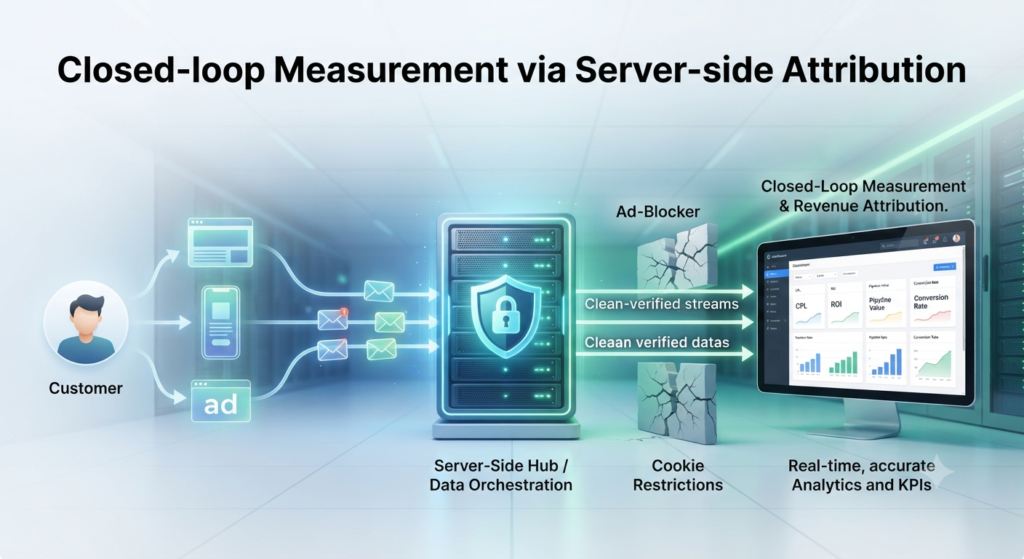
Mastering Closed-Loop Measurement: Why Server-Side Attribution is the Future of B2B Lead Gen
For years, B2B marketers have been trapped in a cycle of “vanity metric” optimization. We celebrate when the Cost Per Lead (CPL) drops, presenting spreadsheets filled with Marketing Qualified Leads (MQLs) to executive leadership, only to be met with the same old refrain from the sales team: “These leads are junk.” The friction between marketing and sales is often a direct result of how we train our advertising algorithms. If you tell Meta or Google to find you the cheapest leads possible, their AI will do exactly that—it will find people who are “click-happy” but have zero intent to buy.
To break this cycle, B2B organizations must move toward **server-side lead attribution** and **closed-loop measurement**. This isn’t just a technical upgrade; it’s a strategic shift. By using **n8n workflow automation** to connect your CRM directly to ad platform Conversion APIs (CAPI), you can stop optimizing for top-of-funnel noise and start training ad algorithms on actual “Sales-Qualified” data.
The Death of Client-Side Tracking and the Rise of Data Fidelity
The traditional way of tracking conversions—the client-side browser pixel—is dying. Between the rollout of Apple’s App Tracking Transparency (ATT), the rise of ad blockers, and the general trend toward privacy-focused browsing (like Intelligent Tracking Prevention in Safari), the data reaching your ad platforms is increasingly fragmented. When a pixel fails to fire or a cookie is blocked, the ad platform loses the “link” between the user who clicked the ad and the lead that eventually closed.
This loss of **data fidelity** is catastrophic for B2B marketers. In a B2B environment, the sales cycle is long, often spanning months. If your attribution window is limited by browser settings to seven days, and your lead doesn’t become a “SQL” for two weeks, the ad platform will never know that the specific ad it showed was successful. Consequently, the platform’s algorithm cannot learn. **Server-side lead attribution** solves this by moving the tracking logic away from the volatile environment of the user’s browser and into a controlled server environment.
What is Closed-Loop Measurement?
**Closed-loop measurement** is the process of “closing the loop” between marketing spend and bottom-line revenue. In a typical disconnected setup, marketing spends money to generate a lead, the lead is handed off to a CRM, and then the trail goes cold for the ad platform. The platform sees a “conversion” at the moment of the form fill, but it has no idea if that person was a CEO of a Fortune 500 company or a student researching a paper.
With a closed-loop system, you feed data back from your CRM (like HubSpot or Salesforce) into your ad platforms every time a lead moves down the funnel. When a lead changes status from “New” to “Sales Qualified Lead” (SQL), or from “Proposal Sent” to “Closed-Won,” that event is sent back to Google or Meta. This allows the ad platforms to understand the *value* of the traffic they are sending, not just the volume.
Moving Beyond “Cheap Leads” with Lead-to-Revenue Tracking
The most dangerous metric in B2B marketing is the “Cheap Lead.” When your primary KPI is lead volume at a low cost, you are essentially incentivizing your ad platforms to find users who are easy to convert but unlikely to buy. This fills your CRM with noise, wastes your Sales Development Representatives’ (SDR) time, and skews your ROI reporting.
By implementing **lead-to-revenue tracking**, you shift the focus from quantity to quality. Instead of telling Google Ads, “Find me more people who will fill out this PDF download form for $20,” you are telling it, “Find me more people who resemble the ones who actually reached the ‘Demo Completed’ stage.” This signals to the algorithm that it should ignore the “window shoppers” and focus its bidding power on high-intent professionals who match your Ideal Customer Profile (ICP). This shift is only possible through **server-side lead attribution**, which ensures that the conversion event is tied to a verified business outcome rather than a mere browser interaction.
The Role of n8n Workflow Automation in MarTech Orchestration
Building a bridge between a CRM and an advertising platform’s Conversion API is historically a heavy lift that requires custom coding and constant maintenance. This is where **n8n workflow automation** becomes a game-changer for Lead Ops and MarTech teams. n8n is an extendable workflow automation tool that allows you to build complex logic between different software systems.
In the context of **Conversion API optimization**, n8n acts as the “brain” or the orchestrator. It listens for changes in your CRM—for instance, a lead record updating its “Lifecycle Stage.” When that change occurs, n8n grabs the necessary identifiers (like email address, phone number, or Click ID), formats them according to the specific requirements of the Meta or Google Conversion API, and pushes the data securely.
Unlike simple “if-this-then-that” tools, n8n allows for the sophisticated data transformation and filtering required for B2B. You can set rules so that only leads from companies with more than 500 employees are pushed back as “high-value” signals, or you can delay the conversion signal to match your specific attribution windows. This level of **MarTech orchestration** ensures that you aren’t just sending data, but sending *intelligence*.
Technical Architecture: How Server-Side Attribution Works
To implement a robust **server-side lead attribution** system using n8n and CAPI, you need to follow a specific technical workflow. It begins at the point of the first interaction.
1. Capturing the “Click ID”
When a user clicks an ad on Google or Meta, they are directed to your landing page with a unique identifier attached to the URL (such as a `gclid` for Google or `fbclid` for Meta). Your website’s lead capture forms must be configured to capture these IDs as hidden fields.
2. Storing Data in the CRM
When the user submits the form, the lead’s contact information and the Click IDs are sent to your CRM. This creates a permanent record that links that specific CRM lead back to the specific ad click that generated it.
3. Monitoring for Status Changes
This is where the **n8n workflow automation** kicks in. You set up a “Webhook” or a “Poll” node in n8n that monitors your CRM. Every time a lead’s status is updated—perhaps to “Qualified” or “Opportunity”—the workflow is triggered.
4. Data Normalization and Hashing
Before sending data to an ad platform, it must be normalized (e.g., ensuring phone numbers are in E.164 format) and hashed using SHA-256 for privacy compliance. n8n handles this transformation seamlessly, ensuring that the **data fidelity** remains high while respecting user privacy.
5. Pushing to Conversion APIs
Finally, n8n sends a POST request to the Google Ads API or Meta CAPI. The ad platform receives this “offline conversion,” matches it with the original click using the Click ID or hashed email, and updates its internal model. The algorithm now knows that the ad it showed was not just a “click,” but a “success.”
Why Conversion API (CAPI) Optimization is the Gold Standard
Traditional pixels are “stateless” and fragile. If a user clears their cookies or switches from a mobile Facebook app to a desktop browser to finish a form, the pixel often loses the trail. **Conversion API optimization** is the gold standard because it is “stateful” and durable.
Because the data is coming directly from your server (via n8n) to the ad platform’s server, it bypasses browser limitations entirely. This leads to several critical benefits:
* **Increased Match Rates:** By sending multiple identifiers (email, phone, Click IDs), platforms have a much higher chance of matching the lead to a known user.
* **Full Funnel Visibility:** You can send signals for stages that happen entirely offline, such as a signed contract or a physical meeting.
* **Better Signal-to-Noise Ratio:** By only sending qualified leads back to the platforms, you prevent the algorithm from over-optimizing for low-quality traffic.
The Business Impact: Aligning Sales and Marketing
The ultimate goal of **closed-loop measurement** is to create a “virtuous cycle” of lead generation. When marketing optimizes for the same milestones that Sales uses to measure success, the tension between the departments evaporates.
Marketing can finally prove its impact on revenue, moving away from “cost per lead” and toward “cost per opportunity” or “return on ad spend” (ROAS). Sales receives a higher volume of leads that actually fit the business’s needs because the ad platforms have been “trained” to find them. This alignment is the hallmark of a high-growth B2B organization. By using **server-side lead attribution**, you aren’t just tracking data; you are building a competitive advantage that makes every dollar of your ad spend work harder.
FAQ
What is the difference between client-side and server-side attribution?
Client-side attribution relies on the user’s browser (pixels and cookies) to track actions. It is prone to data loss from ad blockers and privacy settings. Server-side attribution sends data directly from your server (or CRM) to the ad platform, ensuring higher data accuracy and bypassing browser-based restrictions.
Do I need a developer to set up n8n for server-side attribution?
While n8n is a “low-code” platform, setting up **server-side lead attribution** requires some technical knowledge of APIs, webhooks, and CRM data structures. However, it is significantly faster and more flexible than building a custom integration from scratch.
Which ad platforms support Conversion APIs?
Most major B2B ad platforms support server-side tracking, including Meta (Facebook/Instagram), Google Ads, LinkedIn (via Conversions API), and even TikTok. Each has slightly different requirements, which **n8n workflow automation** can help manage.
How does this improve my ROAS?
By sending “qualified” signals back to the ad platforms, the platform’s AI stops bidding on users who just click and start bidding on users who have the characteristics of your actual customers. This reduces wasted spend on junk leads and increases the efficiency of your budget.
Is server-side tracking compliant with GDPR and CCPA?
Yes, and in many ways, it is more secure. Server-side tracking allows you to control exactly what data is sent to third parties. By using hashing (SHA-256) and filtering data within your n8n workflows, you can ensure that you only share necessary information in a privacy-compliant manner.
Conclusion
The era of “set it and forget it” pixel tracking is over. For B2B companies looking to scale, the focus must shift from lead volume to lead quality. By implementing **server-side lead attribution** and **closed-loop measurement**, you gain the ability to train ad algorithms on the outcomes that actually move the needle for your business.
Using **n8n workflow automation** to bridge the gap between your CRM and **Conversion API optimization** is the most effective way to achieve this level of **MarTech orchestration**. It ensures high **data fidelity**, aligns your marketing and sales teams, and ultimately drives more revenue from your digital spend.
Stop optimizing for “cheap leads” and start building a data-driven growth engine. **Octazing helps B2B companies architect these advanced attribution systems to turn MarTech complexity into a competitive advantage. Ready to close the loop on your measurement? Let’s talk.**